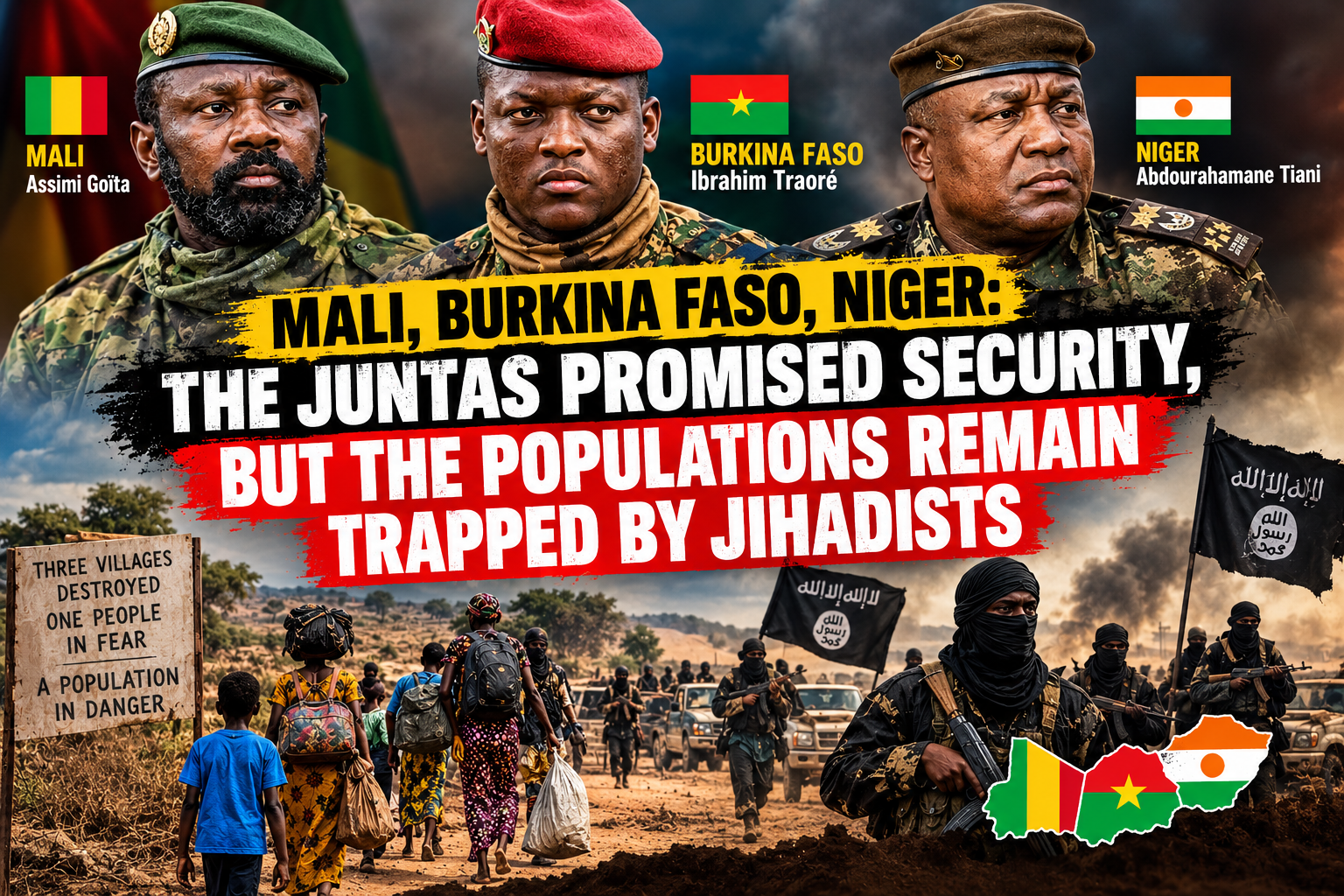

The unrelenting battleground where two jihadist groups wage war
In the vast and lawless Sahel, where the borders of Mali, Burkina Faso, and Niger converge, a brutal turf war between the Islamic State in the Greater Sahara (ISGS) and the Jama’at Nusrat al-Islam wal Muslimin (JNIM) affiliated with al-Qaeda has intensified over recent months. The clashes, now spreading across previously stable regions, have claimed hundreds of lives in a conflict that defies traditional military logic. Yet this is not merely a battle for dominance between extremist factions; it is a crisis that exposes the widening gap between the promises of military regimes and the harsh realities faced by civilians caught in the crossfire.
What the jihadist rivalry reveals about the limits of state power
The escalation between ISGS and JNIM is no isolated incident. These groups are no longer content with attacking state forces or symbols of authority; they are now aggressively competing for control over strategic territories, trade routes, and local populations. The result? Entire communities are paying the price not just with their lives, but with the collapse of daily life. Markets shut down, farmers abandon their fields, and families flee in search of safety, often into areas with little to no state presence. For those who remain, survival means enduring constant fear, restricted movement, and economic paralysis.
The dynamics of this conflict reveal a deeper issue: the inability of military-led governments to translate their anti-jihadist rhetoric into tangible security for civilians. In Mali, Burkina Faso, and Niger, juntas have staked their legitimacy on reclaiming sovereignty and restoring order. Yet in the three-border zone a region critical to regional stability the state’s authority remains fragile, if not entirely absent. Roads once patrolled by government forces are now contested by armed groups. Villages that once relied on basic services now lie abandoned or under the control of extremists.
The hollow promise of sovereignty: when security fails the people
For military rulers in Bamako, Ouagadougou, and Niamey, sovereignty is more than a political slogan it is a cornerstone of their leadership. They have severed old alliances, rebranded their military partnerships, and framed their policies as acts of defiance against foreign interference. But sovereignty, in its truest sense, is not measured by diplomatic defiance or military posturing. It is measured by the state’s ability to protect its citizens.
Consider the daily realities of those living in the conflict zones:
Mobility under threat: civilians risk kidnapping or death when traveling between towns, forcing many to abandon trade and agriculture.
Economic collapse: markets stall, crops rot in fields, and traders refuse to operate in high-risk areas, deepening poverty.
Education and healthcare at risk: schools close, medical clinics shut their doors, and families struggle to access even the most basic services.
Displacement as the norm: thousands have fled their homes, straining already overburdened host communities and creating humanitarian crises.
These are not abstract concerns they are the lived experiences of people who have seen their governments fail to deliver on the most fundamental duty: security.
Military operations vs. civilian protection: why the gap persists
The juntas argue that their hands are tied by operational constraints, limited resources, and the adaptive tactics of jihadist groups. They point to large-scale military campaigns, cross-border cooperation, and the creation of the Alliance of Sahel States as evidence of their commitment. And yet, the violence continues unabated in the three-border region. Why?
The answer lies in the nature of the threat. Jihadist groups do not operate like traditional armies. They thrive in ungoverned spaces, exploit local grievances, and adapt quickly to military pressure. Airstrikes may kill leaders, but they also fuel resentment. Ground operations may reclaim territory, but without a sustained administrative and security presence, control remains fleeting. The result is a cycle of temporary gains followed by resurgent violence, with civilians caught in the middle.
Moreover, the propaganda war complicates efforts to assess the true scale of the conflict. Both ISGS and JNIM manipulate casualty figures, presenting exaggerated victories while downplaying their own losses. Independent verification is nearly impossible in remote areas, leaving both the public and policymakers in the dark about the real toll of the fighting.
What success looks like in the three-border zone
If military strategies alone cannot end the violence, what can? The answer must go beyond battlefield victories. It must address the root causes of instability: the collapse of state authority in rural areas, the lack of economic opportunities, and the erosion of trust between communities and their governments.
For the Sahel’s military regimes, the challenge is clear: to move beyond rhetoric and demonstrate tangible results. This means:
Reinforcing civilian protection: ensuring safe passage for farmers, traders, and students; securing markets and health centers; and guaranteeing the freedom to move without fear.
Restoring state presence: not just through military patrols, but by rebuilding administrative structures, providing essential services, and reopening schools and clinics in conflict-affected areas.
Winning local trust: addressing grievances through dialogue, justice, and development not just force. Extremist groups often fill voids left by absent or corrupt institutions. Closing those gaps is essential.
Coordinating regionally: the threat is transnational, and so must be the response. Intelligence sharing, joint operations, and cross-border initiatives are critical to preventing jihadist groups from exploiting weak borders.
The unanswered question: can sovereignty deliver security?
Military juntas in the Sahel have made sovereignty a defining feature of their rule. They have rejected foreign intervention, forged new alliances, and embraced a narrative of self-determination. But sovereignty without security is meaningless. It cannot justify the displacement of communities, the closure of schools, or the fear that defines daily life for millions.
For the people of the three-border zone, the true measure of their governments’ legitimacy is not how loudly they denounce foreign powers or how fiercely they assert their independence. It is whether they can guarantee one simple, inalienable right: the right to live in peace.
Until that happens, the hollow echoes of sovereign declarations will continue to clash with the harsh realities on the ground where jihadist groups carve out their empires, and civilians bear the cost.
By Idriss MAMADOU — Journalist
