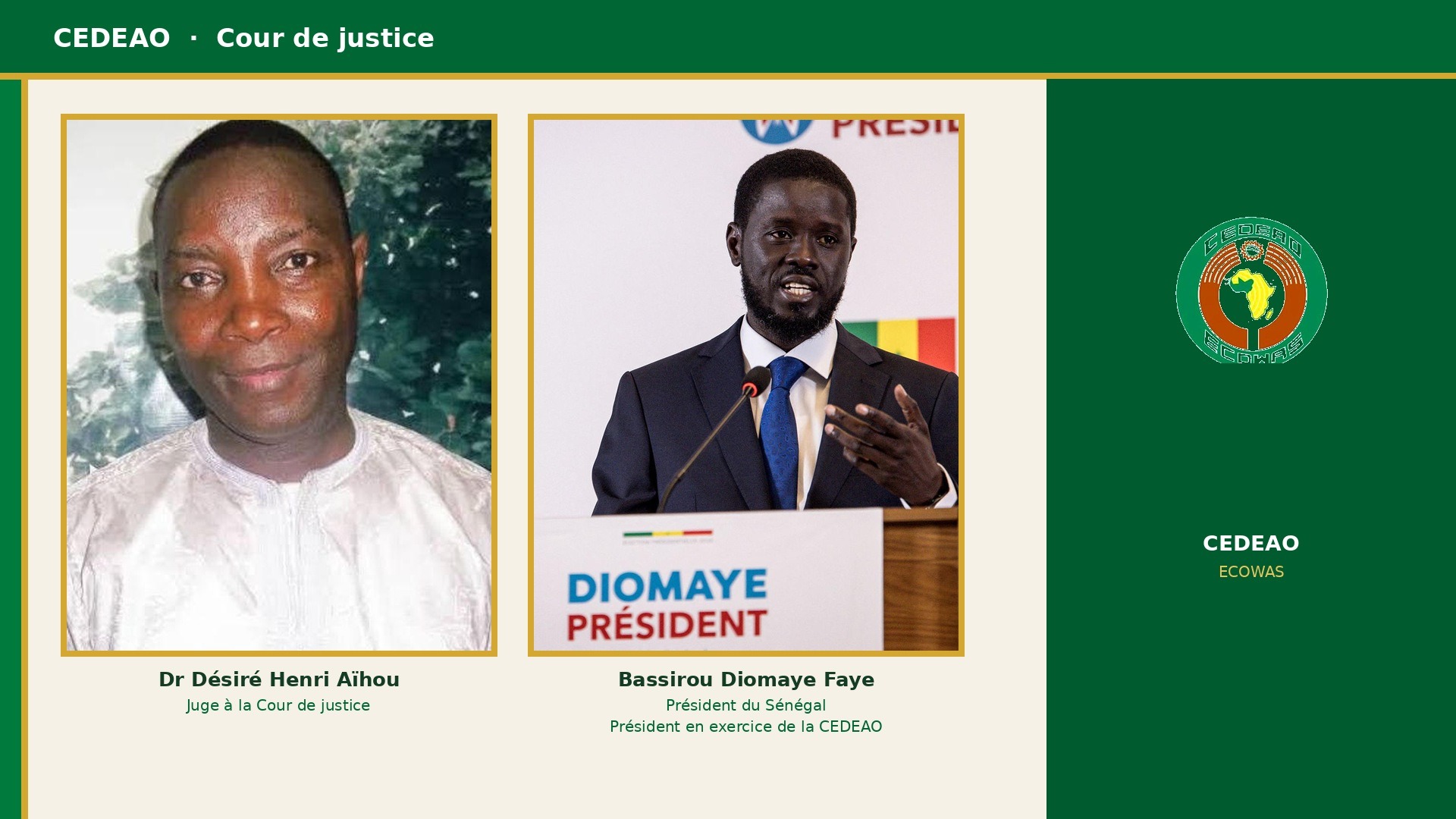

West Africa’s judicial leap: Benin’s new ECOWAS judge sworn in at pivotal moment
In a decisive step for regional justice, Benin has made its mark on the West African legal stage. On October 6, 2026, Dr. Désiré Henri Aihou was officially sworn in as the newest judge of the ECOWAS Community Court of Justice, commencing a non-renewable four-year term. This landmark appointment arrives at a critical juncture where the community court is under intense scrutiny to demonstrate its capacity to uphold the rule of law, protect fundamental rights, and restore public trust in regional institutions across West Africa.
The ceremony, held at the ECOWAS Commission headquarters in Abuja, was presided over by outgoing President Bassirou Diomaye Faye of Senegal in his capacity as chair of the regional organization’s Authority of Heads of State and Government. Five new judges took their oaths that day, including Awa Bah (Gambia), Charlyne M. Brumskine (Liberia), Henrietta Uzoamaka Didigu (Nigeria), Yaouza Ouro-Sama (Togo), and Désiré Henri Aihou (Benin). Their selection followed the 69th Ordinary Session of the Authority, convened on July 19, 2026, in Lungi, Sierra Leone, marking another milestone in the court’s evolving architecture.
The new bench—comprising five independent, highly qualified jurists—represents a renewed commitment to strengthening legal integrity within the ECOWAS framework.
How the ECOWAS Court is becoming a cornerstone of regional governance
The ECOWAS Community Court of Justice is far more than a symbolic body. Embedded in the revised ECOWAS Treaty, it serves as West Africa’s judicial guardian, ensuring that regional laws and principles of equity are interpreted and applied consistently across member states. Its mandate extends to resolving disputes between states and institutions, as well as adjudicating cases involving individuals and states—particularly in matters concerning human rights and constitutional governance.
This dual role—protecting both state interests and individual rights—has become increasingly vital in a region where democratic backsliding, unconstitutional changes in government, and persistent human rights violations threaten regional stability. The court’s ability to deliver binding rulings is now seen as essential to preventing legal loopholes and political declarations from undermining the integrity of ECOWAS commitments.
From Cotonou to Abuja: Benin’s democratic legacy gains new resonance
The appointment of Désiré Henri Aihou reflects more than just Benin’s growing influence within ECOWAS—it echoes a defining moment in the nation’s history. In February 1990, the National Conference of Living Forces in Cotonou marked the birth of modern democratic governance in Benin. For nine days, civil society leaders, political activists, and religious figures convened to dismantle decades of authoritarian rule and lay the foundation for a constitutional democracy.
The outcome was the 1990 Constitution, which enshrined the separation of powers, judicial independence, and the primacy of human rights. It also established the Constitutional Court in 1993—a move designed to anchor the rule of law at the heart of the political system. After years of centralized power, Benin chose transparency, accountability, and institutional checks and balances as the pillars of its new republic.
Today, that legacy reaches beyond national borders. The same principles that defined Benin’s post-1990 transition—legal accountability, judicial independence, and constitutional supremacy—are now being embedded in the regional legal order through the ECOWAS Court.
Breaking new ground: What Aihou’s appointment means for citizens and businesses
For West African citizens and enterprises, the reconstituted Court offers a new avenue for justice. Cases involving violations of human rights, unconstitutional actions by governments, or breaches of ECOWAS treaties can now be pursued directly before a regional judicial body. This is particularly significant in countries where domestic courts face political interference or limited capacity.
The Court’s expanded jurisdiction—now extending to disputes involving individuals against their own governments—represents a quantum leap in regional judicial empowerment. It signals that rights violations, once confined to national remedies, can now be challenged on a broader, collective legal platform.
From promise to practice: Building a justice system that delivers
Yet the real test lies ahead: execution. The ECOWAS Community Court has long faced challenges in ensuring that its rulings are implemented by member states. In 2024, the Community’s Judicial Council acknowledged this gap and initiated reforms aimed at strengthening enforcement mechanisms. Without effective compliance, even the most well-founded judgments risk becoming mere paper guarantees.
Judge Aihou’s role will be pivotal in this regard. His appointment comes at a time when the court is under pressure to prove its utility and authority. As one of the five new judges sworn into office, he joins a team tasked with restoring credibility to regional justice and ensuring that legal principles do not remain aspirational but become enforceable realities for millions of West Africans.
West Africa’s judicial future: Stability, justice, and regional cohesion
The swearing-in of Désiré Henri Aihou is not just a ceremonial event—it is a turning point. It underscores that regional integration is not merely economic or political, but fundamentally legal. A strong, independent judiciary is the bedrock upon which ECOWAS’s vision of peace, democracy, and human dignity is built.
For Benin, a nation synonymous with democratic renewal, this moment is especially poignant. It demonstrates that the commitment to constitutional order and justice, forged in Cotonou thirty-six years ago, is now being exported as a guiding principle for the entire West African region.
The challenge now is clear: to ensure that the ECOWAS Court transcends rhetoric and becomes a living institution—one that protects citizens, holds governments accountable, and secures the region’s democratic future.