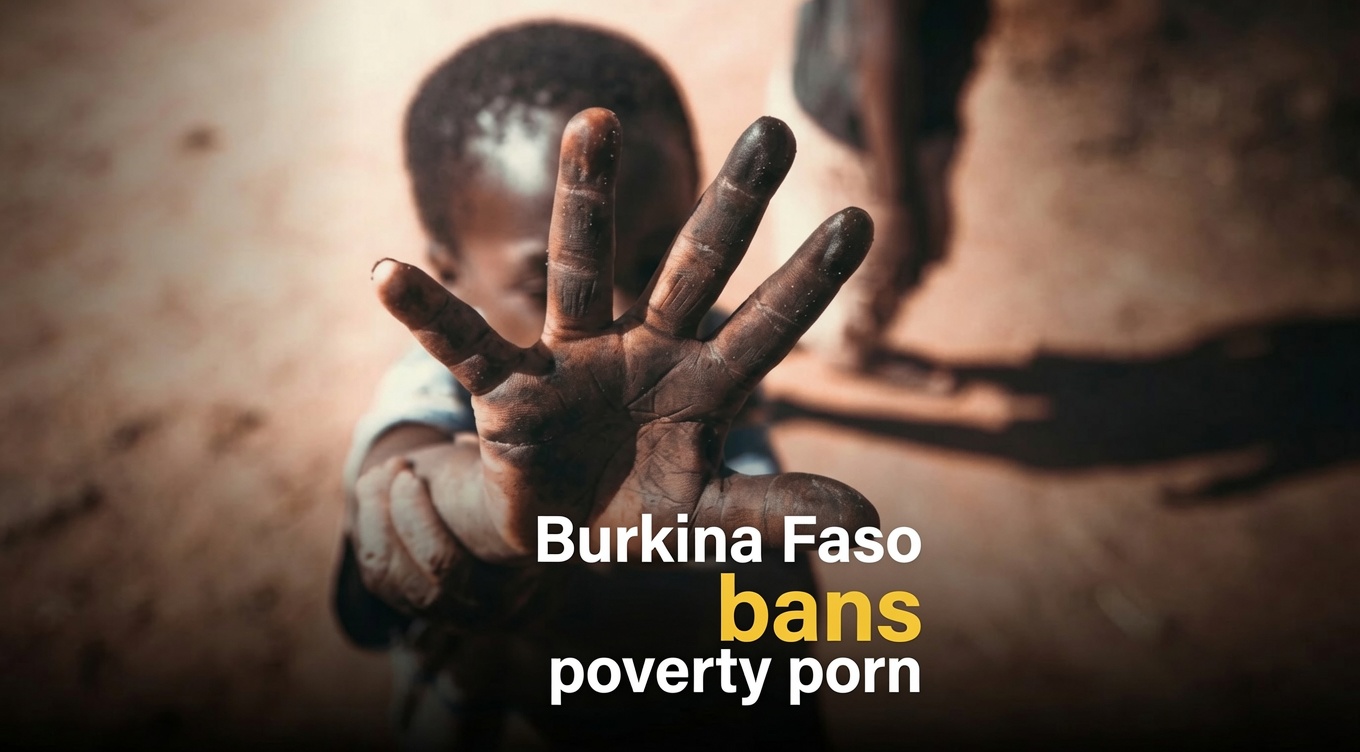

The Government of Burkina Faso has enacted stringent legislation prohibiting the practice known as poverty porn, a term coined by sociologists to describe the exploitation of human suffering for emotional manipulation or financial gain. This decisive move marks a turning point in the nation’s approach to crisis communication, prioritizing human dignity over sensationalism.
the ethical dilemma of exploiting human suffering
In an era dominated by digital platforms, the deliberate portrayal of distress—whether through close-ups of malnourished children, internally displaced families, or communities ravaged by conflict—has become a pervasive yet ethically fraught strategy. While the stated intention may be to mobilize support or raise awareness, the practice raises critical concerns about the commodification of suffering. By reducing individuals to passive objects of pity, such content strips away their agency and erodes their dignity, transforming tragedy into a spectacle for public consumption.
Burkina Faso’s authorities have declared this approach unacceptable, framing it as a violation of both human rights and national integrity. The ban reflects a broader commitment to ethical standards in media representation, ensuring that narratives of crisis are not reduced to exploitative imagery.
sovereignty and security concerns behind the ban
The prohibition of poverty porn is not merely an ethical stance but also a strategic decision aligned with the country’s political and security imperatives. Burkina Faso is navigating a complex crisis, and the widespread dissemination of images depicting its struggles in a one-dimensional, degrading light poses significant challenges to its global perception.
For the transitional government, the unrestricted circulation of such visuals fuels a damaging narrative that undermines national sovereignty. While the intention is not to obscure the severity of the crisis, authorities emphasize the need to reclaim control over Burkina Faso’s public image. The objective is to reject the reduction of the nation to a mere symbol of helplessness, advocating instead for a more nuanced and dignified portrayal.
criticism: censorship or protection?
Despite its stated goals, the ban has sparked intense debate. Civil society groups and critics argue that the measure may serve as a tool to stifle transparency rather than uphold ethical standards. They contend that by restricting the documentation of human suffering, the government could be concealing the true extent of the humanitarian catastrophe unfolding across the country.
The realities on the ground remain stark: millions displaced by insecurity, communities under blockade with limited access to essential supplies, and a population grappling with hunger and inadequate healthcare. For detractors, the legislation functions as a smokescreen, masking the failures of the transitional regime while suppressing the voices of those most affected by the crisis.
redefining humanitarian communication
This legislative shift compels humanitarian organizations and content creators to rethink their strategies. The challenge lies in communicating urgency and mobilizing support without resorting to exploitative imagery or violating the new legal framework. The solution, experts suggest, lies in adopting a more dignified and solution-oriented approach to storytelling.
By focusing on narratives of resilience, courage, and collective action, communicators can highlight the struggles of the Burkinabè people while preserving their dignity. This method not only upholds ethical standards but also reinforces the perception of Burkina Faso as a nation capable of overcoming adversity, rather than one defined solely by its suffering.



