Burkina Faso’s security approach under Ibrahim Traoré faces new challenge after JNIM attack in Ouahigouya
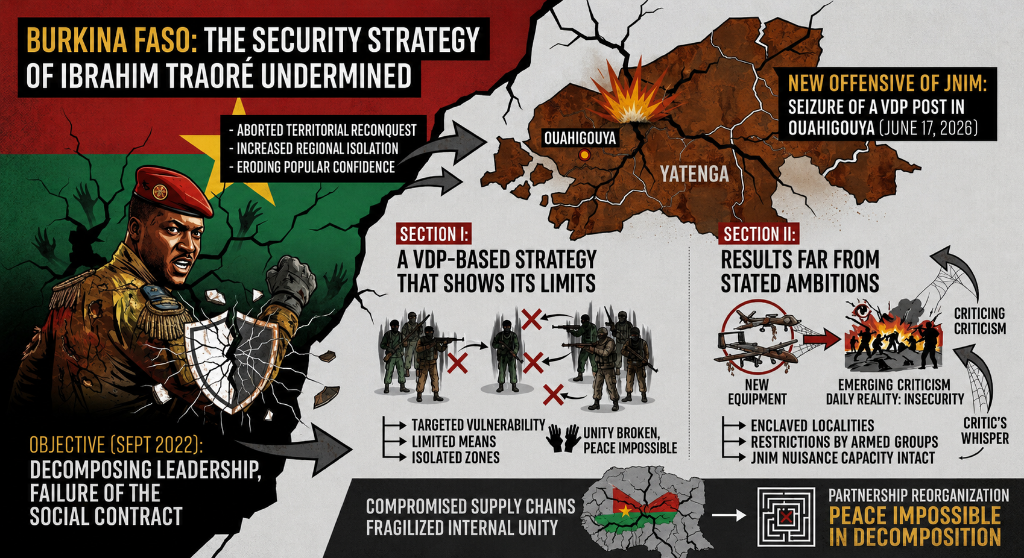
The security situation in Burkina Faso continues to deteriorate. The Group for the Support of Islam and Muslims (JNIM), an Al-Qaeda affiliate in the Sahel, claimed responsibility for overrunning a post of the Volunteers for the Defence of the Homeland (VDP) during an assault carried out on 17 June 2026 in the vicinity of Ouahigouya, the capital of Yatenga province in the northern part of the country.
This latest operation represents a fresh setback for the territorial reconquest strategy championed by the transitional authorities. Captain Ibrahim Traoré, who came to power in September 2022 with a pledge to restore the country’s territorial integrity, now faces growing questions about the effectiveness of his security approach.
A strategy built on the VDP that reveals its limits
To compensate for the regular army’s numerical shortcomings, the authorities have relied heavily on the Volunteers for the Defence of the Homeland. Yet these civilian units, often deployed in isolated areas with meagre resources, have become prime targets for armed groups.
The Ouahigouya attack adds to a string of reversals recorded in recent months. Despite military operations conducted in the field, several positions remain difficult to secure on a lasting basis. Numerous Sahel specialists believe that JNIM retains a substantial capacity to cause harm and enjoys considerable freedom of movement in the northern and eastern regions.
Results falling far short of stated ambitions
The transitional authorities regularly highlight progress made and the acquisition of new equipment, including surveillance and combat drones. Nevertheless, for a segment of the population, insecurity remains a daily reality. Several localities stay cut off, and certain areas continue to endure restrictions imposed by armed groups.
In this context, criticism is emerging over the effectiveness of the current security policy. The main justification for the overthrow of civilian rule in 2022—the failure to ensure the protection of the populace—is now resurfacing at the centre of public debate.
While Ouagadougou proceeds to reorganise its partnerships within the Sahel States Confederation (AES) and plans to intensify operations over the course of 2026, the Yatenga attack underscores the difficulty of overcoming an asymmetrical conflict through military means alone.