
Central African Republic: Wagner’s reign of terror
In the Central African Republic, citizens face summary executions and decapitations at the hands of Wagner Group elements. Opposition groups and civil society organizations are persistently, yet fruitlessly, demanding the withdrawal of these mercenaries, who operate with what appears to be a state-sanctioned license to kill. We bring you the latest dispatches from a capital grappling with Wagnerian terror.
- Politique

On July 8th, a horrifying spectacle once again gripped the Central African Republic, as disturbing videos circulated widely across social media. The graphic scenes unfolded in the country’s interior during the first week of July. Men, caught in an ambush by Wagner mercenaries, were systematically shot and then decapitated. Their severed heads were then meticulously arranged on a mat on the ground, creating a macabre display separate from their bodies. These Wagner operatives were reportedly assisted by African “auxiliaries” of various nationalities, pejoratively dubbed “Black Russians” by local Centrafricans. The perpetrators meticulously filmed the atrocity, adding their own loud commentary. In one video, a Wagner militia leader is clearly heard uttering chilling commands: “You don’t want peace? This is it now. Slit everyone’s throat!” This unbearable exhibition of brutality eerily echoes the worst acts of jihadist groups, whose notoriety in recent years was amplified by the theatrical display of cruelty inflicted upon their captives.
The normalization of extreme violence
The victims of this grim ritual were men belonging to one of the numerous armed groups operating within the territory. These illegal combatants had arrived at the location to participate in what was presented as an official disarmament operation, preempted by the Wagner Group. Instead, the mercenaries transformed the reception of these disarmament volunteers into a beheading session, a defiant act against reason. Among the other casualties of this fatal trap were several civilians, including a village chief, who had come to witness what they believed was the implementation of a disarmament program. While these images have undoubtedly instilled widespread fear, the Central African Republic has become accustomed to countless abuses committed by Wagner operatives across the nation, who wield a perceived license to kill, sanctioned by the Centrafrican authorities.
Since the 1990s, the Central African Republic has often been labeled a non-state, a failed state, or even “a country that didn’t exist.” Following episodes of political instability, failed or successful mutinies, and coups d’état, the nation has evolved into a vast grey zone. It is tenuously co-managed by a central government largely confined to the capital’s perimeter and a multitude of armed groups whose influence has never been curbed by the national army or external partners. In this context, MINUSCA (United Nations Multidimensional Integrated Stabilization Mission in the Central African Republic) has, over the years, become an increasingly anachronistic presence, struggling in vain to make sense of the relentless normalization of extreme brutality in the daily lives of its inhabitants. The presence of Wagner Group agents, under the guise of bilateral cooperation with Moscow, has paradoxically acted as an insane amplifying factor for the country’s endemic violence. The regional and international community appears to be passively accepting this reality, seemingly unconcerned about a nation that has progressively drifted away from the concert of nations, where the spectacle of the worst has become commonplace for its people.
An unprecedented form of colonial order
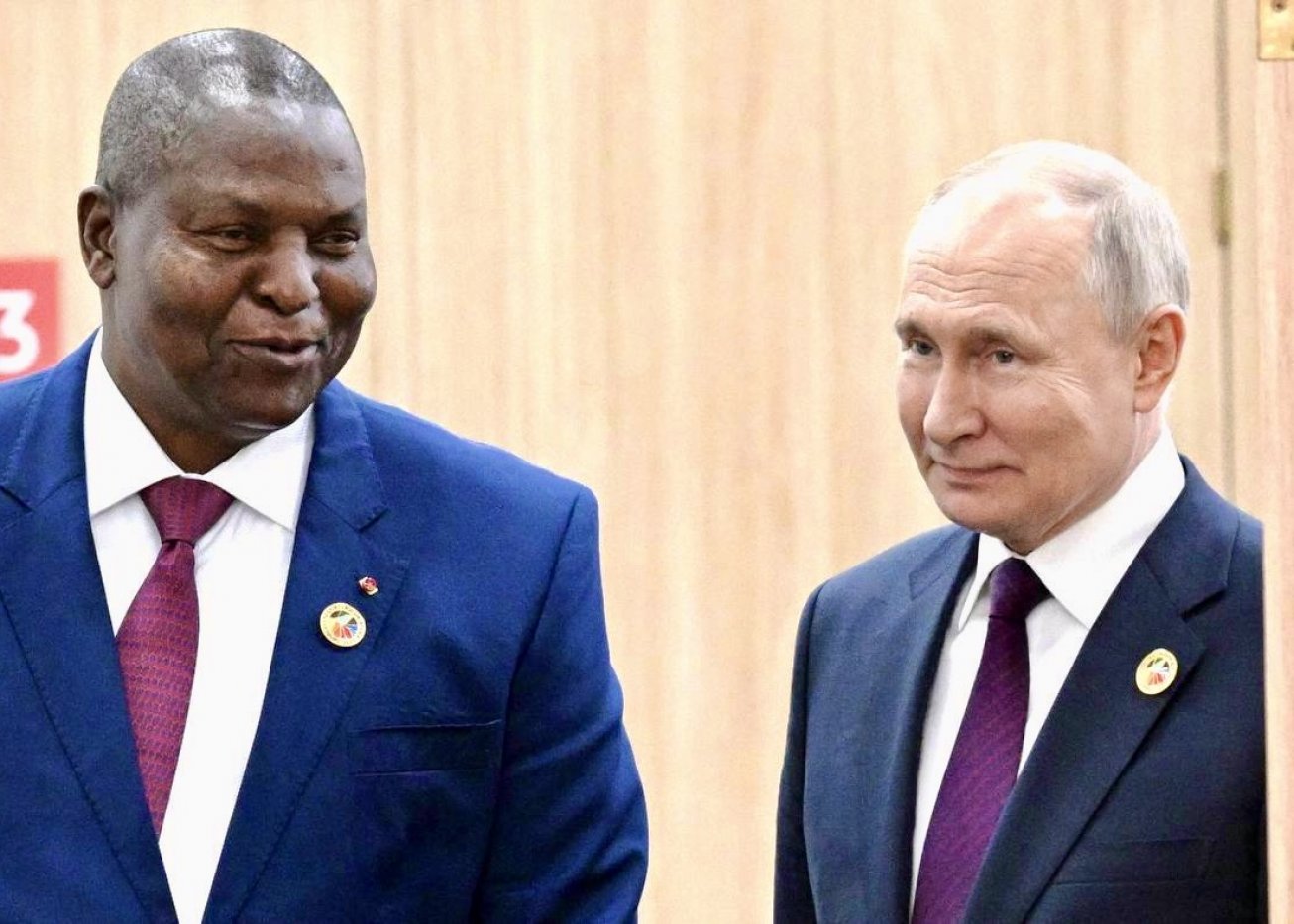
Wagner mercenaries have established a lasting presence in the Central African Republic, making it their home and freely unleashing their excesses upon the population. Simultaneously, they enjoy the privilege of exploiting the country’s rich and varied mineral resources. While human rights organizations alert international opinion to the crimes committed by these mercenaries, the operatives are confident in the pact forged between them and the Centrafrican government, under the aegis of President Faustin-Archange Touadéra. Operating as a parallel governmental structure, the Wagner team, permanently based in the Central African Republic, exerts control over the army, police, judicial system, intelligence services, and even passenger flows at Bangui airport. Their deep intrusion into all sectors of national life has been linked to numerous suspicious disappearances, acts of torture, harassment, and crimes committed without perpetrators being identified or brought to justice. It is often remarked that in this territory, Wagner’s powers eclipse those of government members.
Here in the Central African Republic, Wagner has not been rebranded “Africa Corps,” its “nationalized” version since the death of its founder, Evgeny Viktorovich Prigozhin, in August 2023. Here, the Russian mercenaries insist on retaining the original brand, a symbol of loyalty to their fallen leader. In this country, where their prerogatives appear as enigmatic as they are deadly, a statue has been erected in Prigozhin’s honor, and his birthday is celebrated annually by Centrafrican soldiers alongside their Wagnerian “partners.” Here, with visible shock, we witness the emergence of an unprecedented form of colonial order.
Following the horrifying discovery of the videos on July 8th, political opposition and civil society once again demanded the departure of the Wagner contingent and an end to impunity. However, the authorities have met these pleas from Centrafricans, paralyzed by the horrors of this cooperation with Russia, with their customary silence. This paramilitary entity has transformed terror into a mode of cohabitation with the inhabitants.
Four years ago, during a meeting between President Faustin-Archange Touadéra and several ministers, one participant expressed concern about the potentially devastating effects of Wagner’s behavior on public opinion. The Centrafrican leader, who was then preparing to amend the Constitution to fraudulently seek a third term, reportedly replied: “We need the Russians. It is thanks to them that we remain in power.” To hold onto power at any cost, even if it means transforming the Central African Republic into a capital of extreme terror and a drifting territory, caught between nowhere and farewell.