
DRC takes Rwanda to international court over armed group support
The Democratic Republic of the Congo has formally brought a case before the International Court of Justice against Rwanda, accusing Kigali of providing direct support to armed groups operating in eastern Congo, including the M23 rebel faction.
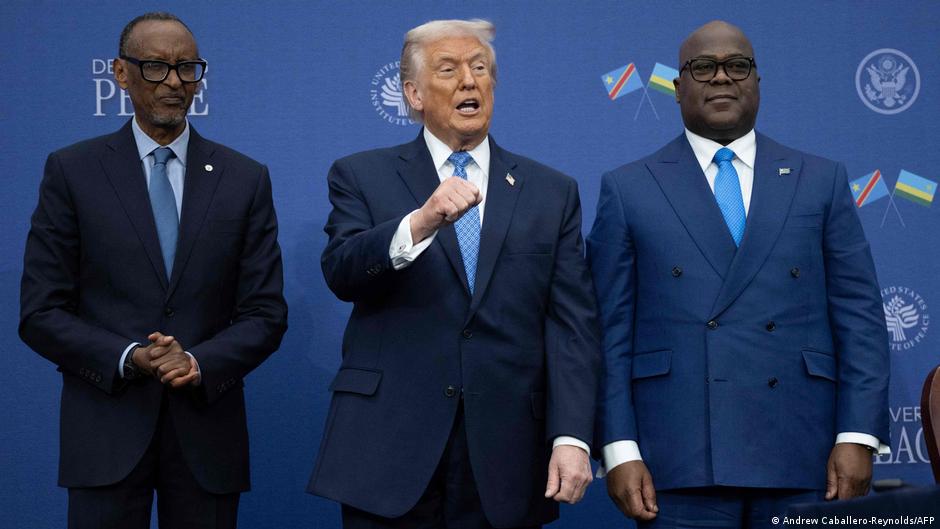
This legal action coincides with the first anniversary of the Washington peace agreement signed between the two nations on June 27, 2025. Despite the accord, clashes between Congolese forces and the M23 rebels—allegedly backed by Rwanda—have intensified in the mineral-rich eastern provinces of North Kivu and South Kivu.
The United States has taken separate action by imposing sanctions on Rwandan officials and entities linked to the illegal mineral trade originating from rebel-controlled zones in eastern Congo, which Washington says funds M23 operations.
Peace pledged on paper, absent in reality
Under the Washington agreement, both Kinshasa and Kigali committed to collaborative efforts to restore stability in eastern Congo, where M23 rebels have occupied vast territories for over a year. Yet, on the ground, tangible progress remains elusive.
« We expected that after signing this agreement, life would improve—banks and airports would reopen. Instead, we’re still trapped in the same suffering », laments a resident of Bukavu, the capital of South Kivu province.
Another Bukavu resident questions the effectiveness of international mediation: « Does the influence the United States once wielded still hold today? Why can’t policies applied in Washington be enforced against our neighbors attacking us here in the DRC? » A third resident adds, « Nothing has changed. They talk peace when they meet, but on the ground, the war continues. »
Rwanda faces sanctions and international legal scrutiny
The DRC’s case at the International Court of Justice centers on Rwanda’s alleged three-decade-long backing of armed groups responsible for severe human rights abuses in eastern Congo. Kinshasa is seeking reparations for victims and formal recognition of Rwanda’s responsibility.
In parallel, Washington has sanctioned Rwanda’s Gasabo Gold refinery, its leadership, and several mining companies accused of trafficking minerals from rebel-held territories in eastern Congo—funds it believes fuel M23’s operations. However, some analysts argue these measures fall short of altering the strategic calculations of involved parties.
« The prevailing view is that sanctions alone are unlikely to shift the strategic calculus of key players. As long as the costs of confrontation remain lower than the costs of concessions, actors will maintain the status quo, which continues to benefit them », notes Yvon Muya, a conflict studies expert at Saint Paul University in Ottawa, Canada.
Military escalation looms
With daily skirmishes persisting in conflict zones, the prospect of peace appears increasingly distant. Professor Bob Kabamba of the University of Liège in Belgium warns that both sides are likely preparing for a decisive confrontation.
« During this lull, both parties are reorganizing, rearming, and bracing for what could be the final battle to determine whether the government can reclaim rebel-held territories or if the rebels will advance toward Katanga, further challenging the Kinshasa regime » Kabamba explains.
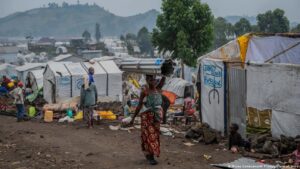
For over a year, M23 rebels have controlled Goma, Bukavu, and multiple towns in North and South Kivu. The ongoing violence has exacerbated the humanitarian crisis, displacing thousands of civilians across the region.