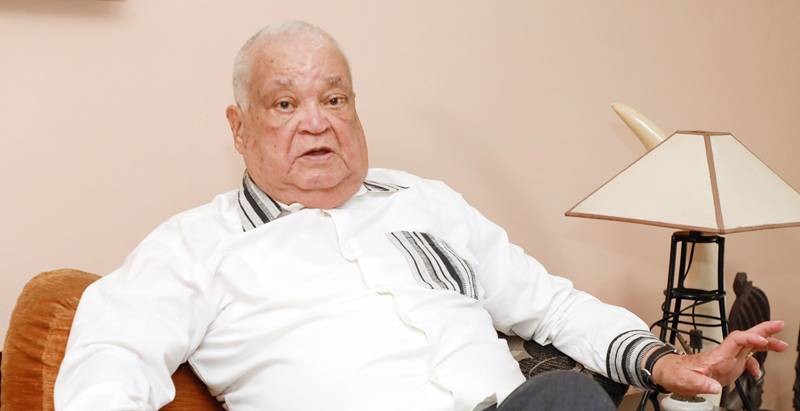

Former Ivorian minister Auguste Miremont: “President Ouattara learned the most from President Houphouët-Boigny”
At 85, Auguste Miremont is a living archive of Côte d’Ivoire’s political history. As the nation’s first Minister of Communication (then called Information) from 1989 to 1993, former director-general of Fraternité Matin, and longtime political figure, he has witnessed decades of national transformation. His insights, shaped by decades of service, are now captured in a new book: “Auguste Miremont: From Houphouët to Ouattara, with Unfiltered Honesty.”
A personal journey through Ivorian history
Miremont recently opened up about his life and times in a series of in-depth interviews that form the backbone of this long-awaited biography. The project, though initially resisted by the former minister, became a labor of love led by author Michel Koffi, who spent 18 months and over 30 hours in conversation with Miremont to capture the essence of a life dedicated to public service.
“I’ve always preferred quiet reflection over public exposure,” Miremont shared. “But over time, I realized that my decades in politics—from the editorial rooms of Fraternité Matin to the cabinet table—had given me a unique perspective. The people asked me to share it, and so I did—not for glory, but for future generations.”
The book traces not just his personal story, but the broader arc of modern Côte d’Ivoire: from the stability under President Houphouët-Boigny to the turbulent transitions between leaders, and the nation’s enduring challenges.
Leadership lessons: Houphouët, Bédié, Ouattara
Asked to compare Côte d’Ivoire’s post-independence presidents, Miremont is clear: President Alassane Ouattara is the one who most absorbed the wisdom of the nation’s founding father, President Houphouët-Boigny.
“President Ouattara learned the art of patience, listening, and timing from Houphouët-Boigny,” Miremont explained. “He has that same ability to navigate crises with calm and resolve. Where he differs is in his approach to governance—less rigid than when he was Prime Minister, more open to dialogue and compromise.”
He recalled Ouattara’s early days as Prime Minister in the late 1990s, when he was known for his uncompromising standards. “He didn’t tolerate mistakes. One misstep, and a minister was gone the next day. That discipline helped lay the foundation for economic recovery. Today, he’s more measured—but that’s the mark of experience.”
Moments that shaped a nation
Miremont spoke candidly about the darkest chapter in recent Ivorian history: the 1999 coup d’état against President Henri Konan Bédié, and the tragic violence that followed. As president of the PDCI parliamentary group at the time, he was at the heart of the crisis.
“Seeing the country we built under Houphouët-Boigny collapse into chaos was heartbreaking,” he said. “We were a beacon in West Africa—stable, respected, a safe haven. And suddenly, we became a source of concern, even mockery in the international press. For someone who grew up during the nation’s construction, it was unbearable.”
He recalled the personal loss of close allies like Emile Boga Doudou, killed during the 2000 post-election violence, and the emotional toll of exile. “I was in France when I heard the news. I wept at the airport. The image of Côte d’Ivoire as a model of stability, a country that helped others in need, was shattered.”
Legacy and the road ahead
Despite the turbulence, Miremont remains optimistic about Côte d’Ivoire’s future under Ouattara. “He’s not slowing down. He’s just begun a new term. And his vision is clear: a united, prosperous, and respected Côte d’Ivoire.”
He praised recent infrastructure projects—new highways, hospitals, and universities—spread across the country. “From Daloa’s grand boulevard to the roads connecting Bin-Houyé and Toulépleu, these are signs of real progress.”
Yet, he acknowledges the challenges: rising living costs, persistent poverty, and social inequality. “The government knows this. That’s why programs like the social safety nets, vocational training, and youth employment initiatives exist. They’re working to balance growth with inclusion.”
Miremont’s final message is one of hope and responsibility: “We must continue building—not just economically, but as a society. Côte d’Ivoire has a bright future, but it depends on all of us.”
Key takeaways from Auguste Miremont’s reflections:
- Leadership continuity: President Ouattara embodies the strategic patience and crisis management of Houphouët-Boigny, though with a more collaborative style.
- National resilience: Despite political fractures and social tensions, the foundations of Ivorian progress remain strong.
- Future focus: Investments in infrastructure and social programs are paving the way for sustainable development.



