
Mali’s 20 million euro Russian drone purchase: a strategic misstep in asymmetric warfare
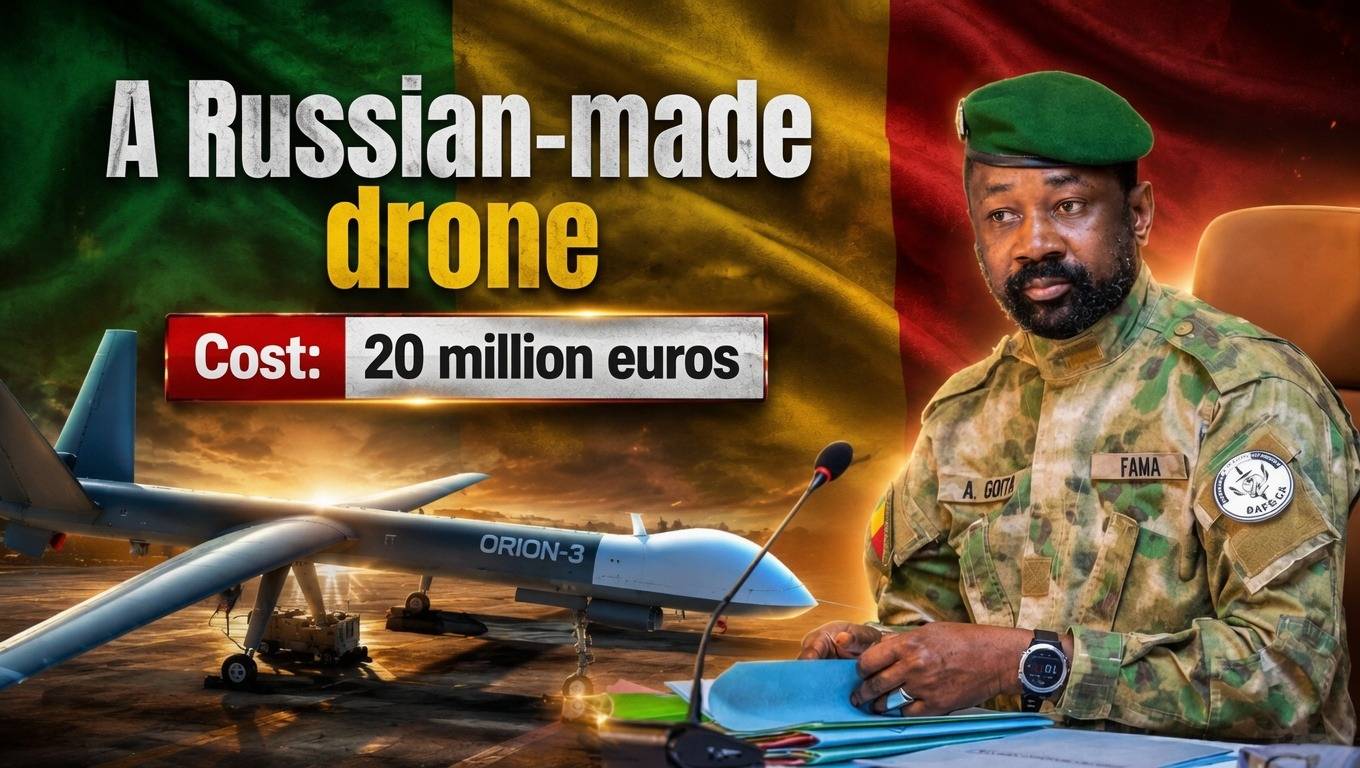
Mali has recently taken delivery of a cutting-edge Russian-made Orion drone, a reconnaissance and attack aircraft hailed by officials as a game-changer in the country’s territorial recovery efforts. Yet, while Bamako celebrates this new addition to its air capabilities, military experts are questioning its practical value. At nearly €20 million, this single acquisition raises serious concerns about financial responsibility, technical suitability, and long-term viability in the face of Mali’s ongoing asymmetric conflict.
From Moscow to Bamako: a high-stakes military partnership
The Orion drone, a Medium Altitude Long Endurance (MALE) system, joins Mali’s air fleet as part of a growing defense cooperation with Russia. Designed for extended surveillance and precision strikes, this advanced aircraft is now the most sophisticated aerial asset in the Malian armed forces. Proponents argue that its arrival marks a turning point in the country’s military modernization, reducing reliance on former Western partners and expanding operational reach across vast, sparsely monitored landscapes.
The sound of failure: why noise is the Orion’s biggest weakness
Mali’s security challenges are defined by asymmetric warfare—fluid, decentralized insurgencies that exploit terrain, speed, and concealment. Yet the Orion drone, though technologically advanced, carries a critical flaw: its acoustic signature. The aircraft’s loud engine alerts enemy combatants long before it reaches its target, giving militants ample time to disperse or take cover in the rugged Sahel terrain. For forces accustomed to evading detection, this vulnerability makes the drone predictable—and therefore, ineffective.
Worse still, the Orion is not invulnerable to ground fire. Militant groups in northern and central Mali have demonstrated growing proficiency in downing aircraft using man-portable air defense systems (MANPADS) and concentrated small-arms fire. A single, slow-moving drone becomes an easy target when its presence is announced by engine noise.
€20 million for one drone: is this the best use of Mali’s military budget?
The financial implications of this purchase have sparked intense debate. At over €20 million—equivalent to more than 13 billion West African CFA francs—the Orion represents a substantial drain on Mali’s constrained defense budget. Critics argue that such an expenditure on a single aircraft is not only imprudent but potentially wasteful, especially in a nation where social services and urgent humanitarian needs compete for limited resources.
For the same cost, Mali could have acquired a fleet of smaller, quieter, and more deployable tactical drones. Instead of prioritizing a high-profile but impractical asset, defense analysts suggest that Bamako would have been better served by investing in scalable, sustainable solutions capable of adapting to the realities of asymmetric warfare.
A single drone, a vast and vulnerable country
Mali’s security landscape is vast and fragmented, with insurgent activity spanning regions from Taoudénit to Kayes. Yet the Orion, despite its endurance, cannot be everywhere at once. A single aircraft cannot provide continuous aerial coverage across multiple hotspots simultaneously. Once it lands for refueling or maintenance, entire swathes of territory fall back into the shadows—leaving gaps that militants exploit with ease. Without a rotation system or additional units, Mali’s skies remain vulnerable to infiltration and attacks.
The hidden costs of operating a high-tech drone
The price tag of €20 million is only the beginning. Sustaining the Orion’s operations requires a complex and costly infrastructure: climate-controlled ground control stations, specialized landing strips, and an uninterrupted supply of imported fuel, spare parts, and precision-guided munitions. All critical components, from electronics to ammunition, must be sourced from Russia, adding logistical and financial strain.
Training Malian personnel to maintain and operate the system further inflates the long-term cost. Without a steady flow of funding and technical expertise, the drone risks becoming a stranded asset—expensive, underutilized, and ultimately obsolete.
Conclusion: prestige over pragmatism
The arrival of the Orion drone underscores Mali’s push for military self-sufficiency, but it also highlights the pitfalls of an acquisition strategy focused on high-visibility hardware rather than operational effectiveness. In a war defined by mobility, unpredictability, and resource constraints, a single, costly, and noisy aircraft offers little more than symbolic value. For Mali to secure its future, its armed forces need agility, discretion, and fiscal responsibility—not monuments of technology that falter under the weight of reality.