
From Kidal to Bamako: The unraveling of a flawed military alliance
The Mali junta’s gamble on Russian-backed security has collapsed under the weight of its own miscalculations. Military setbacks in the north, where rebel factions and jihadist groups have gained ground, exposed the fragility of a strategy built on foreign paramilitary support. By outsourcing national defense to Africa Corps (formerly Wagner), Bamako accelerated its own downfall, trading sovereignty for temporary protection that never materialized.
Kidal: A negotiated surrender, not a military victory
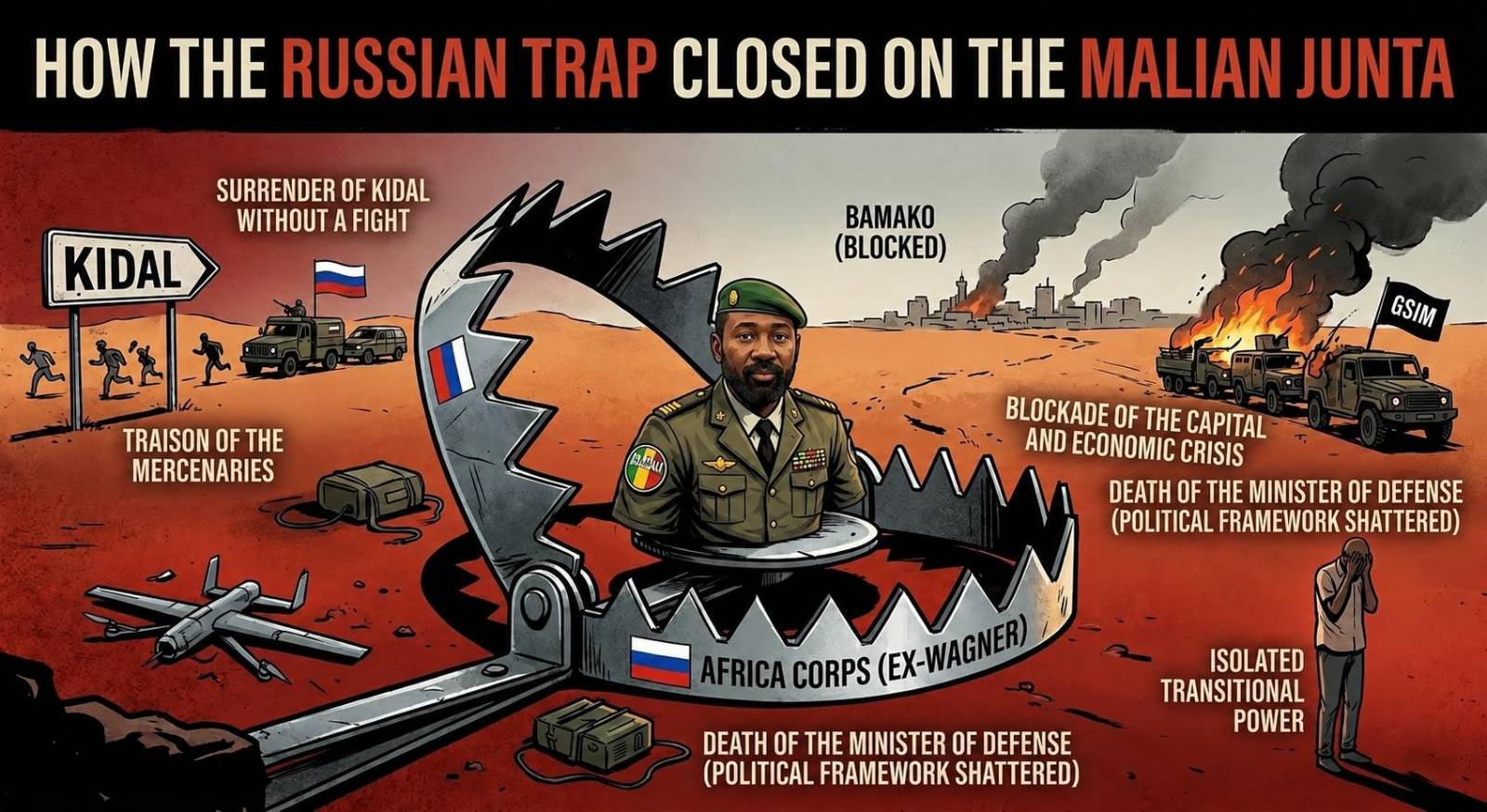
April 2026 marked a decisive turning point in the Sahel conflict. Kidal, a strategic city in northern Mali, fell not through heroic resistance but via a negotiated withdrawal by Russian mercenaries. The Africa Corps troops, who had reclaimed the city in 2023 with fanfare, abandoned their positions without a fight, leaving behind heavy weaponry to secure safe passage. The move exposed a harsh truth: mercenary forces serve only their own interests, not the territorial integrity of Mali.
A Malian official, speaking on condition of anonymity, summed up the sentiment in Bamako: « The Russians betrayed us in Kidal. » The abandonment of Kidal shattered the junta’s credibility and accelerated its isolation in both domestic and regional circles.
Bamako under siege: The collapse of a fragile regime
The fallout from the northern defeats has now reached the capital. In April, rebel offensives targeted Kati and Bamako, culminating in the death of General Sadio Camara, Mali’s Defense Minister and the architect of the junta’s alliance with Moscow. The loss of Camara—a key figure in the Kremlin-Bamako partnership—left the regime decapitated at a time when economic and humanitarian crises were already spiraling out of control.
The Group for the Support of Islam and Muslims (GSIM) has tightened its blockade on fuel, food, and goods entering Bamako, pushing the economy to the brink. Schools have closed, power shortages are rampant, and the junta’s promise of a « surge » in military capacity—bolstered by Russian drones—has failed to stabilize the situation. Instead, these strikes have fueled civilian casualties and deepened local resentment.
The false promise of Russian-backed security
The junta’s reliance on Moscow’s drones and paramilitary support was meant to compensate for the withdrawal of international forces like MINUSMA and Barkhane. Yet the technology has done little to restore security. Analysts now believe Africa Corps is shifting its remaining resources to protect the regime in Bamako, abandoning any pretense of reclaiming or stabilizing the rest of the country.
Meanwhile, Russian narratives of « foiled coup attempts » ring hollow against the backdrop of a junta struggling to hold onto power. Moscow’s priority appears to be securing an honorable exit rather than sustaining a failing ally.
A regime in its death throes
The Alliance of Sahel States (AES), once touted as a regional bulwark, has proven powerless to address Mali’s crisis. Abandoned by its Russian backers, ostracized by regional blocs like ECOWAS, and rejected by a population suffocating under blockades, the junta’s days are numbered. The military leadership’s decision to bet everything on a foreign security contract has backfired spectacularly, leaving Mali in a self-inflicted spiral of instability.
The question in Bamako is no longer whether the regime will fall, but how long it can cling to power before the security vacuum it created swallows it whole.



