
In the remote town of Obo, located in the Haut-Mbomou region of the Central African Republic, a missile launch by Russian mercenaries has raised serious concerns about the security of neighboring Democratic Republic of the Congo.
The incident occurred last week when fighters from the Russian Wagner Group fired a surface-to-surface projectile from the outskirts of Obo, a town already on edge due to its proximity to the Congolese border. The launch, witnessed by local residents, sent shockwaves through the area, with the missile crossing into DRC territory before landing near the village of Zapay.
An abandoned US military legacy
The Wagner Group’s use of heavy weaponry in Obo traces back to a chapter of the town’s history when US special forces operated in the region. Between 2011 and 2017, American troops, part of Operation Observant Compass, were stationed in Obo and nearby Djema as part of a mission to dismantle the Lord’s Resistance Army (LRA) and capture its fugitive leader, Joseph Kony.
The operation involved elite soldiers, including Green Berets, who established fortified bases equipped with surveillance technology and weaponry. When the mission concluded in 2017, US forces withdrew, leaving behind military equipment, including, according to local accounts, containers of weapons and at least one surface-to-surface missile stored in the abandoned base.
Wagner Group seizes control
After the US departure, the Central African Republic’s armed forces, the FACA, took over the base. However, their presence was short-lived. Russian mercenaries from the Wagner Group, deployed at the request of local authorities, arrived in Obo and forcibly expelled the FACA troops. Once inside the facility, they began sifting through the remaining equipment, salvaging usable items and discarding defective ones.
Local reports indicate that regional officials had publicly announced plans for Wagner Group to conduct test firings of the recovered weapons. The evening of the launch, the mercenaries transported a heavy-caliber weapon to Obo’s football field—a highly visible location—and fired the projectile into the night sky. The missile soared over towns like Mboki and Zemio before crossing into Congolese territory.
The impact occurred five kilometers from Zapay, with no immediate reports of casualties. The choice of trajectory avoided densely populated areas in the Central African Republic, such as Bambouti, directing the missile toward the remote Congolese forest instead.
Fear and uncertainty in Congo
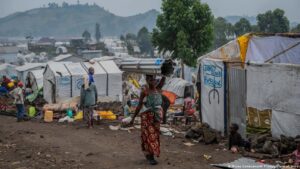
The residents of Zapay are now gripped by fear, particularly the Congolese families and Central African refugees who have fled violence linked to Wagner Group’s operations in the region. Many question whether the missile launch was a deliberate message, demonstrating the group’s reach beyond national borders.
Locals in Obo confirmed seeing Wagner fighters maneuver the weapon and execute the firing, leaving little doubt about their responsibility. In Zapay, families spent the night scanning the skies, unsure if another projectile would follow.
The incident underscores the volatile security situation in the Haut-Mbomou region, where foreign armed groups continue to operate with little accountability. The use of abandoned US military equipment by Wagner mercenaries highlights unresolved questions about the oversight of weaponry left behind after foreign military withdrawals.