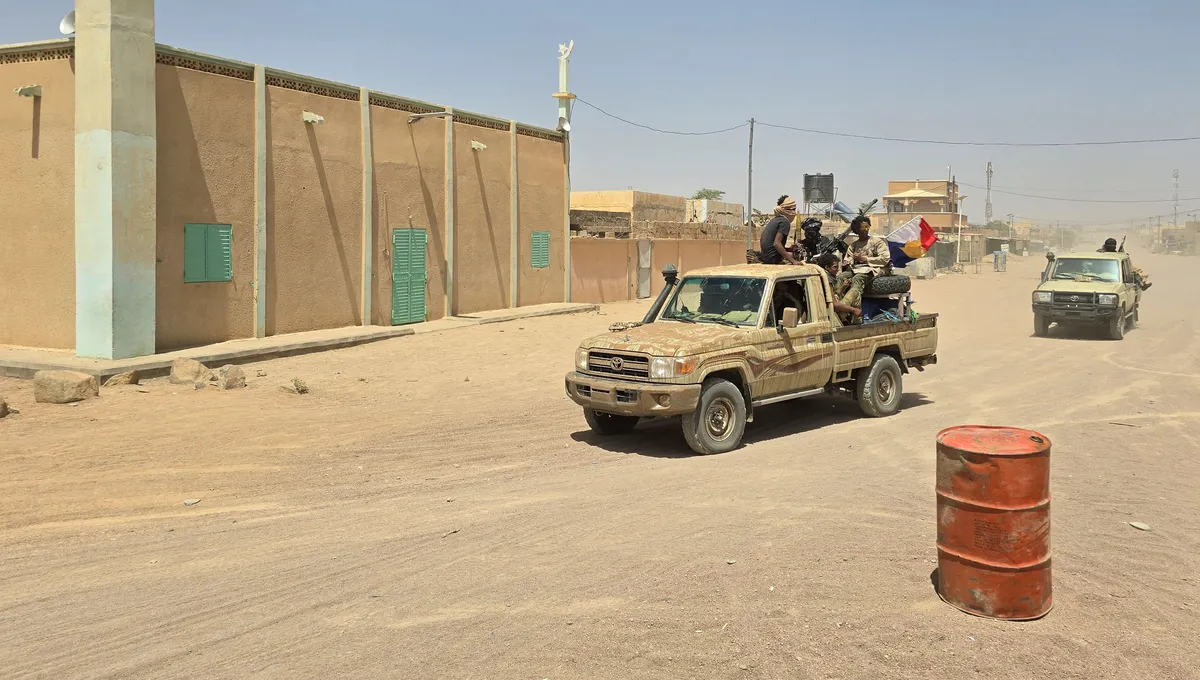

Russian forces evacuate Kidal without resistance, leaving rebels in control
Stunning footage captured the moment when a convoy of Russian military vehicles departed from Kidal in northern Mali yesterday morning—without firing a single shot. The withdrawal marked a dramatic shift in control as Tuareg rebels allied with jihadist factions swiftly took over the city. This unprecedented event highlights deeper issues within Mali‘s security apparatus and raises questions about the effectiveness of foreign military support.
Rebels escalate attacks across Mali, including Bamako
The timing of the Russian retreat was particularly noteworthy, coming just after Jama’at Nusrat al-Islam wal Muslimin (JNIM), a prominent jihadist group, claimed responsibility for simultaneous attacks across multiple regions—including the capital, Bamako. In their statement, they explicitly urged Russian forces not to intervene, signaling a calculated strategy to avoid direct confrontation while positioning themselves for future negotiations.
The 2,500 Russian troops stationed in Mali, operating under the Africa Corps—the successor to the controversial Wagner Group—remained conspicuously inactive during the crisis. This passivity has dealt a severe blow to the military junta in Bamako, which had previously ousted French forces in 2022, hoping to stabilize the country with Russian backing. Instead, the regime now faces its most critical security challenge since the coup five years ago.
Mali’s military government struggles under mounting pressure
The fall of Kidal is more than just a territorial loss—it represents a symbolic defeat. The city, a historic stronghold of the Tuareg rebellion, was recaptured in 2023 after a decade under rebel control, thanks to a collaborative effort between Malian forces and Russian military advisors. This victory, achieved shortly after the withdrawal of French troops and UN peacekeepers, had bolstered the reputation of Colonel Assimi Goïta, the junta’s leader. Yet today, that momentum has evaporated.
Beyond the battlefield, Mali’s leadership faces growing discontent. The junta’s consolidation of power—marked by the dissolution of political parties and the appointment of a leader without elections—has alienated large segments of the population. Recent months have seen Bamako subjected to a crippling blockade, cutting off fuel supplies from neighboring countries and exacerbating public frustration.
Regional implications: a domino effect in the Sahel
The crisis in Mali extends far beyond its borders. If the Malian junta were to collapse, neighboring countries—particularly Niger and Burkina Faso, both members of the Alliance of Sahel States—could face increased destabilization. The JNIM, which is actively involved in Mali, is an Al-Qaeda-affiliated group with ambitions to expand its influence across the region. Coastal West African nations, already grappling with jihadist incursions, would also be at heightened risk.
The potential fragmentation of Mali looms as a grave threat. The north could fall under the control of Tuareg separatists, while the center and south become contested battlegrounds for rival jihadist factions. Such a scenario would not only redraw the political map of the Sahel but also create a vacuum that extremist groups would eagerly exploit.
From French intervention to Russian disappointment: a decade of failures
The roots of today’s crisis trace back to 2014, when France launched a military intervention to prevent a jihadist advance on Bamako. For years, French forces played a pivotal role in restoring stability to northern Mali. However, the subsequent years saw a gradual erosion of trust in Western-backed solutions, culminating in the 2022 coup that expelled French troops and welcomed Russian support.
Yet the transition from French to Russian assistance has not yielded the expected results. Four years after the withdrawal of Western forces, Mali is once again mired in insecurity, with civilians bearing the heaviest burden. The failure of this strategy underscores a harsh truth: without inclusive governance and sustainable security solutions, the Sahel remains trapped in a cycle of instability.



