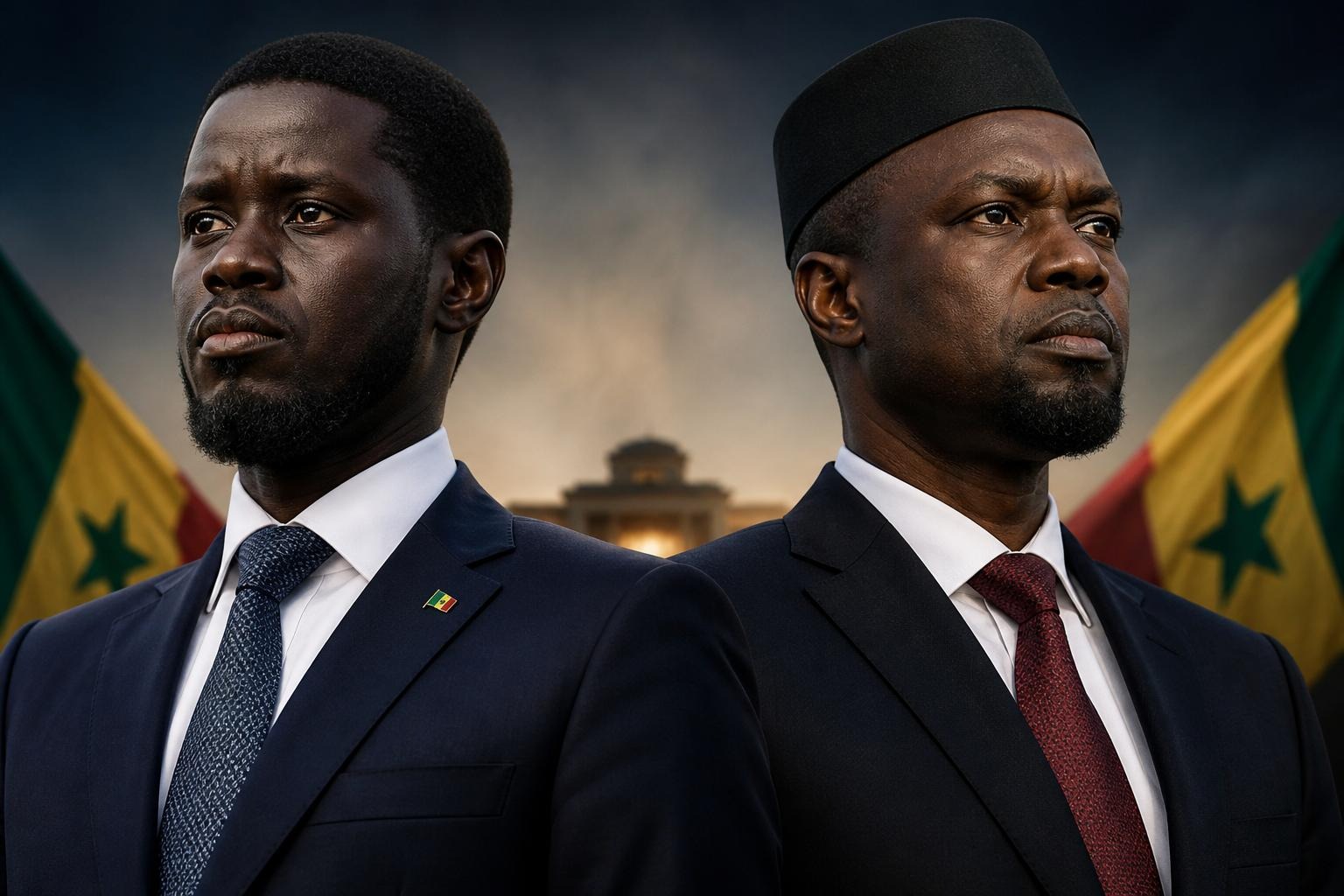

Senegal’s political landscape is witnessing a defining moment as President Bassirou Diomaye Faye signals a bold departure from the earlier narrative of an unbreakable partnership with Prime Minister Ousmane Sonko. The weekend of May 2–3, 2026, served as a turning point, revealing fractures in what was once presented as a united front. With his public acknowledgment of diverging views and a firm stance on prioritizing national interests, the President shattered the illusion of an inseparable duo. The nation watches closely as the delicate balance between presidential authority and partisan loyalty begins to tilt.
a weekend of stark revelations
During a nationally televised interview, President Faye made a statement that sent shockwaves through Senegal’s political circles. The media narrative had long painted the picture of a harmonious duo, where mentor and protégé marched in lockstep toward a shared vision of change. Yet, the President’s words introduced a stark shift in tone.
Addressing the growing tensions between government policies and the sometimes outspoken remarks from Pastef party officials, Bassirou Diomaye Faye underscored a critical distinction. He emphasized that while his commitment to the national project remains unwavering, his ultimate responsibility lies with the Senegalese people. His declaration that he would not hesitate to formalize a separation if partisan agendas clashed with his vision of governance marked a definitive assertion of presidential autonomy. The message was clear: the presidency would no longer be beholden to any political faction.
the weight of ousmane sonko’s influence
To grasp the depth of this tension, it’s essential to revisit the origins of this administration. Elected under the banner that casting a vote for Diomaye equated to choosing Sonko, the President initially found himself navigating the shadow of a Prime Minister whose charisma and visibility often overshadowed official communications. Ousmane Sonko’s persistent role as party leader—despite his governmental position—has repeatedly sparked debates, particularly when his public engagements appeared to bypass or challenge the executive’s messaging.
The divide has grown more pronounced in recent months, particularly on high-stakes issues. Disagreements over debt management and international relations highlight a stark contrast: while Sonko advocates for a radical break with global financial institutions, Faye leans toward measured diplomacy. Similarly, the appointment of officials has become a flashpoint, with the President favoring technocratic expertise and the Prime Minister pushing for loyalist placements. The differing styles—Sonko’s fiery rhetoric versus Faye’s measured approach—further underscore the widening rift.
is separation inevitable for Senegal’s leadership?
While an immediate split may still be premature, the possibility is now firmly on the table. President Faye’s latest declarations suggest a deliberate move toward establishing his own legacy, independent of partisan constraints. Close advisors to the Prime Minister downplay the remarks as mere role delineation, yet the President’s words convey a deeper intent: the institution of the presidency will not be subservient to any external pressure.
This evolving dynamic places Senegal at a crossroads. Historical precedents of fractured executive duos have often led to institutional paralysis, raising concerns about potential gridlock. Should a definitive split occur, Faye would face the challenge of governing without the full backing of Pastef’s grassroots machinery, compelling him to seek new alliances or rely on decree-based governance.
the stakes of presidential independence
For Bassirou Diomaye Faye, the immediate challenge is twofold: reassuring international partners of Senegal’s stability while proving to citizens that he is firmly in control. Public opinion remains deeply divided. The youthful base, drawn to Sonko’s dynamic leadership, may interpret this shift as a betrayal of their shared vision. Conversely, those prioritizing institutional stability view the President’s actions as a long-overdue assertion of constitutional authority.
The President is playing a high-stakes game of strategy. Asserting his leadership without triggering social unrest or handing ammunition to his detractors demands precision. The question now transcends personal rapport—it hinges on whether Senegal’s governance structure can endure dual centers of power.
As observers of Senegal’s political evolution, we are witnessing the conclusion of an idealized chapter. Governance is not built on camaraderie but on the judicious exercise of power. Bassirou Diomaye Faye has made it clear: the Constitution grants him unassailable prerogatives, which he is determined to wield independently. What began as a partnership forged in the crucible of electoral victory now risks becoming an obstacle to effective governance. Senegal stands at the threshold of a new era—one where the state must transcend the party, and the President has just drawn the line in the sand.