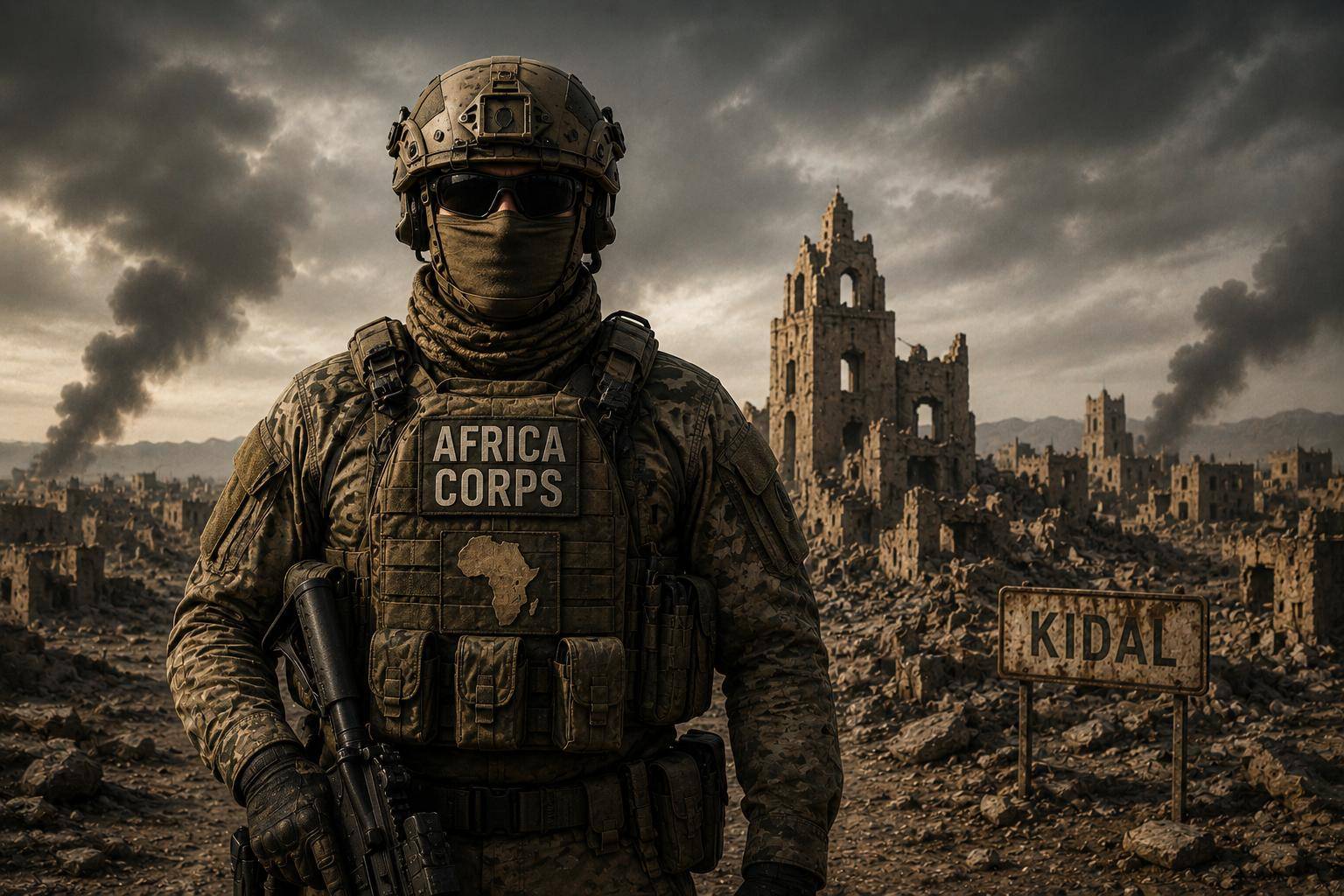

A recent document circulated by Russia’s Africa Corps, allies operating on the ground in the Sahel, reveals a profound shift in military rhetoric that, upon closer examination, uncovers a politically charged truth. This publication signals that Russian strategists are actively preparing public opinion for a significant change in their approach to Northern Mali. As a Sahel Reporter observing current affairs, two compelling scenarios emerge from this development.
Is the Africa Corps distancing itself from Assimi Goïta?
For an extended period, the transitional president, Assimi Goïta, built his political capital on a steadfast promise: to reclaim and secure every inch of Malian territory, with Kidal standing as the primary symbol of national pride. This commitment resonated deeply with the Malian populace.
However, the Africa Corps’ current assertion that Kidal is ‘worthless’ and should be avoided directly undermines President Goïta’s standing. Should the Russian forces opt against further engagement for Kidal, they would effectively leave the Bamako government to grapple with its unachievable pledges alone. This move could mark the beginning of a significant political disengagement, impacting Mali Niger Burkina reporting.
The prospect of a clandestine agreement with the FLA and JNIM
The language within the Africa Corps’ text also hints at another possibility: that the Russian contingent may already be implementing a discreet agreement forged behind closed doors with elements of the Front de Libération de l’Azawad (FLA) rebels and the jihadist group Jama’at Nasr al-Islam wal Muslimin (JNIM). This would be critical Sahel news English.
To rationalize ceding territory to these armed factions without appearing to capitulate, Russian communicators employ a strategic narrative: ‘We haven’t lost; we are merely circumventing a trap in the desert.’ In reality, downplaying Kidal’s strategic importance could be a calculated maneuver to condition public perception for an impending cohabitation or a pre-negotiated territorial division. This development would send ripples through Sahel current affairs.
This pronouncement from the Africa Corps unequivocally indicates that their initial operational strategy has faltered. For the Africa Corps, the era of reconquest appears to be over. This suggests two paths: either the Russian partners are diverging from Assimi Goïta’s hardline stance to safeguard their own interests, or they are formally acknowledging the abandonment of the North to rebel and Islamist groups through a non-aggression pact. Our on the ground Sahel analysis suggests this is a pivotal moment for regional stability.