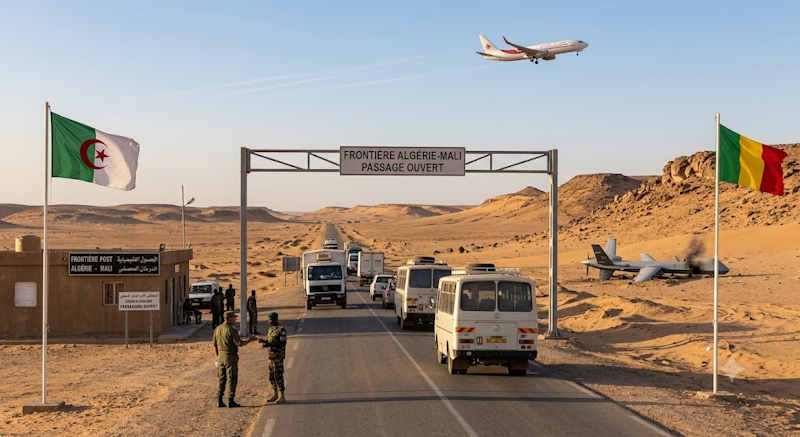


After more than a year of strained diplomacy sparked by a military incident, Algeria and Mali have formally announced the restoration of their airspace connectivity and the imminent return of their respective ambassadors.
Friday’s dual statements from Algiers and Bamako mark the conclusion of a 15-month standoff that had placed regional security cooperation in the Sahel at risk. Both governments confirmed the lifting of mutual sanctions, enabling civilian and military flights to resume while diplomats prepare to return to their posts.
The diplomatic rupture began in April 2025 following a serious military incident along the shared border.
Tinzaouaten incident: the spark that ignited the crisis
Tensions escalated on March 31, 2025, when Algerian defense forces shot down a Turkish-made military drone operated by Malian forces near the town of Tinzaouaten. Located in the Kidal region—a historically contested area near the Algerian border and a stronghold of Tuareg separatist groups—the site’s strategic significance amplified the dispute.
Algiers insisted radar data confirmed the drone had entered Algerian airspace, a claim Bamako vehemently denied. The military leadership in Mali labeled the incident an “unprovoked aggression” and demanded evidence, which was never provided.
The conflict quickly expanded into a regional dispute:
- Regional solidarity: The Malian junta, backed by its allies in the Sahel Confederation—Niger and Burkina Faso—reciprocated by withdrawing its ambassador in protest, framing the act as an attack on Sahelian sovereignty.
- Algerian response: Describing Bamako’s accusations as “unfounded and reckless,” Algeria retaliated by closing its airspace to all Malian flights and recalling its diplomatic staff.
A fracture in regional security architecture
Over the following months, the disagreement intensified on the international stage. In September 2025, Mali escalated the matter by filing a case with the International Court of Justice, accusing Algeria of deliberately targeting the drone to undermine Malian counterinsurgency operations. Shortly after, Bamako withdrew from the Joint Operational Staff Committee (CEMOC)—a critical framework for counterterrorism coordination in the Sahel, originally championed by Algeria.
Historical context: For over a decade, Algeria served as the primary mediator in the conflict between the Malian state and Tuareg separatist movements, culminating in the 2015 Algiers Accords.
A shifting geopolitical landscape
The thaw comes at a time when the geopolitical map of the Sahel has undergone a dramatic transformation since the military coups in Mali in 2020 and 2021. The ruling juntas in Bamako, Niamey, and Ouagadougou have increasingly distanced themselves from traditional partners—including Algeria and France—in favor of deepening military ties with Russia.
Despite these changes, the security situation remains dire. Since 2012, Mali has faced a deadly insurgency linked to Al-Qaeda and the Islamic State. Recent months have seen a surge in coordinated attacks, with jihadist factions and Tuareg separatists launching simultaneous offensives. The restoration of dialogue between Algeria and Mali could prove pivotal in restoring stability across the region.