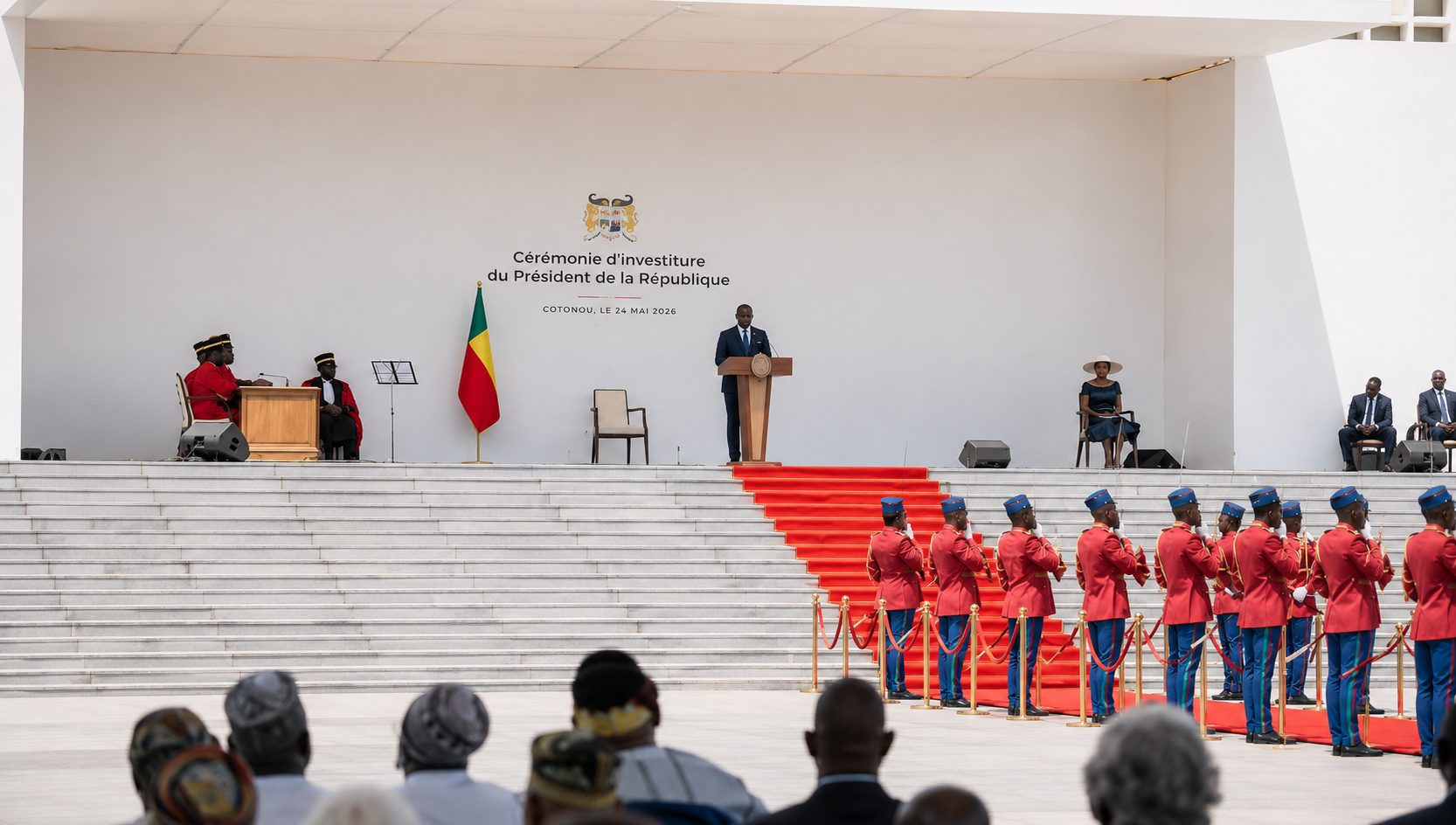

The Republic of Bénin has entered a new chapter with the inauguration of Romuald Wadagni as its fifth president since the democratic renewal of 1990. On Sunday, May 24, 2026, in a highly orchestrated ceremony at the Palais des Congrès in Cotonou, Wadagni took the oath of office for a seven-year term, succeeding Patrice Talon, who was constitutionally barred from seeking a third consecutive mandate.
With more than 94% of the vote in an election where the main opposition party was disqualified, Wadagni’s victory was unprecedented. His only challenger, Paul Hounkpè of the Forces cauris pour un Bénin émergent (FCBE), did not pose a meaningful challenge, underscoring the altered political terrain. The vice-presidency was retained by Mariam Chabi Talata, a continuity choice mandated by the 2019 constitutional revision.
From Deloitte to the Palais de la Marina: A technocrat’s rise
Born in Lokossa, Romuald Wadagni is a career technocrat whose résumé reflects the continuity he now embodies. Before joining the government in April 2016 as Minister of Economy and Finance, he spent seventeen years at Deloitte, where he honed skills in financial strategy and international fundraising. Under his leadership, Bénin maintained its sovereign credit rating and successfully floated multiple bonds on global markets, a record that shaped his reputation as a steady hand in economic governance.
His election victory on April 12, 2026, was secured in the first round, a result validated by the Constitutional Court. The seven-year mandate, introduced in a 2025 constitutional reform, marks a shift from the previous five-year cycle and decouples presidential elections from legislative contests—a structural change now embedded in Bénin’s electoral calendar.
A tightly controlled transition
The inauguration ceremony unfolded with military precision, beginning at 9:30 a.m. and concluding by noon. Patrice Talon formally handed over the presidential insignia in a private meeting at the Palais de la Marina, followed by a solemn swearing-in before the Constitutional Court. The new president was then invested with the Grand Collar of the National Order and the Command Flag, in the presence of over 6,000 guests.
Among the dignitaries were former presidents Nicéphore Soglo and Thomas Boni Yayi, both singled out in Wadagni’s address. While international observers praised the logistical smoothness of the event, the political environment remained notably constrained. The country’s leading opposition party, Les Démocrates—founded by former president Thomas Boni Yayi—had been barred from participating in the election after its candidate list was invalidated in October 2025 for failing to meet the required parliamentary sponsorship.
Electoral exclusion and institutional tightening
The disqualification of Les Démocrates followed a pattern of growing restrictions on political participation. The rejection of the party’s ticket—Renaud Agbodjo and Judes Lodjou—was confirmed by the Constitutional Court after the Electoral Commission ruled their sponsorship invalid due to a last-minute withdrawal of support by one of the required 28 parliamentary deputies. The episode capped years of legal and administrative pressure on opposition figures, including high-profile detentions such as that of Reckya Madougou, sentenced to 20 years for “terrorism” in 2021, and Joël Aïvo, given a 10-year term for “conspiracy.” Several opposition leaders now live in exile.
Institutional barriers have also intensified. High registration fees, state-controlled certification processes, and a 2025 threshold requiring parties to secure at least 20% of the vote in each constituency to retain seats have significantly reduced opposition representation. In the January 2026 legislative elections, Les Démocrates failed to win a single seat.
Security and regional diplomacy: A cautious opening
Wadagni’s inaugural address outlined a dual agenda: translating economic growth into tangible benefits for families across Bénin—especially youth, women, rural communities, and the middle class—and adopting a firm stance against armed groups operating in the north since 2022. However, the most significant shift came in regional diplomacy. For the first time in memory, Sahelian leaders attended a Bénin presidential inauguration. High-level delegations from Mali, Burkina Faso, and Niger were present, including the Malian Foreign Minister Abdoulaye Diop, Burkina Faso’s Foreign Minister Karamoko Jean-Marie Traoré, and Niger’s Prime Minister Ali Mahaman Lamine Zeine—representing the Alliance des États du Sahel (AES). Nigeria was represented by a special envoy of President Bola Tinubu.
The presence of the Nigerien prime minister drew particularly strong applause, signaling a subtle but deliberate softening of Bénin’s previously firm stance toward military regimes in the Sahel. Relations with Niamey had been strained since July 2023, following the coup in Niger, with repeated closures of the shared border—critical for the transit of Nigerian hydrocarbons via the Bénin oil pipeline. Wadagni’s conciliatory tone marked a departure from the rigid posture maintained by his predecessor.
The president’s speech was structured around a recurring refrain—“to you, I say”—addressed to different segments of society: youth, women, rural populations, the middle class, the diaspora, and descendants of the transatlantic slave trade. He reaffirmed Bénin’s role as a “house of return,” a symbolic gesture toward the diaspora. A notable emphasis was placed on women’s leadership, reflected in the vice-presidency held by Mariam Chabi Talata.
What to watch in the coming months
Several immediate indicators will reveal the depth of Wadagni’s mandate. The composition of the new government, expected within days, will signal whether he intends to broaden decision-making beyond the inner circle of the previous administration. The fate of imprisoned opposition figures—including Reckya Madougou and Joël Aïvo—will also be closely watched. A potential amnesty law, already demanded by Les Démocrates, could serve as a powerful signal of political openness.
Equally pivotal will be the trajectory of relations with the AES bloc. Concrete gestures—such as a state visit to Niamey, Bamako, or Ouagadougou—could consolidate this diplomatic thaw. The question now facing Bénin is not merely one of stability, but of pluralism: a nation whose economic model is praised by international donors, yet whose political space offers increasingly limited room for dissent.