
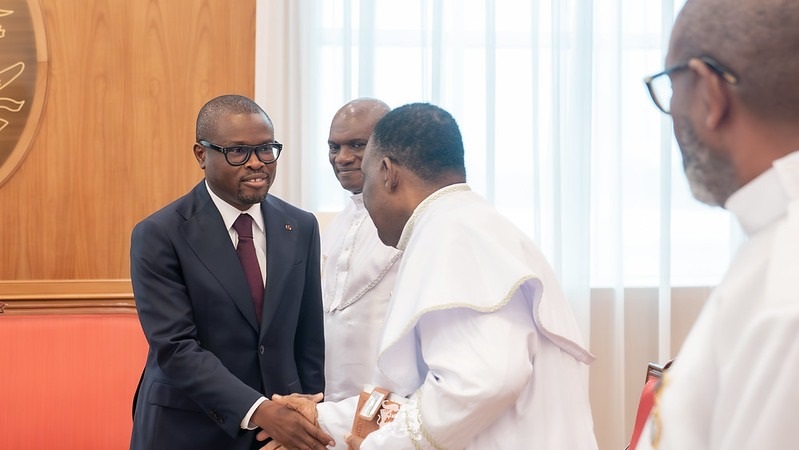
The audience granted on June 4, 2026, by President Romuald Wadagni to the delegation from the Celestial Christianity Church offers an insightful political perspective: it illustrates an exemplary state transition in Bénin, where two presidents clearly defined their roles, collaborating to serve a peace process extending beyond Bénin’s borders. This highlights robust Bénin political continuity.
Certain issues, by their very nature, illuminate the effectiveness of governance. The ongoing reunification of the Celestial Christianity Church is one such case. Its significance doesn’t stem from dramatic public events – rather, it unfolds through discreet meetings, theological consultations, and internal deliberations. What makes it critical is the demand for unwavering continuity from political authorities. Any perceived hesitation or break in state commitment could signal fragility to the Church’s various factions, making the process vulnerable to electoral shifts. This potential risk appears to have been thoroughly addressed.
A pivotal moment: two presidents, one critical agenda
To fully grasp the unique nature of this transition, one must recall the ceremony for submitting the conclusions and recommendations of the Superior Labor Council (CST). On that occasion, Patrice Talon and Romuald Wadagni stood together. Talon was the sitting president, while Wadagni was the president-elect, yet to be sworn in. This joint presence transcended mere protocol; it was a profound political statement. It underscored that this specific dossier had undergone an explicit transfer, a tacit agreement between the two leaders on the imperative of ensuring its seamless continuation.
It is uncommon for an outgoing president to involve their successor so early in such a sensitive matter. This action speaks volumes about the depth with which the transition was managed.
The events of June 4, 2026, further illustrate this well-orchestrated mechanism. In the morning, Patrice Talon officially inaugurated the Superior Council tasked with implementing the CST’s recommendations. Just hours later, in the evening, Romuald Wadagni received the very same Council’s delegation. The sequence was meticulously choreographed: one president established the framework, the other embraced and animated it.
A deliberate political architecture: defining distinct roles
This sequence reveals a thoughtfully constructed governance architecture. Patrice Talon assumed the role of facilitator – a term in mediation that denotes one who creates conditions for dialogue without acting as an arbiter. His legitimacy regarding this issue is historical, as the process was initiated, structured, and the CST’s conclusions rendered during his tenure. He serves as the guarantor of the approach in the eyes of the ecclesiastical stakeholders.
Romuald Wadagni, on the other hand, embodies active republican continuity. By reaffirming his support and encouragement to the delegation, he signaled that the state was not merely transferring the file but actively taking ownership of it. This distinction is crucial. A simple handover would have sufficed for transition. Wadagni went further, demonstrating personal engagement and offering reassurance.
President Wadagni did not simply listen; he actively posed questions, indicating a thorough briefing and detailed understanding of the dossier. This was clearly more than a courtesy meeting.
A real-world test of leadership cohesion
Beyond the Celestial Christianity Church itself, this dossier serves as a clear indicator of the quality of relations between the two presidents. In many African transitions, matters left unresolved by an outgoing president often languish in institutional limbo, neither officially abandoned nor fully embraced by the new administration. The temptation to restart from scratch, or simply let previous initiatives fade, is a common challenge.
Here, the message is quite the opposite. By actively engaging with a dossier initiated by his predecessor within the initial weeks of his mandate, Wadagni established a governance principle: state continuity takes precedence over agenda disruption. If this principle holds true in other sectors, it could well become a defining characteristic of this new presidential term, solidifying Bénin political continuity.
The approach observed with the Celestial Church dossier sets a precedent, with many hoping to see similar continuity applied to other significant national projects, marking the true measure of the transition.
An issue with international ramifications
It would be reductive to confine this dossier to its purely Béninois dimension. The Celestial Christianity Church is a global organization with adherents across continents. Its reunification process, if successful, will be an international event, with Bénin, as its founding nation, serving as its gravitational center.
The commitment of both Béninois presidents to this matter therefore carries diplomatic and symbolic weight far beyond Cotonou. It positions Bénin as a hub for resolving a global religious division and its leaders as responsible actors in a peace process affecting millions of believers. In a different vein from traditional diplomacy, this represents a form of deliberate soft power: the capacity to exert positive influence through mediation rather than coercion.
In this regard, the audience of June 4, 2026, is not merely a religious news item. It is an act of foreign policy intertwined with an act of national cohesion – and a tangible illustration, for any lingering skeptics, that the transfer of power between Patrice Talon and Romuald Wadagni was executed with profound substance, not just superficial formalities.