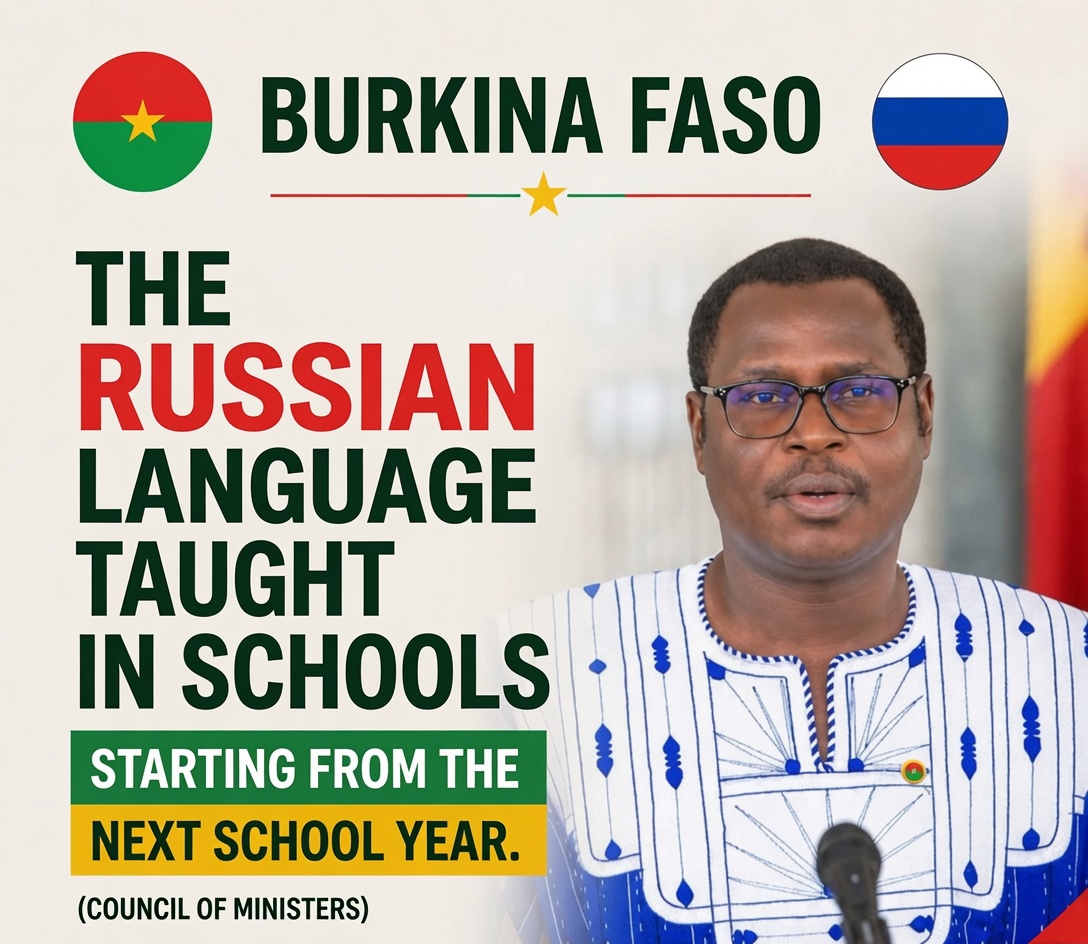

A recent governmental decision in Burkina Faso signals a profound shift in the nation’s strategic alliances. The transitional government, following a Council of Ministers meeting, has officially decreed the integration of Russian language instruction into the Burkinabè school curriculum, commencing next academic year. While authorities present this initiative as a gateway to cultural and economic opportunities, it has ignited a significant public discourse and raised serious concerns regarding the true motivations behind such a pivotal announcement.
What is the actual intent driving this new adoption? Proponents of the current administration articulate a pragmatic, forward-looking rationale. In an increasingly multipolar global landscape, they argue that diversifying the linguistic capabilities of the youth will prove invaluable for fostering future commercial, technological, and academic exchanges with the Eurasian bloc. With Russia now established as a crucial security partner for the regime, its language is poised to enter classrooms. For the authorities, this move simply aims to embed, within the educational framework, a partnership deemed essential for the state’s survival against persistent terrorist threats.
Yet, beneath this veneer of educational cooperation, the specter of disguised foreign influence looms large. Does this decree not represent the concealed facet of a geopolitical transition, where the government withholds certain truths? As Burkina Faso legitimately strives to shed the burdensome legacy of French colonialism and Western paternalism, the rapid pace at which Moscow is deploying its influence raises fears of an inverted dependency trap. Replacing one external influence with another does not equate to sovereignty; rather, it suggests a mere change of guardianship.
Several compelling arguments suggest this measure could be interpreted as the precursor to a modern, insidious form of colonization:
- Soft Power as a Tool for Political Penetration: Contemporary history demonstrates that the introduction of a language via political decree is rarely a purely academic endeavor. It often serves as the armed wing of cultural influence, or ‘soft power.’ By familiarizing Burkinabè youth with Russian language and culture, Moscow aims to cultivate a future local elite sympathetic to its interests, capable of consuming its media, internalizing its narratives, and legitimizing its long-term presence.
- The Precedent of Eastern Bloc Nations: During the Cold War, the imposition of Russian in schools across the Soviet Union’s satellite states was precisely designed to standardize thought and consolidate political control. Applying this identical methodology today in the heart of the Sahel bears a strong resemblance to a well-established manual of influence, where the school becomes an extension of the barracks.
- A Fundamentally Asymmetrical Relationship: Genuine linguistic cooperation is predicated on reciprocity. However, this adoption unfolds within a context of extreme vulnerability for Burkina Faso, which heavily relies on Russian military and logistical support to secure its territory. Introducing Russian into schools under these conditions appears more akin to a significant political concession made to a Muscovite savior than a thoroughly deliberated strategic choice by the educational community.
- The Risk of Cultural Asphyxiation: Burkina Faso boasts a rich tapestry of local languages that struggle to secure their rightful place and funding within the educational system, hindering the valorization of national identity. The prioritization of a foreign language, distant from West African realities, raises pertinent questions. Instead of decolonizing minds, this measure risks merely shifting the locus of dependency.
By allowing Russia to embed itself so deeply across the military, mining, and now the intimate sphere of classrooms, Burkina Faso exposes itself to the peril of a disguised colonization—more subtle, yet equally constraining of liberty. Faced with this precarious geopolitical gamble, the nation’s future remains contingent upon the vigilance of its populace. May discernment guide Burkina Faso to ensure that today’s cry for independence does not transform into tomorrow’s submission.