Burkina Faso’s financial sovereignty: between slogans and real debt realities
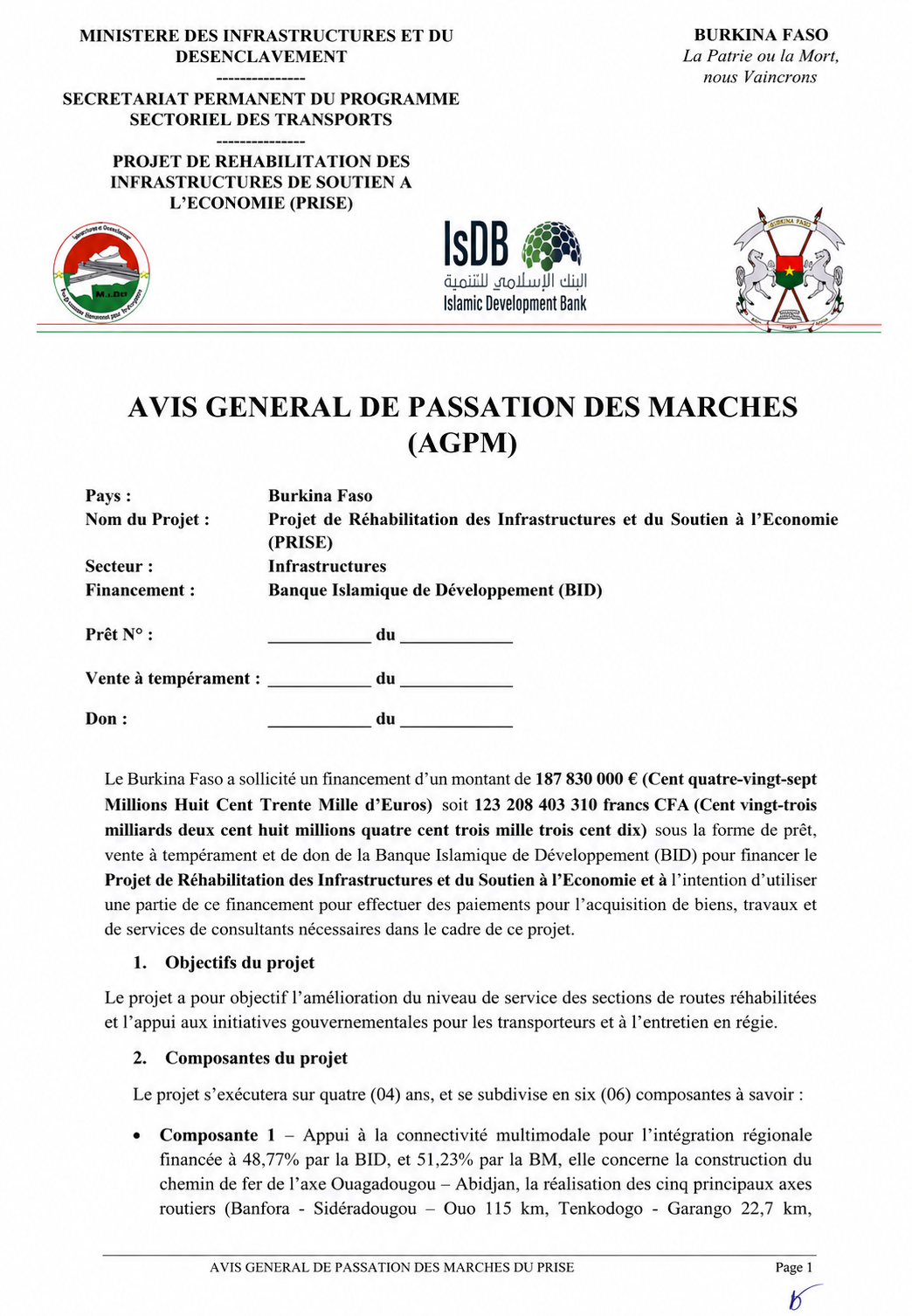
In the official discourse of Burkina Faso’s military-led government under Captain Ibrahim Traoré, a catchphrase has taken center stage as the emblem of economic self-reliance: ‘Y’a pas crédit dedans’ — ‘there’s no credit in it.’ Repeated across social media and echoed by the regime’s supporters, the slogan aims to project an image of national resilience, suggesting that the country’s ambitious infrastructure projects—from road rehabilitation to state modernization—are being funded entirely through domestic resources, without recourse to foreign debt.
At first glance, the message is compelling: Burkina Faso, so the narrative goes, is advancing under its own steam, free from the shackles of international lenders. Yet, beneath the polished rhetoric lies a far more nuanced—and troubling—financial reality.
From Slogan to Fiscal Facts: The Gap Between Words and Numbers
There is no denying that economic sovereignty is a legitimate goal for any nation. The aspiration to reduce external dependence, bolster domestic revenue collection, and strengthen national capacity is universally acknowledged as a pillar of sustainable development. However, when official communications insist that every public investment is financed exclusively by internal funds, the claim begins to unravel under scrutiny.
Take, for instance, the recent agreements with the Islamic Development Bank (IsDB) to fund major road infrastructure projects. While these loans come with concessional terms, they are nonetheless loans—financial obligations that will appear on Burkina Faso’s balance sheet and must be repaid within agreed schedules. Far from being ‘free money,’ they represent deferred liabilities that will shape the country’s fiscal landscape for years to come.
Why the Denial? The Paradox of Public Debt Communication
The insistence on ‘no credit involved’ raises an obvious question: if international partners are actively financing public projects, why insist on a narrative of complete financial autonomy? The use of external financing is not an anomaly—it is a standard tool in public finance, especially for countries facing resource constraints.
What is striking is not the borrowing itself, but the disconnect between two contradictory realities:
- A political narrative of near-total financial independence.
- A fiscal reality that continues to rely on external partners for critical investments.
This contradiction fuels skepticism about the transparency of the government’s financial reporting and the sincerity of its claims.
A Nation Under Strain: Why Self-Financing Is a Myth
Beyond the rhetoric, Burkina Faso’s economic environment tells a different story. The country is grappling with multiple, compounding crises:
- A protracted security emergency draining public coffers.
- A surge in military expenditure.
- Shrinking fiscal space and weakened tax revenues due to economic slowdowns in key regions.
- Massive internal displacement disrupting local economies.
- Critical infrastructure gaps requiring urgent attention.
In such a context, the idea that the government could fund multi-billion-franc investments entirely through domestic revenue—without borrowing—strains credibility. Most economists argue that responsible fiscal management does not mean avoiding debt altogether, but rather borrowing wisely, transparently, and for productive purposes.
The Real Issue Isn’t Debt—It’s Lack of Clarity
Public borrowing, when used judiciously, can be a catalyst for growth. Well-structured loans can finance roads that unlock agricultural potential, hospitals that improve public health, and schools that build human capital. The problem arises not from the act of borrowing itself, but from the opacity that often surrounds it.
Citizens deserve to know:
- Where the money comes from.
- How much is being borrowed.
- What interest rates apply.
- When and how repayment will occur.
- What guarantees are pledged.
- The true cost of each project.
True economic sovereignty is not measured by the absence of debt, but by the ability to manage it responsibly, accountably, and in full view of the public.
The Political Function of the Slogan
‘Y’a pas crédit dedans’ serves a clear political purpose. It reinforces the image of a leadership breaking from past practices, positioning every completed project as proof of regained independence. It also taps into a deep reservoir of national pride, resonating with a population increasingly focused on sovereignty in the face of external pressures.
Yet when communication eclipses fiscal pedagogy, the risk is real: unrealistic expectations are raised about the state’s capacity to fund development without borrowing. Future generations will inherit not only the bridges and schools built today, but also the debt obligations that come with them.
Sovereignty Isn’t Built on Denial
A nation’s strength is not demonstrated by pretending it never borrows. It is proven through:
- Sound public financial management.
- Strategic investment in productive sectors.
- Transparent reporting and accountability.
- Responsible debt practices that prioritize long-term sustainability.
- A gradual reduction of dependence through economic diversification and innovation.
Burkina Faso, like all developing nations, will continue to need external financing to bridge critical gaps in infrastructure, security, and human development. The challenge is not to avoid borrowing, but to borrow wisely—and to tell the truth about it.
The Way Forward: From Rhetoric to Responsibility
The slogan ‘Y’a pas crédit dedans’ has resonated widely. But the sustainability of Burkina Faso’s development strategy cannot rest on slogans alone. The international financing agreements signed in recent months serve as a reminder: the country still relies on external partners to fund part of its growth.
The debate should not pit borrowing against sovereignty. It should focus on governance quality, financial transparency, and the effectiveness of investments. Ultimately, it is today’s taxpayers—and tomorrow’s citizens—who will bear the consequences of today’s fiscal choices. Their right to clear, accurate information is not negotiable.