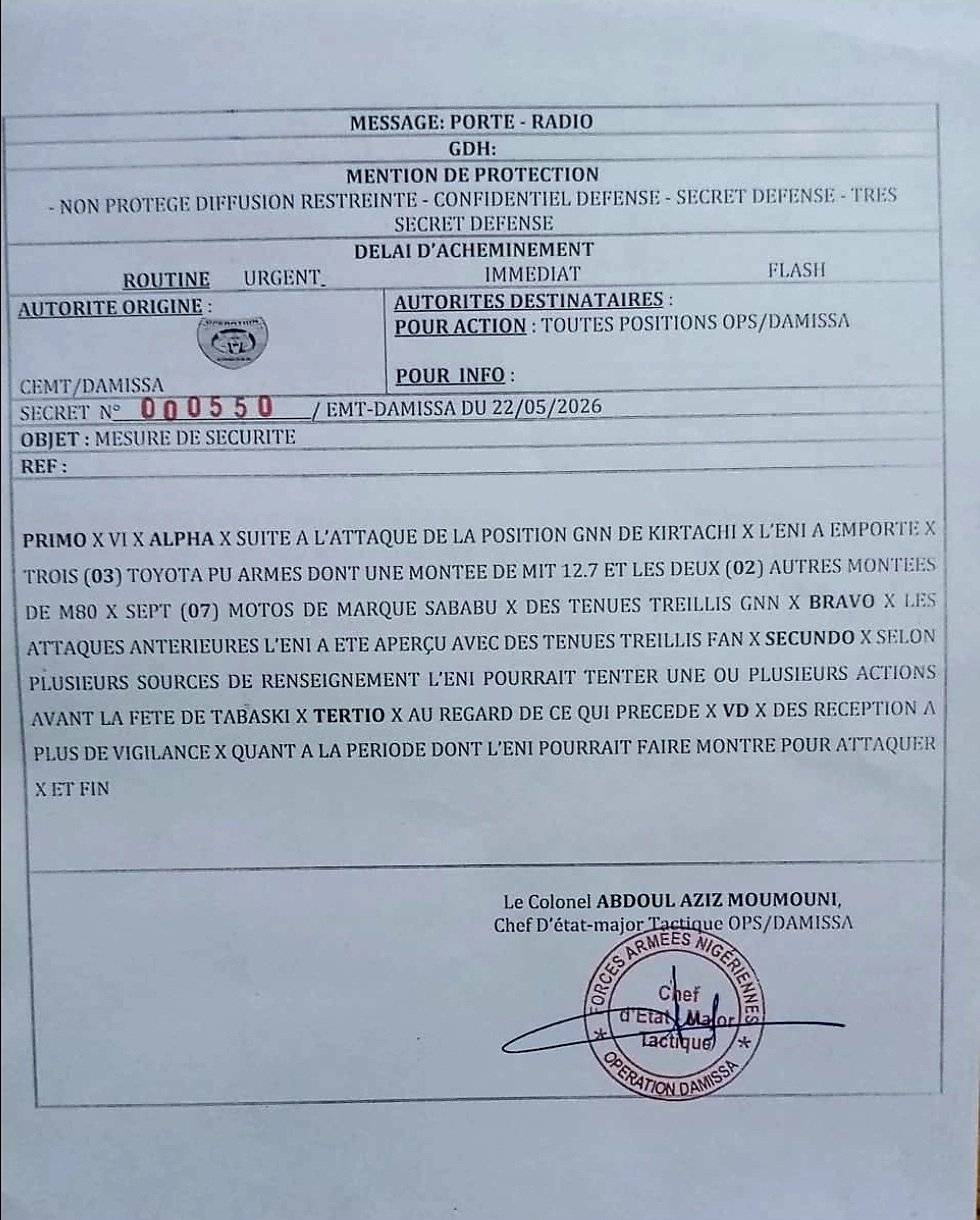

Following a fierce assault on Niger’s National Guard (GNN) at Kirtachi, nestled within the Tillabéri region, a confidential internal radio message dated May 22, 2026, has brought to light the true extent of losses suffered by the nation’s defense and security forces (FDS). This official military document, marked “secret defense,” corroborates the significant cache of weaponry and critical strategic equipment that fell into the hands of terrorists from the Group for the Support of Islam and Muslims (JNIM). With a particularly heavy human toll and the looming threat of infiltrations as the Tabaski holiday approaches, Nigerien forces are confronting a substantial security challenge.
The story behind a revealing leak
In the asymmetric warfare currently gripping Niger, official assessments frequently offer only partial accounts. However, an internal radio message, intercepted and reviewed this Friday, May 22, 2026, shatters the usual regulatory silence. Originating from the highest military echelons, this classified document meticulously details the operational setback endured by the Niger National Guard detachment in Kirtachi, a strategic locality situated in the “three borders” zone. The disclosure of this technical note provides a precise measure of the assault’s logistical impact. Far removed from the typical social media speculation, this staff document presents a rigorous inventory that deeply concerns the command of the national operation.
Arsenal and logistics: an alarming inventory
The true shockwave from this document stems from the detailed list of military hardware seized by the JNIM. The attackers executed a comprehensive logistical plunder, stripping the detachment of its mobility and essential firepower. According to the internal radio message, the adversaries successfully captured three armed Toyota pick-up vehicles, all combat-ready. One of these vehicles was mounted with a formidable 12.7 mm heavy machine gun, known for its high rate of fire against ground troops, while the other two were equipped with M80-type machine guns. The assailants also acquired seven Sababu brand motorcycles, which are lightweight yet robust vehicles perfectly suited for swift, lightning-fast assaults across the challenging Sahelian terrain. Even more alarming for the security of future operations, the document indicates the theft of several GNN camouflage uniforms. This appropriation of official attire raises the immediate risk of infiltration attacks, where terrorists could impersonate Nigerien soldiers to circumvent checkpoints and deceive security personnel.
A human toll that worsens
This material catastrophe is compounded by a human tragedy, the official tally of which remains profoundly distressing. The Kirtachi engagements claimed the lives of 12 FDS personnel, who made the ultimate sacrifice defending against the incursion. Beyond these lives lost, the secret document reports the disappearance of 4 additional Nigerien soldiers, officially classified as abducted. The fate of these military hostages remains uncertain, as the JNIM frequently leverages prisoners of war as bargaining chips or propaganda tools via its media channels. This dual crisis underscores the intense pressure exerted by non-state armed groups throughout the Tillabéri region.
Maximum alert as Tabaski approaches
Given the gravity of the situation and the recovery of such strategic equipment, military command swiftly responded. The confidential note from May 22, 2026, issues an urgent directive to all operational positions nationwide, calling for heightened vigilance. Military analysts express concern that the JNIM may immediately exploit this captured arsenal to launch new, large-scale operations. This period is particularly critical as the Tabaski festival draws near. This time of intense religious observance and significant population movement creates a window of vulnerability that terrorist groups have historically attempted to exploit to make a profound impact.
The Kirtachi attack and the revelations contained within this “secret defense” document serve as a stark reminder of the complex and severe security crisis plaguing Niger. By seizing armed pick-ups, heavy machine guns, and official uniforms, the JNIM temporarily enhances its capacity for harm and its operational mobility within the “three borders” area. For the Nigerien army, the challenge is now twofold: to ensure the safety of its citizens in the lead-up to Tabaski celebrations and to urgently adapt field tactics to counter an adversary now equipped with its own captured weaponry. This on-the-ground Sahel reporting highlights the pressing Sahel current affairs for Niger current affairs and Sahel news English audiences.