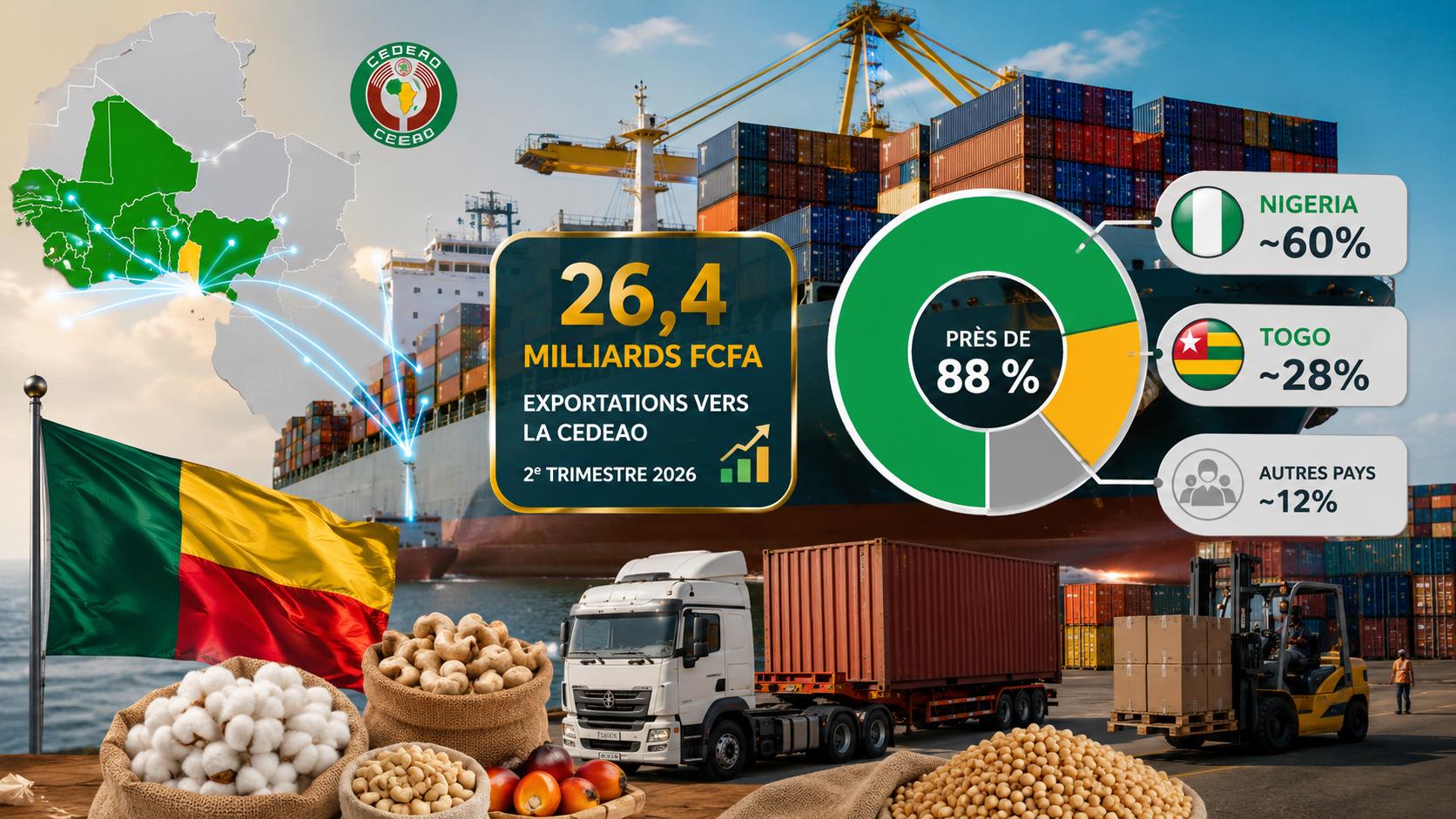

With 26.4 billion FCFA in exports to ECOWAS nations during the second quarter of 2026, Benin is steadily solidifying its position in West African markets. The substantial demand from Nigeria and Togo, collectively absorbing nearly 88% of these sales, underscores both the inherent potential of regional proximity and the positive effects of an economic strategy focused on industrial transformation, enhanced competitiveness, and deeper trade integration.
The figures from the second quarter of 2026 offer an encouraging signal for Benin’s economy. During this period, Benin’s exports to other member states of the Economic Community of West African States (ECOWAS) reached a significant 26.4 billion FCFA, representing 14% of the nation’s total exports.
Beyond the sheer volume, it is particularly the nature and destination of these trade flows that command attention. Nigeria, the region’s leading economic power and Benin’s immediate neighbor, accounts for a substantial 56.1% of the value of Benin’s exports destined for ECOWAS. Togo ranks second, receiving 31.7%, while Côte d’Ivoire contributes 5.1%.
Together, Nigeria and Togo concentrate an impressive 87.8% of Benin’s exports within the community space. While this concentration indicates a certain reliance on a few key markets, it simultaneously presents a tremendous opportunity: to build a more integrated regional economic zone around Benin, capable of fostering production, attracting investment, and generating employment.
Nigeria, a pivotal market
The commercial relationship with Nigeria naturally holds a special significance. Geographic proximity, the sheer demographic weight of the Nigerian market, and the intensity of cross-border exchanges make this nation an indispensable partner for Beninese enterprises.
During the second quarter, exports to Nigeria were notably propelled by petroleum or bituminous mineral oils, valued at 7.6 billion FCFA and totaling over 8,500 tons.
Iron or steel bars, exclusively intended for re-export, followed with 3.3 billion FCFA, succeeded by soybean oil and its fractions, contributing 2.3 billion FCFA.
These statistics reveal a crucial insight: beneath the commercial figures lie intricate value chains, involving transporters, merchants, port operators, processing companies, and numerous other stakeholders whose operations depend on the smooth flow of trade.
For Benin, the imperative now is to advance further by increasing the proportion of higher value-added products within its export portfolio. This strategic direction aligns perfectly with the ongoing, gradual transformation of the national economy, a process initiated in 2016.
Economic transformation at the heart of the strategy
Since the administration of President Patrice Talon took office in 2016, Benin has prioritized the modernization of its economy, the development of critical infrastructure, and the transformation of its agricultural potential.
The stated objective is to evolve the country’s economic model: moving beyond merely producing and exporting raw materials to creating significantly more value domestically.
Trade with Togo exemplifies this dynamic. The neighboring country primarily receives oilseed cakes and other solid residues, valued at 2.2 billion FCFA, cotton seeds amounting to 1.5 billion FCFA, and unbleached cotton fabrics totaling approximately 0.7 billion FCFA.
Cotton, in this context, serves as a particularly illustrative example. This historic Beninese sector is no longer confined to agricultural production alone; it is progressively slated to feed a more structured textile industry, capable of generating employment and higher revenues for all participants in the value chain.
This ambitious vision is gaining traction with the development of infrastructure and industrial zones specifically designed to welcome investors and promote local processing. The objective is clear: to ensure that a greater share of the wealth generated from Benin’s resources remains within the country.
Beyond foreign trade figures: broader economic impacts
The expansion of regional trade is far more than just an additional line in national statistics. It can generate cascading effects throughout the real economy.
When a Beninese company increases its external sales, it necessitates greater production, packaging, storage, and transportation of its goods. This activity, in turn, mobilizes farmers, factory workers, drivers, logistics specialists, freight forwarders, traders, and various service providers.
A sustained export dynamic also contributes to bolstering corporate revenues, stimulating investment, and progressively enhancing productive capacities.
For Beninese households, the anticipated benefits are manifold. The growth of productive activities can foster job creation, particularly for young people. Improved infrastructure facilitates travel and the movement of goods. Furthermore, the establishment of new industrial units can help diversify employment opportunities beyond traditional sectors.
It is also from this perspective that infrastructure modernization emerges as a strategic lever. Roads, logistics platforms, port facilities, and industrial zones all play a role in reducing costs and transit times, two critical factors for a nation’s competitiveness.
An economy increasingly oriented towards its regional environment
The performance recorded in the second quarter of 2026 primarily demonstrates that the regional market offers a tangible outlet for Beninese products.
Nigeria and Togo naturally act as key drivers, but the presence of Côte d’Ivoire in the top three confirms that Beninese businesses possess a much broader commercial landscape to explore and conquer.
Regarding Côte d’Ivoire, unbleached cotton fabrics notably represent 1 billion FCFA in sales. Prints, water-based varnishes and paints, as well as certain plastic materials, round out these exchanges.
This geographic diversification represents a major challenge for the coming years. The more Beninese companies can adapt to the needs of diverse markets, the more they can mitigate their exposure to the fluctuations of any single trading partner.
The imperative of diversification
The concentration of 87.8% of regional exports on Nigeria and Togo must therefore be viewed with clear-sightedness. While it demonstrates the robustness of these two markets for Benin, it also underscores the critical need to pursue further diversification.
The ambition could involve strengthening exports to Côte d’Ivoire and other ECOWAS economies, while simultaneously developing new processed products.
In this regard, agricultural processing, the textile industry, agro-food, and manufactured goods represent sectors poised to significantly increase the value of Beninese exports.
The true challenge for Benin, therefore, is not solely to sell more, but to produce more, process more, and ultimately sell at a higher price thanks to locally created added value.
A consolidating trajectory
The 26.4 billion FCFA in exports to ECOWAS during the second quarter of 2026 thus serves as an interesting indicator of Benin’s economic integration within its regional context.
The country possesses a clear geographical advantage: situated at the heart of a West African market encompassing hundreds of millions of consumers, it can leverage its proximity to Nigeria and its connections with other economies in the region.
Since 2016, the governmental strategy has precisely aimed to capitalize on these strengths by investing in infrastructure, industrialization, agricultural modernization, and an improved business environment.
While commercial results alone are insufficient to measure an economy’s transformation, they provide a valuable indication of Benin’s capacity to strengthen its trade relationships and better leverage its inherent advantages.
The next phase will involve translating this dynamic into greater employment, increased income, and enhanced added value for the population. In essence, transforming regional trade not only into an export engine but also into a sustainable instrument for improving living conditions.
Benin appears to be entering a phase where regional proximity, long considered a mere geographical advantage, is progressively becoming a genuine economic asset. Nigeria and Togo are currently the primary outlets. Tomorrow, industrial transformation and diversification could enable the country to further broaden its commercial horizons and consolidate the benefits of the economic trajectory initiated in 2016.