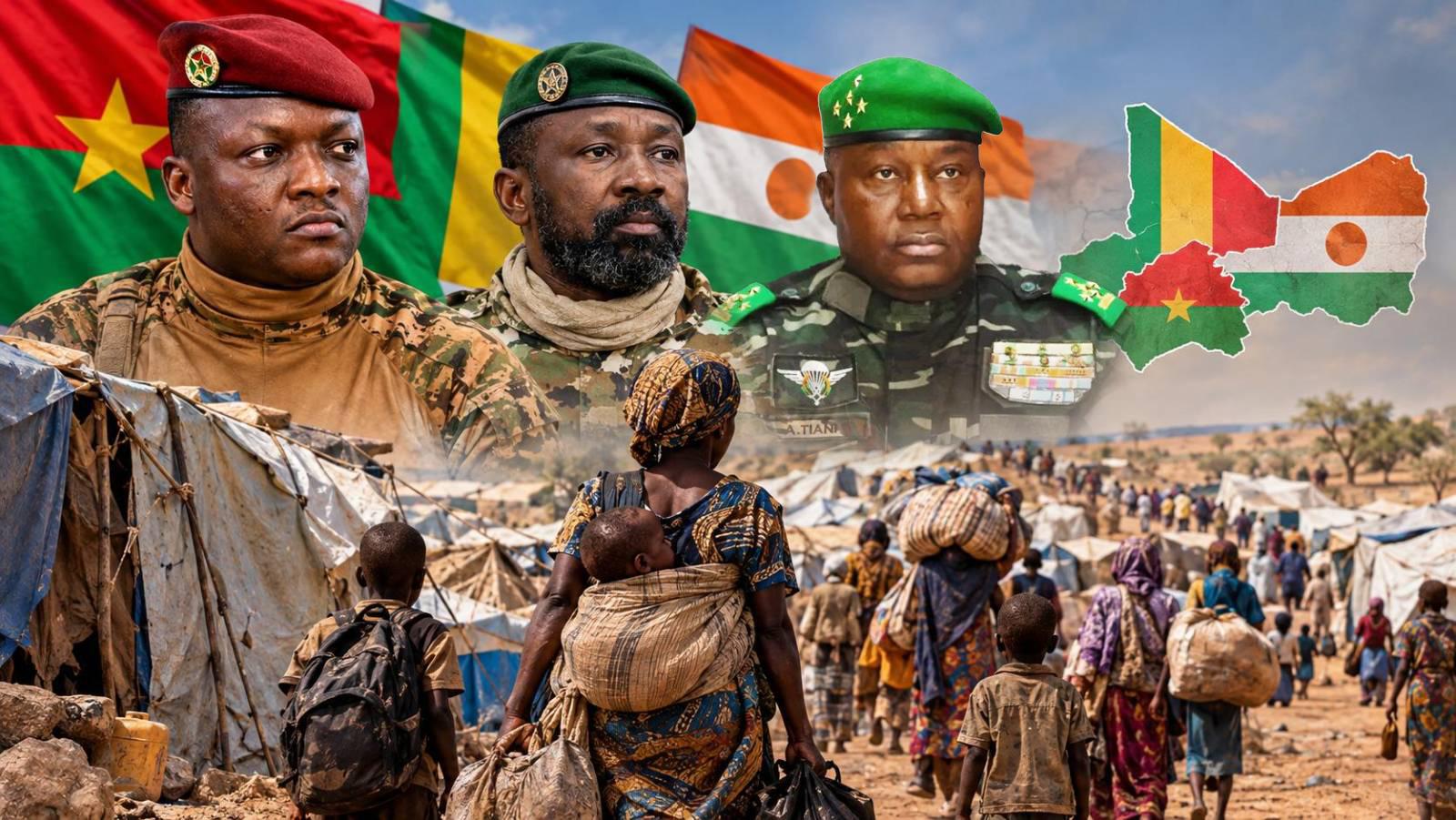

From promises to displacement: the Sahel’s humanitarian inflection point
The Sahel region stands at a critical juncture. With nearly 4 million people forcibly displaced across Burkina Faso, Mali, and Niger, the humanitarian toll of ongoing conflict has reached unprecedented levels. This staggering figure represents nearly double the number recorded in 2020, a year that marked the beginning of a series of military takeovers in the region.
For the Alliance of Sahel States (AES), the escalation of forced displacement forces a reckoning between rhetoric and reality. While governments emphasize territorial recovery and security restoration as pillars of their legitimacy, the unrelenting growth in displacement underscores a grim disconnect. Behind the official declarations lie millions of individuals who have lost homes, livelihoods, and community ties due to relentless violence.
The human cost behind the numbers
The 4 million displaced individuals are not mere statistics. Each person represents a family torn from its roots, children deprived of stability, and communities shattered by insecurity. The mass exodus primarily driven by attacks from non-state armed groups has forced entire populations to flee agricultural lands and economic hubs, deepening vulnerability and poverty.
The crisis has evolved into a structural humanitarian challenge. Displaced families face daunting barriers to access essential services, including healthcare, education, and food security. The strain on local resources in host communities has compounded the challenge, leaving countless individuals in protracted states of displacement with little prospect of return or resettlement.
When sovereignty meets reality: assessing AES priorities
Since the military-led transitions in Burkina Faso, Mali, and Niger, governments have framed their rule as a necessary response to insecurity and a path to sovereignty. The discourse has been dominated by narratives of territorial control, security operations, and political sovereignty. Yet the persistent rise in displacement rates raises a critical question: how do governments reconcile bold declarations with the unabated expansion of forced displacement?
Military interventions, while intended to restore order, have yet to translate into tangible improvements for affected populations. Security gains in one area are often offset by escalation in others, leaving communities in a perpetual cycle of displacement and uncertainty. The focus on sovereignty, when unaccompanied by inclusive humanitarian strategies, risks overshadowing the urgent needs of the displaced.
This dissonance between stated goals and ground realities demands closer scrutiny. Governments must move beyond symbolic actions and address the structural causes of displacement ensuring not only physical safety but also access to basic services and economic opportunities for those uprooted.
Humanitarian action in the balance: beyond rhetoric
No amount of political messaging can substitute for meaningful humanitarian intervention. Displacement in the Sahel is not merely a consequence of conflict it is a crisis sustained by inadequate responses and misaligned priorities. While governments invest in military campaigns and political messaging, the displaced continue to face dire conditions without durable solutions in sight.
The international community’s role, too, remains pivotal. Aid agencies and partners must scale up support to meet the region’s growing humanitarian needs, prioritizing protection, shelter, and livelihood recovery. Coordination with local and regional actors is essential to ensure that aid reaches those most in need and aligns with the long-term needs of affected communities.
The moment demands decisive action not just declarations of intent. The Sahel cannot afford another year in which displacement spirals while solutions remain elusive. For the millions displaced, sovereignty and security are not abstract ideals; they are lived realities that must be restored through concrete measures.
Key indicators of the crisis
Nearly 4 million displaced persons in Burkina Faso, Mali, and Niger, nearly double the 2020 figure.
Protracted displacement with limited prospects for safe return or resettlement.
Growing strain on host communities and public services due to mass displacement.
Persistent insecurity despite military-led efforts to restore territorial control.
By Idriss MAMADOU — Journaliste / Rédacteur
