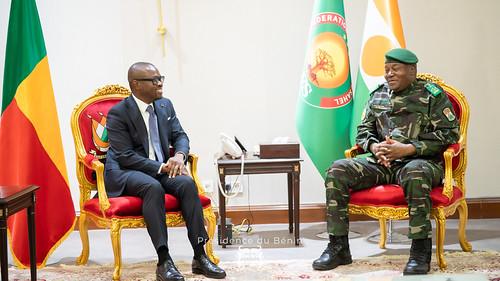

On Friday, June 19, 2026, the atmosphere at the Cotonou airport reflected a significant shift in West African diplomacy. The arrival of an official delegation from Niger, received with full protocol honors by the authorities in Bénin, marked the formal commencement of a second round of bilateral negotiations. This event represents more than just a ceremonial greeting; it is a concrete sign that the diplomatic ties between these two neighbors, once thought to be severed, are being carefully re-established.
This resumption of high-level dialogue did not happen by chance. It follows a path set during a historic face-to-face meeting in Niamey between the President of Bénin, Romuald Wadagni, and the leader of the Nigerien transition, General Abdourahamane Tiani. Both leaders recognized the urgent need to break the existing deadlock. Before today’s meeting, technical experts, career diplomats, and high-ranking military officers from both nations spent two weeks working behind closed doors to address mutual grievances and prepare a framework for political decision-makers. The primary objective is now clear: to finalize a comprehensive and lasting agreement to reopen the shared border, which has been closed following the political shifts in Niamey.
There is a palpable sense of urgency from both governments to move beyond hostile rhetoric and embrace a period of rigorous pragmatism. In Cotonou, those close to the negotiations describe the environment as heavy with responsibility yet deeply constructive, as the pressure from local populations and economic actors for a resolution continues to mount.
A shared economic struggle
The necessity of these talks is underscored by dramatic macroeconomic indicators that have worsened for both nations during the border closure. Because the economies of Bénin and Niger are so closely linked, the prolonged blockade has functioned as a double stranglehold, impacting both sides of the frontier simultaneously.
As a landlocked nation, Niger depends heavily on the infrastructures of the Port of Cotonou for the majority of its imports and exports. The disruption of this traditional logistical corridor has left Nigerien transporters and merchants in Niamey in a desperate situation. To bypass the Bénin route, supply chains were forced through alternative regional ports, requiring long journeys over dangerous or poorly maintained tracks. This shift resulted in a massive spike in transportation costs, leading to soaring inflation in Niamey and further straining the purchasing power of a population already affected by international measures.
In Bénin, the economic fallout has been equally severe. The corridor connecting Cotonou to Niamey is a vital financial artery, supporting a major portion of the country’s port activity. The sudden halt in transit has led to a sharp decline in customs revenue, which is essential for funding national development projects. Beyond the statistics, the stoppage has devastated a socio-economic ecosystem that relies on cross-border traffic. From large logistics firms to informal roadside vendors and restaurant owners, thousands of families have seen their livelihoods disappear. For them, reopening the road is no longer just a political matter but a question of daily survival.
Security and sovereignty at the heart of the deadlock
While economic distress is driving the delegations toward a compromise, the core of the dispute remains tied to national security and state sovereignty. Since the National Council for the Safeguard of the Homeland (CNSP) took power in Niamey, the military authorities have maintained a strict doctrine: economic needs will not be prioritized over territorial security or the stability of the transitional institutions.
Consequently, the discussions in the economic capital of Bénin are focusing on highly sensitive geopolitical issues. Negotiators are tasked with establishing rigorous controls over the Niger River, a natural border that has seen complex security challenges. Another critical point involves creating joint surveillance protocols along the land border to prevent the movement of armed terrorist groups active in the Sahel region. Niamey has frequently expressed concerns that a porous border could be exploited to destabilize its territory. To address these fears, the delegation from Bénin must offer credible guarantees, including mechanisms for real-time military and security intelligence sharing.
The challenge for the experts in Cotonou is to design a new border management model—one that is secure against asymmetric threats and illicit trafficking while remaining fluid enough for legitimate trade. Balancing state sovereignty with the pragmatic economic needs of the people is the essential key to these negotiations.
Analysis: A shift in regional dynamics
This prolonged engagement in Cotonou illustrates that Realpolitik and geography eventually outweigh ideological stances. While the crisis originated from sanctions following the change of government in Niamey, the resulting blockade has highlighted the fundamental interdependence of these two nations. Providing on the ground Sahel insights, this meeting suggests that a simple return to the status quo is unlikely.
Mutual trust has been shaken, and any eventual agreement will likely form the basis of a redefined bilateral relationship. This new partnership will be characterized by increased vigilance and stricter controls, but also by the realization that neither nation can thrive in isolation. International partners and neighboring countries are watching the outcome closely, as the Cotonou-Niamey axis is a central component of regional economic integration. The resolution of this crisis will serve as a benchmark for how states in the region handle Sahel current affairs and political differences to protect economic stability and social peace.