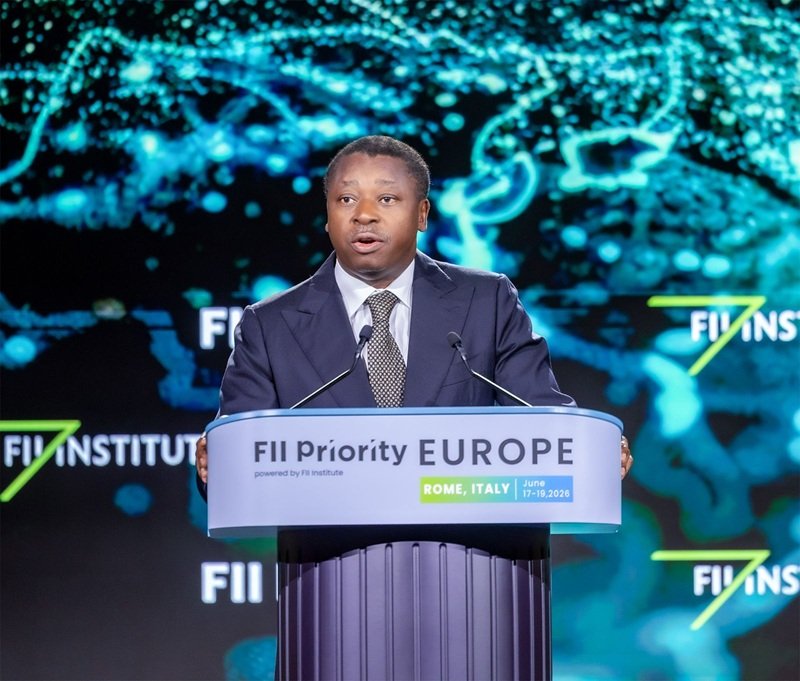

President Faure Essozimna Gnassingbé has been participating in the FII PRIORITY Europe summit since June 18, 2026. This high-level assembly is dedicated to addressing the financing of reindustrialization, the resilience of global supply chains, and the shifting nature of work in the era of artificial intelligence.
Speaking at this international forum, the Togolese leader advocated for a fundamental restructuring of the relationship between Europe and Africa. He called for a shift toward shared strategic interests, productive investment, and a more effective management of economic interdependences.
Faure Gnassingbé urges a move away from traditional cooperation frameworks
During his address, the President emphasized that the challenges facing both Europe and Africa have become increasingly similar within a global landscape defined by geopolitical tensions and fierce economic competition.
He argued that the classic models based on aid or traditional cooperation are no longer suited to today’s realities.

“It is no longer about discussing aid or conventional cooperation, but about establishing a more balanced strategic relationship between Europe and Africa,” he stated.
For the Togolese head of state, both continents must develop partnerships capable of addressing modern requirements for economic, energy, and technological sovereignty.
Strategic autonomy through managed interdependence
Faure Gnassingbé also shared his perspective on strategic autonomy, which he views not as a move toward isolationism, but as a more structured organization of economic ties between nations.
He noted that recent global crises have highlighted the necessity of interdependence, provided these links are more secure, equitable, and predictable.
The President believes that Europe and Africa possess natural complementarities that can drive the creation of a new cooperation model.
Europe-Africa: towards a mutually beneficial partnership
The Togolese leader reminded the audience that while Europe seeks reliable partners to secure its supply chains and boost competitiveness, Africa requires capital, technology, and infrastructure to speed up its economic transformation.
“These requirements are not in conflict. They can strengthen one another,” he affirmed.
For Faure Gnassingbé, the Euro-African partnership should be viewed as a convergence of strategic goals that benefit both regions.
Togo aims to solidify its position as a West African logistics hub
Turning to Togo’s national strategy, the President reaffirmed the country’s goal of becoming a premier logistics, industrial, and commercial hub in West Africa.
This roadmap is built on several key pillars:
- Modernizing the Port of Lomé;
- Developing regional transport corridors;
- Streamlining trade facilitation;
- Digitalizing administrative procedures.
According to the President, these infrastructure developments do not only benefit Togo but also contribute to the economic resilience of the entire sub-region.
An Africa focused on production and value creation
Faure Gnassingbé stressed Africa’s commitment to moving beyond its historical role as a supplier of raw materials.
The continent, he pointed out, aims to transform into a space for production, processing, and innovation, capable of generating significant local value.
He added that a more industrialized and integrated Africa would represent a major opportunity for Europe and international investors alike.
Togo boosts its profile among global investors
Beyond the strategic discussions, Togo’s presence at the FII PRIORITY Europe summit serves as a platform to showcase the country’s logistical, industrial, and financial strengths to global economic leaders.
For Lomé, this international engagement is part of a broader effort to attract more investment, establish transformative partnerships, and reinforce its standing as a regional economic hub.
The summit brought together several prominent figures, including Yasir ben Othman Al-Rumayyan, Chairman of the Future Investment Initiative Institute, and Richard Attias, the founder and CEO of the institution, alongside political leaders and major international financial stakeholders.