
France demonstrates decisive nuclear deterrence shift amid rising European tensions
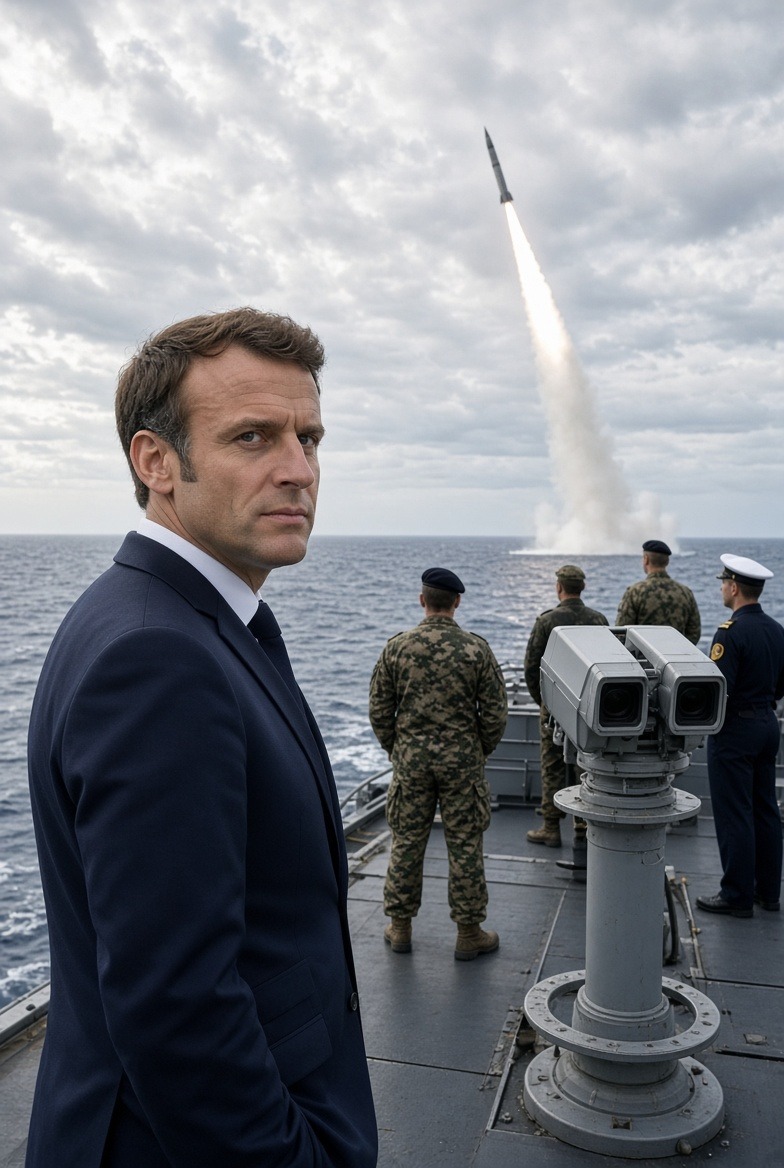
The maiden launch of the M51.3 ballistic missile from the nuclear-powered submarine Le Vigilant marks a decisive turning point in France’s strategic defense posture. Observed firsthand by President Emmanuel Macron aboard the Auvergne multi-mission frigate, the test—conducted October 6, 2026, off the coast of Finistère—validated the upgraded missile’s operational readiness after maintenance. Without a nuclear payload, the trajectory was tracked by Direction générale de l’armement assets, including the Monge trials vessel.
This technological demonstration underscores France’s commitment to maintaining a credible nuclear deterrent in an era of escalating military uncertainty across Europe. The M51.3, now fully operational since October 2025, enhances the nation’s submarine-launched ballistic missile fleet with improved range, precision, and penetration capabilities against evolving anti-missile defenses.
Europe’s shifting security landscape demands stronger deterrence
The M51.3 test coincides with a period of heightened instability across the continent. Since Russia’s 2022 invasion of Ukraine, NATO has documented an alarming increase in provocative military actions—from airspace violations and drone incursions to cyberattacks and sabotage. Recent incidents, including Russian-linked drone incursions in Lithuania and Poland, as well as joint Swedish-Finnish fighter intercepts over the Gulf of Finland, have intensified regional vigilance.
In response, NATO expanded its Eastern Sentry operation in 2025 to bolster airspace surveillance with integrated fighter jets, missile defense systems, and maritime patrol assets. While Alliance leaders deny an imminent direct conflict with Russia, they emphasize that any aggression against a member state would require visible military preparations—prompting Europe to adopt a proactive, multi-domain defense strategy.
From Black Sea to Baltics: a new era of hybrid threats
The evolving threat matrix extends beyond traditional warfare. In the Black Sea, maritime attacks—such as the October 6 sinking of a Togolese-flagged vessel off Bulgaria and a prior drone strike—have highlighted vulnerabilities in regional security. Though attribution remains contested, the incidents reflect a broader shift: modern conflicts increasingly leverage inexpensive drones, cyber intrusions, and infrastructure sabotage alongside conventional forces.
France’s nuclear modernization aligns with this reality. The M51.3’s enhanced capabilities address not only Russia’s growing anti-access/area-denial systems but also the proliferation of asymmetric threats. As Macron has stated, “Freedom requires deterrence; deterrence requires power.” This doctrine prioritizes autonomous strategic autonomy, ensuring France can act decisively without relying solely on allied guarantees.
France’s nuclear triad: pillars of a resilient deterrent
The submarine-launched M51.3 complements France’s dual-component deterrent: oceanic and aerial. Nuclear-powered ballistic missile submarines (SSBNs) like Le Vigilant provide survivable second-strike capacity, while ongoing programs—including a future hypersonic glide vehicle—aim to modernize the airborne leg. Over the past decade, defense investment has doubled, with next-gen SSBNs under construction and advanced missile programs in development.
This transformation reflects a strategic pivot: from Cold War-era deterrence to a 21st-century framework capable of countering hybrid warfare, cyber threats, and emerging technologies. For Macron, the M51.3 test is more than a technical achievement—it’s a statement that France will maintain a decisive voice in Europe’s security architecture, regardless of external pressures.
Looking ahead: deterrence in a fragmented world
The broader implications of the M51.3 test extend beyond military hardware. As NATO reinforces its eastern flank and Russia’s war in Ukraine grinds on, Europe faces a paradox: preparation does not equate to inevitability of war, but complacency invites risk. France’s approach prioritizes resilience—balancing conventional strength, European cooperation, and national strategic autonomy.
In this climate, the M51.3 isn’t just a missile; it’s a symbol of France’s resolve to deter aggression while navigating an increasingly volatile security environment. The question Europe now faces isn’t whether to prepare for crisis—but how far to go to prevent escalation into open conflict.