
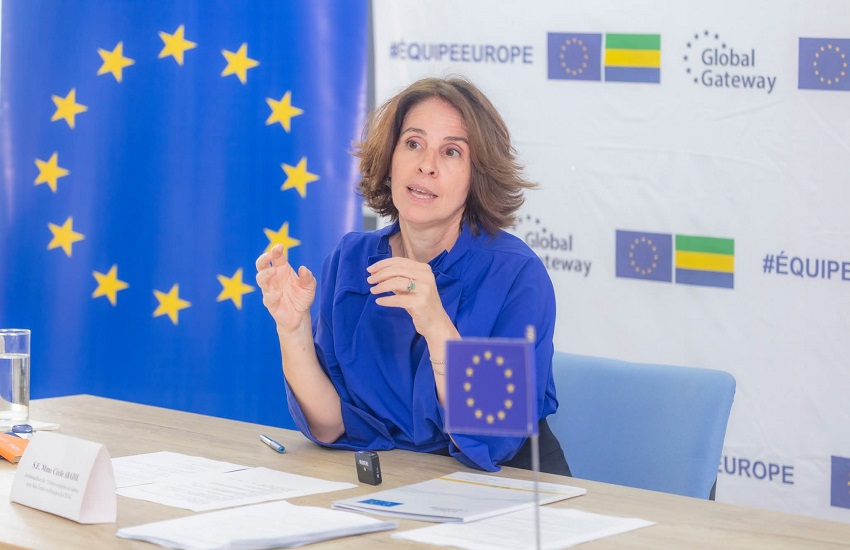
Libreville, June 8, 2026 – The second round of political dialogue between Gabon and the European Union, held in Libreville today, transcends conventional diplomatic exchanges. Beyond the formal speeches and institutional consultations lies a far-reaching ambition.
For Gabon, this marks an effort to convert its restored political stability into an economic transformation lever. Meanwhile, the European Union seeks to redefine its African presence through partnerships focused on investment, value creation, and shared sovereignty.
In a world shaped by geopolitical rivalries, competition for strategic resources, and shifting international alliances, this dialogue sends a powerful signal. Gabon’s Fifth Republic no longer positions itself merely as a diplomatic partner but as an economic player capable of attracting capital, modernizing its administration, and building growth rooted in local resource transformation.
Opening the proceedings at the Palais des Congrès de la Cité de la Démocratie, Vice-President of the Government Hermann Immongault set the tone by emphasizing the shared commitment to strengthening cooperation rooted in multilateralism, peace, security, and sustainable development. This reflects Gabon’s new diplomatic doctrine: an economic diplomacy driven by tangible results.
A partnership taking on new dimensions
Historically, Gabon and the European Union’s relationship centered on political exchanges, development aid, and technical cooperation. Today’s session signals a significant shift.
The EU delegation leader highlighted that the proposed partnership aligns with a multilateral approach aimed at building a shared economic agenda. This reflects a profound evolution in Europe’s strategy toward Africa.
Facing the rise of new international partners from Asia and the Middle East, Brussels now aims to position itself as an investment catalyst rather than just a donor. For Gabon, this shift opens fresh opportunities in infrastructure, industrial transformation, energy, and economic diversification.
The stakes are high. Gabon seeks to gradually reduce its dependence on raw commodity exports by developing high-value-added sectors capable of generating more jobs and wealth domestically.
The Fifth Republic at the reform test
This meeting occurs at a pivotal moment. Since President Brice Clotaire Oligui Nguema’s election and the establishment of the Fifth Republic, Gabon has embarked on sweeping institutional and economic reforms.
Discussions with European representatives will focus on political reforms, governance, the rule of law, the business environment, and administrative modernization—key areas for boosting the country’s economic appeal.
Foreign Minister Marie Edith Tassyla Doumbeneny emphasized that the talks will also assess all aspects of relations between Libreville and Brussels, both at the EU level and through bilateral partnerships with member states.
The Samoa Agreement, now framing this cooperation, prioritizes good governance, sustainable development, energy transition, and economic resilience—directly aligning with Gabon’s stated objectives.
In this context, political dialogue becomes a tool supporting the national transformation strategy launched in 2023.
Gabon aims to become a regional investment hub
A defining feature of this meeting is Gabon’s shifting international posture. The nation is no longer merely seeking financial support but actively pursuing productive investments to accelerate its economic transformation. Priority sectors include forestry, mining, infrastructure, agriculture, digital technology, and renewable energy.
Sustainable natural resource management also takes center stage. Internationally recognized for its role in preserving the Congo Basin forests, Gabon seeks to turn its environmental assets into drivers of sustainable growth while reinforcing its position in international climate negotiations.
This aligns with a broader vision of economic sovereignty. As Hermann Immongault noted, this dialogue represents a true exercise in economic diplomacy where Gabon advocates for its strategic priorities with consistency.
The significance of this meeting lies not just in declarations but in its potential to yield tangible outcomes. The partnership’s credibility will now be measured by mobilized investments, supported reforms, and completed projects.
The Gabon-EU dialogue stands as one of the Fifth Republic’s first major international engagements. It symbolizes Libreville’s determination to transform its regained political capital into an engine for economic development. In an increasingly competitive global environment, Gabon is choosing measured openness, strategic partnerships, and investment as catalysts for its emergence. An ambition that could reshape its standing within African and global economies.