
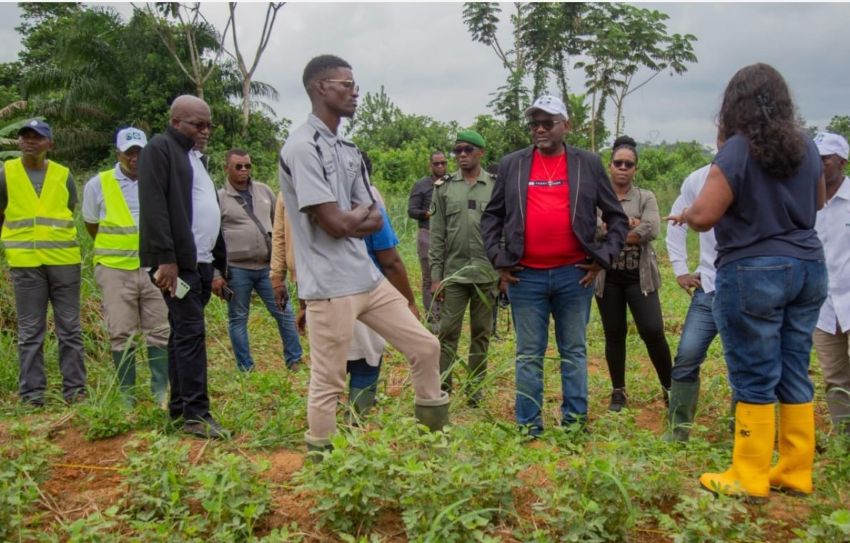
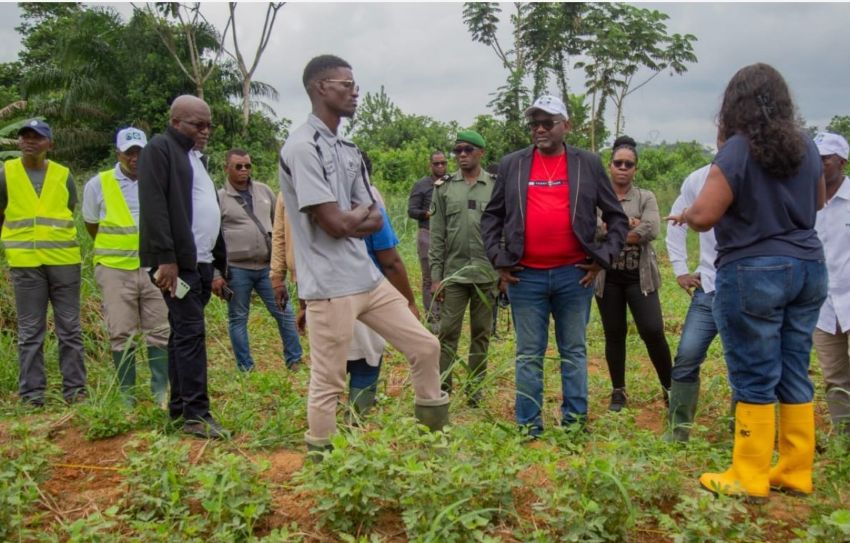
Libreville, Monday June 8, 2026 — A bold new chapter is unfolding in Gabon’s economic strategy. While the nation aims to slash its food import dependency and eliminate foreign poultry imports by 2027, the real battle is being fought not in markets or ports, but in the experimental fields of the National Center for Scientific and Technological Research at Kougouleu.
The visit by Minister of Higher Education, Scientific Research and Government Spokesperson Charles Edgar Mombo to this strategic site represents more than an administrative inspection. It signals a fundamental shift where scientific research becomes a direct driver of economic transformation and a pillar of national sovereignty.
With food imports still consuming a significant portion of the country’s foreign expenditure, the ability to locally produce essential livestock feed ingredients has emerged as a strategic priority—one as vital as mining or energy development.
Research as a national engine
The government’s clear objective: to build a robust poultry sector capable of meeting domestic demand while gradually reducing reliance on imports. At the heart of this ambition lies animal feed production, where maize and soybeans form the backbone of industrial poultry nutrition.
Until these key ingredients can be produced locally, the sector’s self-sufficiency remains precarious. That’s why researchers at CENAREST are conducting groundbreaking trials on eleven maize varieties specifically selected for Gabon’s unique soil and climate conditions. The goal is to identify high-yield seeds that can sustainably fuel the nation’s expanding poultry industry.
Complementing this work, eleven soybean varieties imported through international research cooperation with centers in Malawi are now being tested in Nyanga province, particularly around Tchibanga. These parallel experiments across different ecological zones aim to determine optimal crop performance under varied local conditions.
This marks a historic shift. Once viewed as disconnected from immediate economic concerns, scientific research has now become an operational force in national development.
Building an integrated agricultural value chain
The government’s strategy rests on a clear principle: produce essential inputs domestically to lower production costs and enhance the competitiveness of Gabonese farmers. This approach mirrors trends seen across Africa, where reliance on food imports remains one of the continent’s most pressing economic vulnerabilities.
Gabon, however, possesses remarkable natural advantages—fertile land, abundant water resources and favorable climatic conditions for multiple crops. Minister Mombo’s recent visit confirmed these strengths firsthand. He praised the dedication of local researchers and highlighted the nation’s higher education system’s capacity to support the president’s strategic vision.
Beyond agricultural output, this initiative carries profound political significance. Science is no longer confined to knowledge creation; it is now expected to deliver tangible solutions to national priorities.
The road ahead: challenges and opportunities
While progress is promising, critical hurdles remain. Researchers emphasize the need to expand experimental farmland to improve trial quality and scale up production volumes. The transition from laboratory success to industrial-scale farming often proves the most challenging phase.
Financial considerations loom large as well. Agricultural modernization demands substantial investment in infrastructure, accessible financing mechanisms and better-organized value chains. Yet for the first time in decades, Gabon appears to be aligning research, agriculture, industry and economic sovereignty into a coherent national strategy.
Minister Mombo’s visit to Kougouleu embodies this paradigm shift. In the government’s new vision, food independence will not result merely from policy or investment—it will emerge from laboratories, research centers and scientific innovation.
By 2027, if targets are met, Gabon may prove that in Africa, food sovereignty is forged as much in research labs as in farm fields—a quiet revolution with potential to reshape the nation’s economic future.