
General Tiani in a bind: shadowy negotiations and fragile ranks in Niger
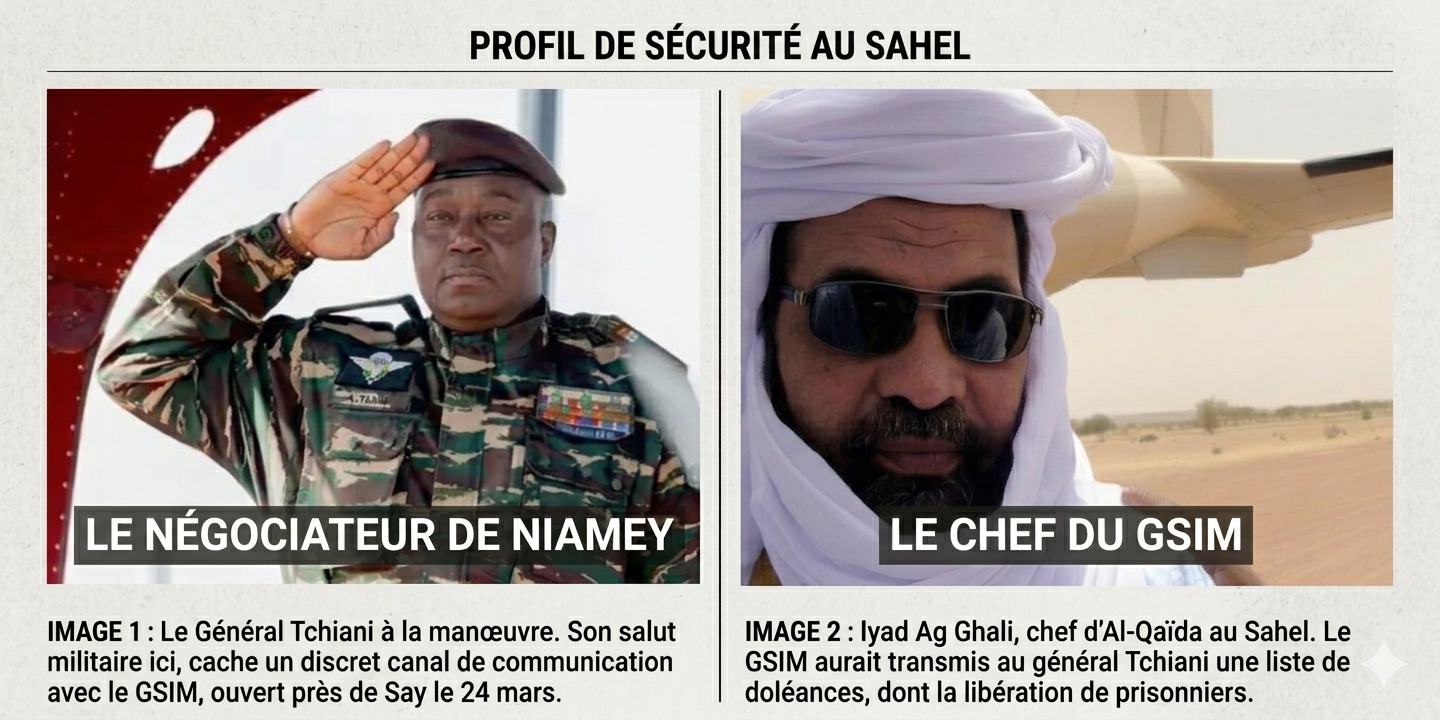
Facing a multifaceted terrorist threat and simmering discontent within his own ranks, General Abdourahamane Tiani is attempting a last-ditch maneuver. Between secret talks in Say with the GSIM and a forceful reassertion of control over the military hierarchy, the head of Niger’s transition is navigating treacherous waters to prevent the capital from being strangled.
the say channel: a costly tactical realism
The confidential meeting on March 24 near Say marks a major turning point. By dispatching a delegation of four emissaries to the Group for the Support of Islam and Muslims (GSIM), General Tiani is abandoning the stance of “absolute firmness” to embrace a realism of survival.
An analysis of the facts reveals two strategic pillars:
- Prioritizing the enemy: Faced with the EIGS (Islamic State in the Greater Sahara), whose radicalism was demonstrated by the attack on Diori-Hamani airport last January, the junta seeks to “neutralize” the GSIM through dialogue. The idea is to transform a draining triangular conflict into a more manageable bilateral front.
- The specter of the Bamako blockade: Niger is watching with concern the situation in Mali, where the GSIM is trying to suffocate the capital. By discussing the grievances of the Katiba Hanifa (release of prisoners, payment of an annual tithe), Niamey hopes to secure a vital logistical respite.
unease beneath the kepis: the ticking time bomb of pay
However, no high-level strategy can hold without a united troop. The recent dismissal of the head of the Security and Intelligence Battalion (BSR) in Tahoua, following complaints about pay (800 CFA francs received instead of 1,200), reveals a deep structural flaw.
This elite unit, once a pillar of cooperation with US special forces before their forced departure in 2024, today symbolizes the disarray of an army that must face budget cuts and internal logistical problems. Colonel Mamane Sani Kiaou, Chief of Staff of the Army, had to intervene in person to put out the fire, proving that the internal threat is at least as formidable as the jihadist threat.
the security vacuum and the geopolitical pivot
The intensification of these secret negotiations is part of a context of profound changes in alliances. Since the departure of French and American troops, Niger has turned to the Alliance of Sahel States (AES) and new partners such as Russia and Turkey.
However, despite the arrival of military advisers and new equipment (including surveillance drones), the terrain remains difficult. The lack of high-precision aerial intelligence sharing, formerly provided by Base 101 in Niamey and Agadez, now forces the junta to reinvent field diplomacy with those it fought yesterday.
the paradox of continuity: the shadow of mohamed bazoum
The supreme irony lies in the involuntary mimicry of the former regime’s strategy. While the coup d’état of July 26, 2023 was officially justified by the “security failure” of Mohamed Bazoum, General Tiani finds himself forced to use the same levers: negotiation as a component of counter-insurgency.
But where Bazoum assumed this aspect of dialogue to free hostages (such as the nun Suellen Tennyson), the current junta must operate in secrecy, for fear that this dialogue will be perceived by its most radical supporters — and its AES allies — as an admission of weakness in the face of Al-Qaeda.
The Niamey regime is today at a crossroads. Negotiating with the GSIM to isolate the EIGS is a rational calculation, but extremely politically perilous. By agreeing to discuss on the basis of “tithes” or “withdrawal from zones”, the junta takes the risk of permanently legitimizing armed groups. For General Tiani, the hardest part is no longer taking power, but maintaining the cohesion of an army that is beginning to count its pennies while the enemy counts its conquests.