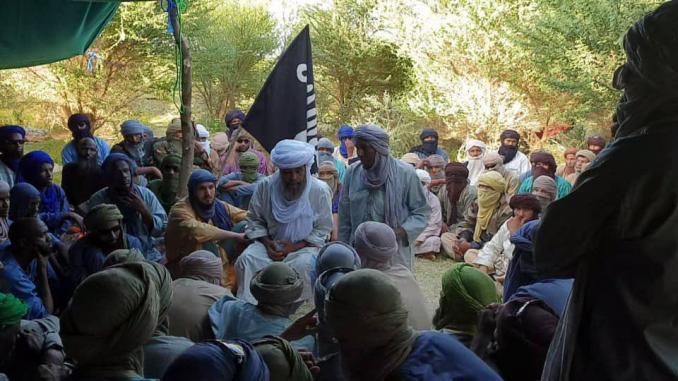

The Group for the Support of Islam and Muslims (JNIM), an Al-Qaïda-linked militant faction, is rapidly expanding its influence across Mali, raising alarm over its potential to gain near-total territorial control. Recent attacks, including ambushes on military convoys and assaults on remote outposts, underscore the group’s growing operational capacity despite ongoing counterterrorism efforts by Bamako and international allies.
The escalation extends beyond Mali, casting a shadow over the entire Sahel region. With fragile governments and deepening economic crises, neighboring nations face mounting risks as jihadist networks deepen their roots. The threat isn’t confined to sporadic violence—it’s morphing into a systemic challenge that could destabilize West Africa’s second-tier states.
JNIM’s quiet territorial takeover
Residents and local officials report that JNIM is no longer just a shadowy insurgent force but a de facto administrator in some areas. In Bandiagara, a central region of Mali, five villages were struck this week in coordinated raids. While casualties remain unconfirmed, the group’s claim of responsibility signals a deliberate push to assert dominance.
Unlike traditional insurgencies, JNIM blends military strikes with governance tactics. It exploits local grievances—ethnic tensions, weak state presence, and economic despair—to embed itself as an alternative authority. In rural zones where government services vanish, the group imposes its own rules: taxing movement, mediating disputes, and enforcing parallel justice systems. This dual strategy makes military victories fleeting; without rebuilding state institutions, security gains are temporary.
A shifting security landscape in Mali
Mali’s military leadership has pivoted away from Western security partnerships, embracing a sovereignty-first doctrine since the withdrawal of French forces and the arrival of Russian-backed Wagner affiliates. Officials tout this as a bold step toward self-reliance, yet violence persists unabated. Armed groups continue to exploit porous borders and fractured state structures, while accusations of human rights abuses involving allied forces further complicate the crisis.
Bamako dismisses criticism as foreign interference, framing it as part of a coordinated campaign to undermine its legitimacy. But the erosion of political mediation creates a vacuum that militant factions are quick to fill. As international support wanes and mercenary groups like Africa Corps recede, the question looms: what happens when external security umbrellas lift?
Geopolitical chessboard in the Sahel
The Sahel has become a battleground for global powers. Russia, Turkey, the UAE, and Western states vie for influence, while regional actors maneuver to protect their interests. This geopolitical fragmentation weakens collective responses to terrorism, allowing militant networks to thrive amid closed borders and collapsing regional cooperation.
The danger isn’t just escalating violence—it’s the normalization of instability. Entire swaths of Mali now exist in a precarious balance where neither the state nor armed groups fully control the territory. The juncture is critical: will the country’s leadership confront the roots of this crisis, or will the JNIM and its allies continue to carve out unchallenged zones of influence?
— Field report from Bamako