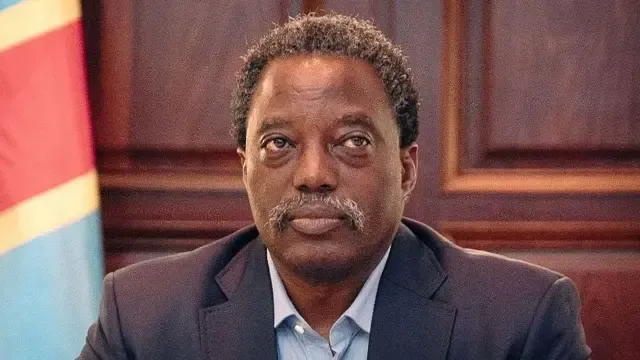

Joseph Kabila, former President of the Democratic Republic of Congo (DRC), has taken a bold step forward by assuming leadership of the Front for the Rebirth of the Nation (FRN), a newly formed politico-military coalition unveiled in Goma, eastern DRC, on October 12. The announcement signals a significant turning point in the country’s ongoing power struggle, as the FRN brings together key figures from the Congo River Alliance (AFC) and the M23 rebel group in a unified push against President Félix Tshisekedi’s government.
The coalition’s formation was revealed during a press conference led by Claude Ibalanky, a senior advisor to the movement. According to FRN leaders, the alliance aims to consolidate resistance forces and dismantle what they describe as a « tyrannical regime, » vowing to achieve this « through all necessary means, including force. » While the proclamation underscores a direct challenge to Kinshasa’s authority, specifics regarding military strategy or timelines remain notably absent.
Restructuring the opposition: new leadership, new strategy
The FRN’s leadership team reads like a who’s who of opposition figures. Joseph Kabila takes the helm as president, flanked by vice presidents Corneille Nangaa—a former head of the Independent National Electoral Commission and leader of the AFC—and Bertrand Bisimwa, a prominent political figure within the M23. Military command falls to General Sultani Makenga, chief of the M23’s armed wing, who now heads the Revolutionary Congolese Army’s general staff. Freddy Rukema Kaniki serves as the coalition’s secretary-general.
This reshuffling marks more than just a change in leadership—it represents a deliberate realignment under the FRN’s banner. The coalition’s founding declaration explicitly states that the FRN replaces the AFC, effectively dissolving the alliance and consolidating its factions under a single structure. The M23’s position within the new framework, however, remains ambiguously defined, with no separate clarification offered in the coalition’s foundational document.
A coalition of grievances: economic, political, and social fractures
The FRN’s manifesto is a scathing indictment of Kinshasa’s governance. In a sweeping condemnation, the coalition accuses the Tshisekedi administration of systemic institutional decay, rampant corruption, and deliberate marginalization. These allegations, though unproven, underscore the coalition’s resolve to challenge the legitimacy of the 2023 election outcome, which brought Tshisekedi to power. The movement’s declaration stops short of detailing how these grievances will translate into action, leaving observers to question the coalition’s next moves.
Amid conflict and stalled diplomacy
The FRN’s emergence coincides with a precarious moment in eastern DRC’s decade-long conflict. The M23 and its political counterpart, the AFC, currently exert control over critical territories, including Goma, which fell to rebel forces in a dramatic 2025 offensive. While the UN and Western governments have accused Rwanda of backing the M23—a claim Kigali vehemently denies—the coalition’s formation further complicates efforts to broker peace. Diplomatic initiatives, such as those pursued in Doha or through Kinshasa-Kigali talks, now face even steeper hurdles as the FRN vows to escalate its resistance.
Kabila’s leadership of the FRN also reignites longstanding controversies. The former president, who governed the DRC from 2001 to 2019, has consistently denied ties to the M23, despite Kinshasa’s repeated allegations of his involvement. In 2025, Kabila was sentenced to death in absentia by a military tribunal on charges of treason, war crimes, and rebellion—charges he dismisses as politically motivated. The timing of his FRN appointment, coupled with the coalition’s aggressive rhetoric, places him at the center of a crisis that threatens to unravel the fragile balance of power in the region.
Unanswered questions and looming threats
While the FRN’s declaration raises alarms, critical uncertainties remain unaddressed. The coalition’s military strategy, the operational role of the M23 within the new structure, and the potential fallout for ongoing peace negotiations all hang in the balance. Most pressing is whether the FRN will succeed in uniting disparate factions under a cohesive vision—or if it will fracture under the weight of its own ambitions. As Kinshasa grapples with this newfound challenge, the DRC stands at a crossroads, where the FRN’s actions could either ignite a wider conflagration or force long-overdue accountability.