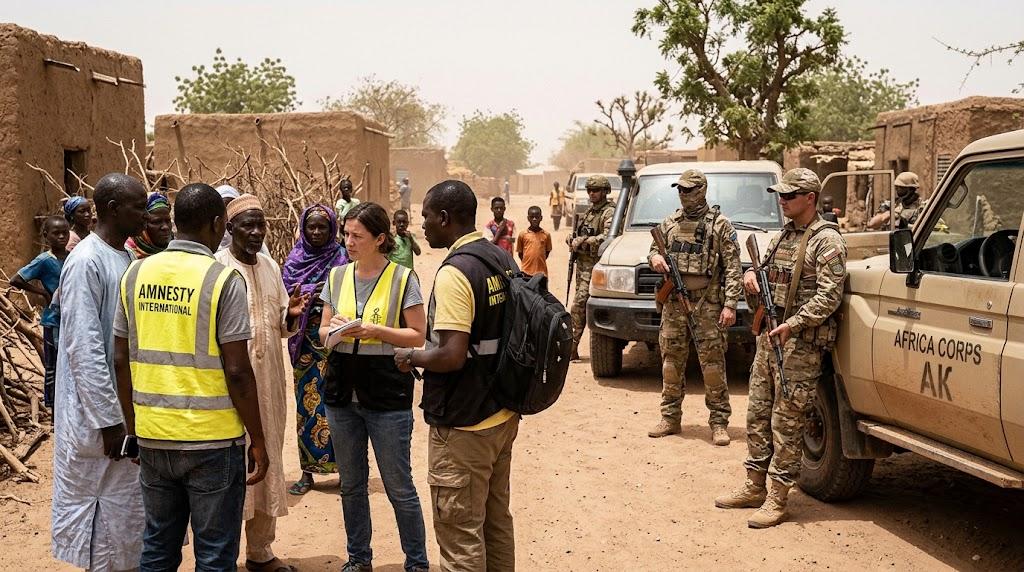

As Mali’s military landscape undergoes a significant transformation with the transition from Wagner to Africa Corps, a disturbing pattern of human rights violations persists across critical conflict zones. New evidence suggests that civilian harm, torture, and arbitrary detentions have not only continued but may have been perpetrated by forces operating under the new structure. The shift in security partnerships was expected to mark a turning point, yet the reality on the ground appears to reinforce patterns of abuse that have plagued the region for years.
Civilian casualties mount in military operations
Between June 2023 and December 2025, at least 34 civilians lost their lives in seven border localities between Mali and Mauritania during joint operations involving Malian Armed Forces and former Wagner personnel. Survivors and witnesses report disturbing patterns of violence, including executions of detained individuals and civilians attempting to flee. In some cases, victims were reportedly slashed or burned alive after capture.
Drone strikes have also contributed to civilian fatalities. On March 16, 2025, an attack on a market in Ejdeir claimed 16 lives. Similarly, a November strike on a residential area in Tangata resulted in seven deaths. Investigations reveal no evidence of armed combatants or military objectives at these locations, raising serious questions about targeting protocols and accountability mechanisms.
Systematic torture and unlawful detentions documented
A grim picture emerges from detention centers in Léré and Nampala, where survivors describe harrowing accounts of torture and degrading treatment. Fifteen individuals reported being suspended by their arms, subjected to waterboarding, electrocution, and severe beatings with weapons and blunt objects. Sexual violence was also documented among the abuses.
At least five detainees died in custody due to torture or appalling detention conditions, while others endured months of isolation without access to legal representation or family contact. Disturbingly, some of these acts appear to have occurred with the involvement or presence of Malian soldiers, who failed to intervene despite witnessing the violence.
Marginalized communities bear the brunt of violence
Vulnerable ethnic groups, including the Fulani, Arab, and Tuareg communities, face disproportionate targeting under the guise of counterterrorism operations. Accusations of collaboration with armed groups, particularly the Group for the Support of Islam and Muslims (Jama’at Nusrat al-Islam wal Muslimin), have led to widespread abuses against these populations.
The report documents systematic looting of livestock, cash, jewelry, and property, alongside the destruction of homes and agricultural infrastructure. Such collective punishments exacerbate the humanitarian crisis, leaving communities grappling with displacement, food insecurity, and disrupted livelihoods.
Communities under siege: the human cost
Beyond physical violence, the psychological and economic toll on these communities is severe. Families displaced by conflict struggle to rebuild their lives, while the constant threat of violence disrupts seasonal farming and trade activities essential for survival. The erosion of trust in security forces further undermines stability in regions already ravaged by instability.
Africa Corps’ deployment: more of the same?
The formal handover from Wagner to Africa Corps in June 2025 was anticipated to bring a new era of accountability and restraint. However, fresh allegations in Bombori on July 10, 2026, paint a starkly different picture. In a Fulani neighborhood, approximately 80 men were reportedly rounded up, beaten, and interrogated about alleged ties to armed groups. Six individuals attempting to escape were shot dead, while three others were executed on the spot.
These incidents cast a shadow over Mali-Moscow cooperation, raising critical questions about the oversight of Russian personnel and the accountability of Malian authorities in joint operations. The lack of transparency surrounding these collaborations only deepens concerns about due process and the protection of civilians.
Justice remains a distant promise
Despite the gravity of the allegations, no judicial proceedings have been initiated against government forces for civilian-targeted abuses since 2023. This impunity emboldens perpetrators and silences victims, while limited access to conflict zones hampers the documentation of crimes. Without independent investigations and transparent accountability mechanisms, the cycle of violence is poised to continue unchecked.
Urgent reforms are needed to ensure that counterterrorism efforts do not trample on human rights. Authorities must prioritize impartial inquiries, prosecute those responsible for atrocities, and guarantee victims’ access to justice. The transition from Wagner to Africa Corps must mark a genuine turning point—one that prioritizes civilian protection over military expediency.