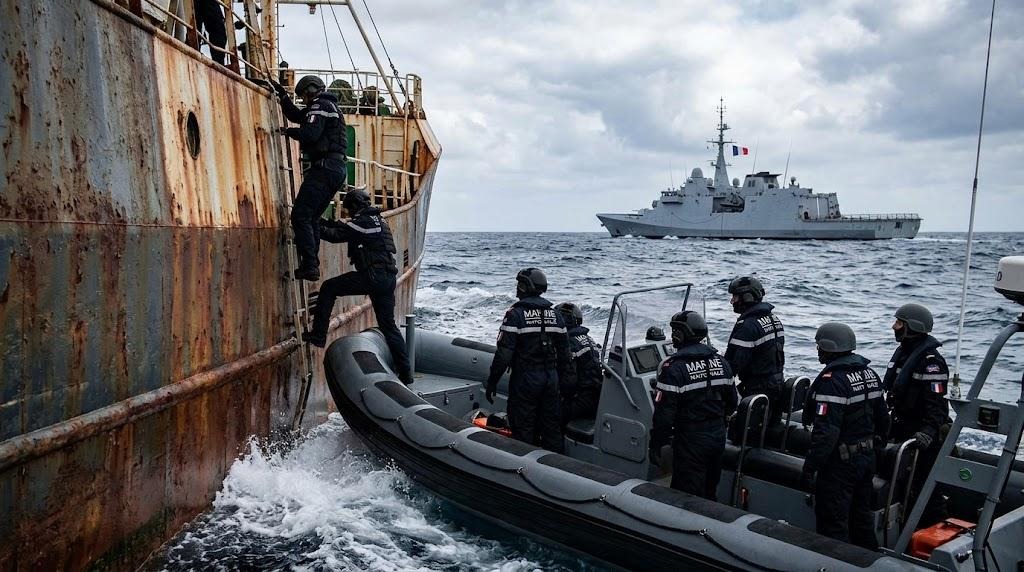

In a decisive move against illicit maritime trade, the French Navy has intercepted a suspected Russian oil tanker violating international sanctions near the Indian Ocean. The DF Peak, a 244-meter vessel, was detained at sea under suspicious circumstances, marking a critical turning point in global efforts to curb circumvention of trade restrictions imposed on Moscow.
High-seas crackdown: France seizes vessel linked to sanctions evasion network
On October 12, 2026, naval forces operating more than 450 nautical miles south of Réunion intercepted the DF Peak, a 110,000-ton tanker suspected of transporting sanctioned petroleum products. The operation, ordered by high-ranking authorities, reflects growing concerns over the so-called ghost fleet—a shadow armada used to bypass restrictions on Russian oil exports.
During the boarding inspection, French maritime officials uncovered severe irregularities regarding its Benin-flagged registration. Following requests by judicial authorities, the vessel was escorted to a secure anchorage off Réunion’s coast where further forensic and legal examinations will determine its true ownership, cargo legitimacy, and compliance with international maritime law.
Identity obfuscation: The DF Peak’s decade of name changes and false registries
The intercepted tanker is no stranger to deception. Originally launched as the NS Captain, the ship switched identities multiple times—first to Kaliningrad in 2024 under the Russian flag, then to DF Peak in 2025 under the Benin flag. Its recent voyage from Venezuela, tracked via satellite data, raised red flags due to its appearance on sanctions lists from the European Union, United States, and United Kingdom since 2024.
Ghost fleet tactics: How sanctions evaders exploit weak maritime oversight
Such vessels routinely exploit weak flag state controls, shell company structures, and in-transit cargo transfers to obscure their origin and destination. The French interception underscores the vulnerability of African maritime registries—particularly in Benin—to manipulation by illicit networks seeking to evade global trade penalties.
The legal crossroads: Benin’s sovereignty at stake over false-flag vessel
This case thrusts Benin’s maritime authority into the spotlight. Under the country’s maritime code, granting vessel nationality requires a genuine economic or operational link to national entities—such as a registered owner based in Benin or a locally incorporated shipping company. The use of a false or fraudulently obtained Beninese flag constitutes a criminal act and an affront to national sovereignty.
Analysts warn that if the vessel was registered through a front company, Benin’s authorities must immediately revoke its registry for violating safety and compliance standards. As a signatory to the United Nations Convention on the Law of the Sea (UNCLOS), Benin is legally bound to enforce rigorous oversight over ships flying its flag.
From an international law standpoint, France acted within its rights under Article 110 of the United Nations Convention on the Law of the Sea, which permits visits on the high seas when there is reasonable suspicion of a vessel sailing under a false flag or without proper nationality. Meanwhile, Benin may formally request judicial cooperation from France to investigate potential violations of its national registration laws by intermediaries or shipping agents.
Global ripple effects: Time for Benin to retool its maritime registry
The interception of the DF Peak signals a systemic challenge: sanctions on paper often fail in practice unless enforcement agencies and flag states align their efforts. For small island and coastal states like Benin, the risk of becoming a haven for legal shell games is real. In response, the government is under pressure to overhaul its maritime registration system, enhance due diligence, and strengthen real-time monitoring to prevent future exploitation.
As global regulators tighten scrutiny, the DF Peak case may serve as a catalyst for reform—one that could redefine how nations monitor and regulate vessels under their flags in an era of economic warfare at sea.