
Mali places high bounties on Iyad Ag Ghaly and other terror group leaders
Crédit photo, Getty Images
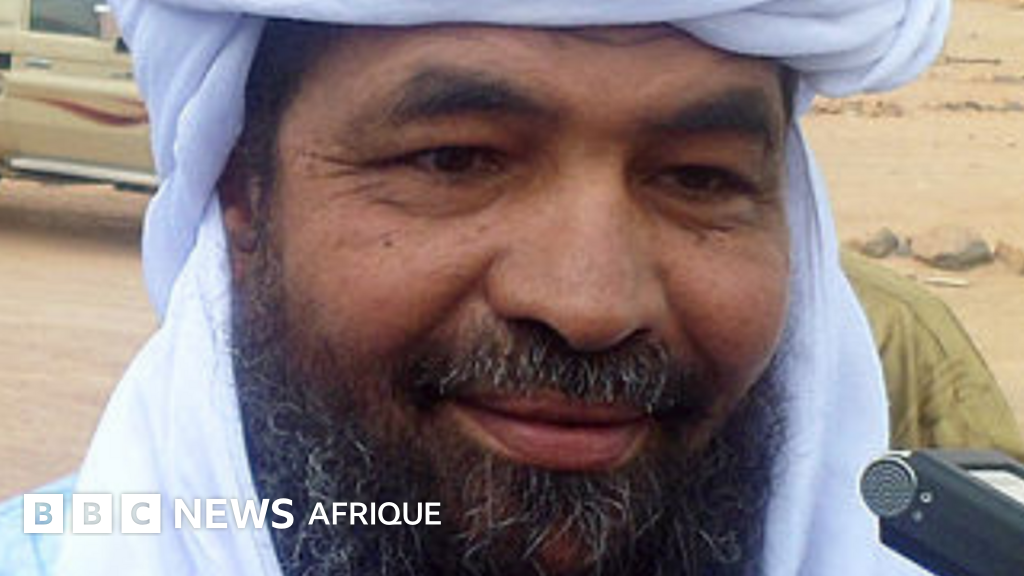
Malian authorities have announced substantial rewards, offering up to 2 billion FCFA for information leading to the capture of Iyad Ag Ghaly, the prominent leader of the Sahelian jihadist group JNIM, and several of his associates. This decisive action targets individuals allegedly involved in acts of terrorism and comes just under two months after coordinated assaults on Kidal and Kati by jihadists and separatists from the Front de libération de l’Azawad (FLA).
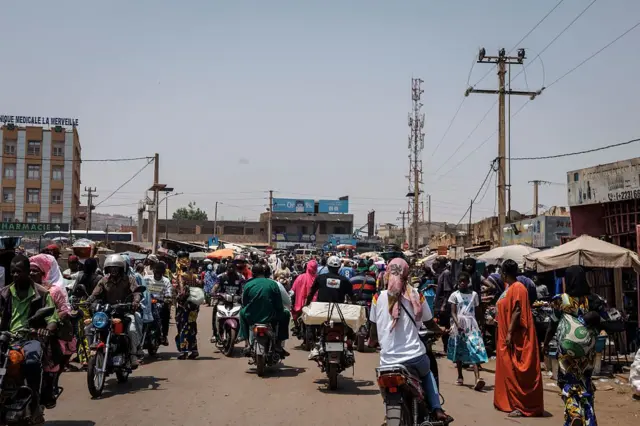
In an official statement released by Mali’s Minister of Security and Civil Protection, Major General Daoud Aly Mouhammedine, the government urged citizens to collaborate with national armed and security forces. The appeal seeks public assistance in locating seven individuals identified as significant threats to the nation’s security.
Malian authorities issue high-value rewards
Crédit photo, Getty Images
“As part of the fight against terrorism and the preservation of national security, the Government of the Republic of Mali informs the public that a financial reward is offered to anyone providing reliable, relevant, and actionable information enabling the arrest or neutralization of the individuals designated below,” read the communiqué from the Ministry of Security and Civil Protection, broadcast on state television.
The Malian government has specifically offered a reward of 2 billion FCFA for the capture of jihadist leader Iyad Ag Ghaly, who heads the Jama’at Nusrat al-Islam wal-Muslimin (JNIM), also known as the Group for the Support of Islam and Muslims (GSIM).
Additional bounties include 1.5 billion FCFA for Amadou Koufa, leader of Katiba Macina, and Abdoulaye Mohamed, also known as Habib, another figure from Katiba Macina.
Algabas Ag Intallah, a prominent political and military figure within the Front de libération de l’Azawad (FLA), has a 1 billion FCFA bounty placed on his head. Following him are three other FLA commanders—Ghita, Bilal Chérif, and Abderrahmane Al Banna—each with a 500 million FCFA reward for their apprehension.
This significant announcement follows the devastating coordinated attacks on April 25, carried out by JNIM jihadists and FLA separatists, which tragically resulted in the death of Defense Minister Sadio Camara. These events underscore the urgent need for action in the Sahel region.
Profile of Iyad Ag Ghaly
Crédit photo, Romario Ollo Hien/AFP via Getty Images
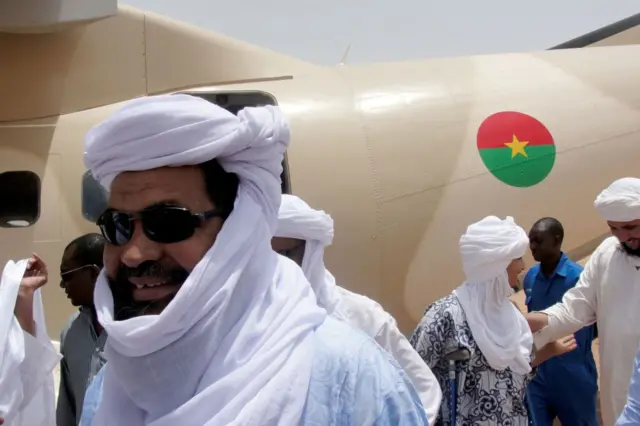
Born in 1958 in Boghassa, within Mali’s northern Kidal region, Iyad Ag Ghaly is a prominent Tuareg warlord who transitioned into a leading jihadist figure. His early years saw him seek refuge in Libya during the 1970s, where he joined Colonel Mouammar Kadhafi’s forces, participating in conflicts in Lebanon and Chad—a path many young Tuaregs of his generation took.
Upon returning to Mali in the early 1990s, Ag Ghaly founded the Mouvement populaire pour la libération de l’Azawad (MPLA), igniting the Tuareg rebellion. He later established and led the Mouvement populaire de l’Azawad (MPA), engaging in combat against the Malian state before signing a peace accord in 1992.
His trajectory shifted towards Islamism and jihadism, leading to radicalization. By 2007, he forged ties with the jihadists of the GSPC, a group that would later become Al-Qaïda in the Islamic Maghreb (AQMI). In 2012, Ag Ghaly founded the Salafist jihadist group Ansar Dine, aligning it with AQMI’s objectives. Five years later, in 2017, he unified several Malian jihadist factions to create and lead the Groupe de soutien à l’islam et aux musulmans (GSIM), or JNIM, which pledged allegiance to both AQMI and Al Qaïda. This makes him a central figure in Sahel current affairs.
Experts from the Timbuktu Institute identify Iyad Ag Ghaly as “the most wanted man in the Sahel and the greatest threat to the Malian government.” The think tank, led by Dr. Bakary Sambe, highlights a shift in his operational tactics. “For several months now, this rebel leader has altered his warfare methods. Instead of merely engaging the army on the battlefield, he now employs a strategy of ‘economic blockade’,” the institute noted.
The Timbuktu Institute further elaborated: “By severing major supply routes and destroying critical infrastructure like power lines, he aims to deprive the capital of essential provisions, fuel, and energy. His objective is to make daily life unbearable for residents, thereby weakening the nation from within.” According to regional specialists analyzing the situation, Ag Ghaly’s ultimate goal is purely political: to isolate the current regime in Bamako and instigate its downfall, rather than to directly govern Mali.
“He would undoubtedly prefer to remain in the shadows, controlling the situation remotely. For the government, this threat is extremely serious. It no longer solely manifests on the military front but directly impacts the daily lives of Malians, compelling the authorities to urgently devise new solutions to protect the nation’s core,” the Timbuktu Institute argued. On the ground Sahel reporting consistently shows the impact of these strategies.
An international arrest warrant has been active against Iyad Ag Ghaly for several years, issued by the International Criminal Court (ICC). He stands accused of crimes against humanity and war crimes allegedly committed between 2012 and 2013.
JNIM, affiliated with Al-Qaïda, remains one of the most active jihadist groups in the Sahel, spreading terror across Mali, Niger, and Burkina Faso, the nations comprising the Alliance of Sahel States (AES). This ongoing situation is critical for Sahel news English audiences seeking updates on Mali Niger Burkina reporting.