Mali’s junta under fire as militant offensive exposes security gaps
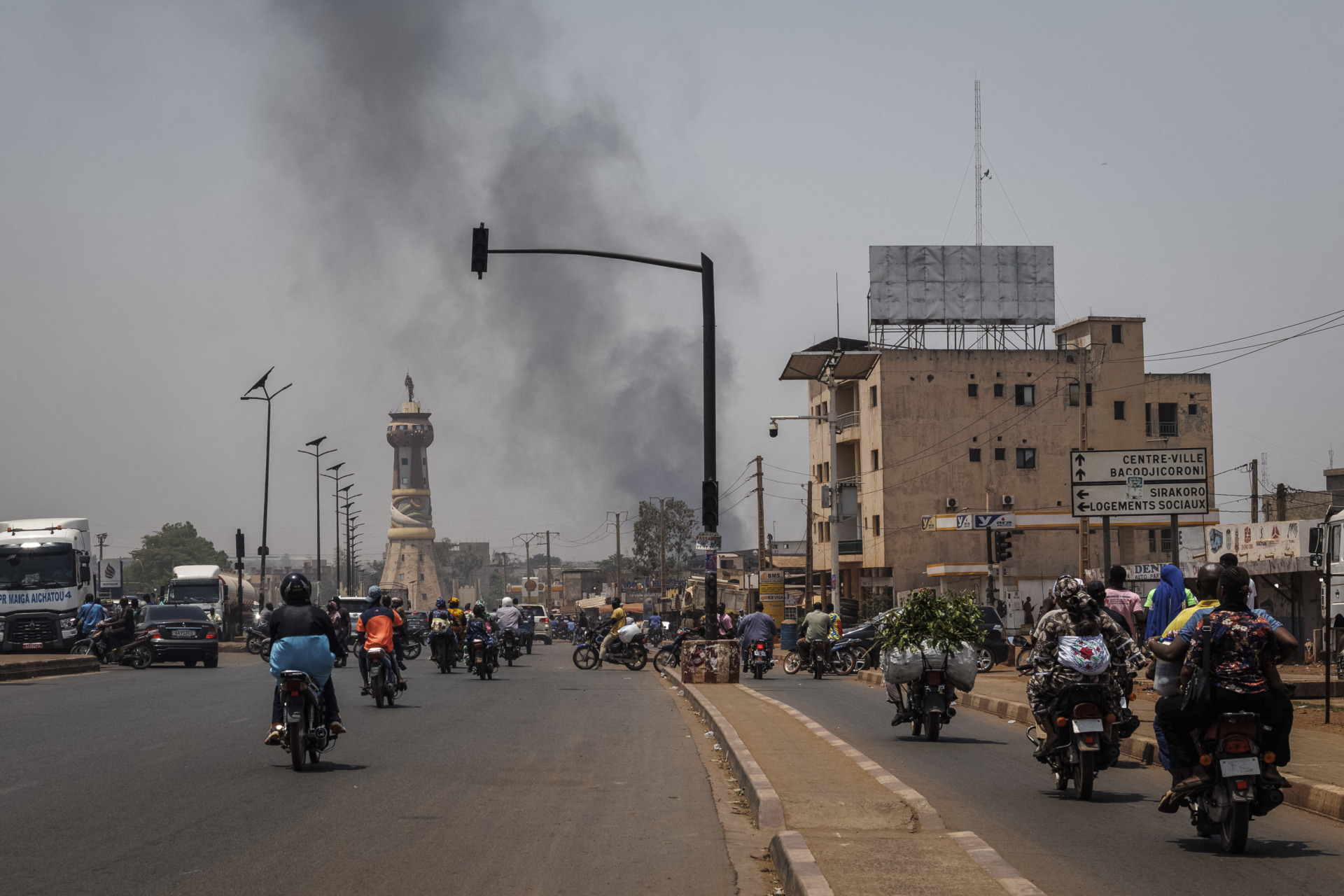
On April 25, before daybreak, a wave of coordinated attacks erupted near Kati, a military stronghold just 15 kilometers northwest of Bamako, Mali’s capital. Explosions and gunfire shattered the predawn calm, signaling the start of a nationwide offensive. Within hours, armed groups linked to the Group for the Support of Islam and Muslims (JNIM) and the Tuareg separatist Front for the Liberation of Azawad (FLA) had launched simultaneous strikes across multiple regions. By the following day, the ruling military junta confirmed the death of Defense Minister Sadio Camara, who succumbed to injuries sustained in an attack on his residence. Speculation also emerged regarding the fate of intelligence chief Modibo Koné, with reports suggesting severe injury or death in the same wave of violence.
Despite the regime’s official claims that the situation was under control, fighting persisted across vast swaths of the country. This gap between public statements and ground reality underscores the persistent weaknesses in the junta’s security framework, raising urgent questions about its ability to safeguard Mali from escalating militant threats.
Militant alliance tests junta’s grip on power
The coordinated offensive marks the most direct challenge to the authority of junta leader Assimi Goïta since he seized power in a 2020 coup. It arrives at a time when the military regime’s position was already fragile, compounded by the JNIM’s months-long blockade of landlocked Mali. Since September, the blockade has disrupted critical fuel and food imports from Senegal and Côte d’Ivoire, forcing school closures and fuel shortages. In March, the junta denied allegations that it released over 100 JNIM prisoners to secure a temporary truce allowing fuel convoys to resume. These events collectively expose the limitations of the regime’s security strategy, which hinges on Russian-backed support and the suppression of civil liberties.
This offensive also tests the junta’s assertion that suspending democratic processes and turning to Moscow for security assistance could stabilize the country—an approach that contrasts sharply with the failures of Western-backed efforts in previous decades. The ripple effects of this strategy are being closely watched by neighboring juntas in Burkina Faso and Niger, which have similarly overthrown Western-aligned governments in pursuit of alternative security partnerships.
A resurgence of jihadist-separatist collaboration
The current offensive reflects a tactical alliance between JNIM and the FLA, mirroring a coalition that emerged in 2012. During that period, a jihadist-separatist alliance routed Malian forces across the north, with Tuareg fighters returning from Libya—bringing weapons and combat experience—joining forces with groups like al-Qaeda in the Islamic Maghreb (AQIM) and Ansar Dine. Though their alliance ultimately fractured, the recent offensive demonstrates a renewed collaboration between these unlikely partners. While their long-term goals remain divergent, the tactical alliance serves to weaken the Malian state by showcasing its inability to protect its own institutions.
Defense Minister Camara, who was killed in the attacks, played a pivotal role in Mali’s partnership with Moscow and was instrumental in the initial deployment of the Wagner Group in late 2021. His death removes a key figure within the junta, creating a leadership void at a time when the regime’s legitimacy is already under severe strain. Since Wagner’s rebranding as the Africa Corps under Russian Ministry of Defense control, its operational focus has shifted from frontline combat to advisory and training roles, significantly reducing its effectiveness. Data from the Armed Conflict Location and Event Data (ACLED) project shows a decline in battles involving Russian fighters from 537 in 2024 to 402 in 2025, with Africa Corps averaging just 24 incidents per month in early 2026. This reduced engagement, compounded by Russia’s commitments in Ukraine, has further constrained its capacity to support Mali’s security.
A costly retreat in Kidal
The Africa Corps’ withdrawal from Kidal in the wake of the April 25 attacks epitomizes the failures of the junta’s security partnership with Moscow. Captured by Malian and Wagner forces in November 2023, Kidal was hailed as a triumph of the junta’s strategy. However, the recent offensive forced Africa Corps to withdraw from the city without resistance, surrendering a strategic gain in the face of militant advances. This retreat highlights the fragility of the junta’s security model and calls into question the efficacy of the Alliance of Sahel States (AES), which includes Mali, Burkina Faso, and Niger. These juntas have expelled Western partners, formed their own defense alliance, and withdrawn from ECOWAS—yet the security environment in the region has deteriorated measurably under their watch.
The recent offensive underscores the growing risks of this approach. Since 2012, military coups in Mali and Burkina Faso have repeatedly cited insecurity as justification for seizing power. These coups have not only overthrown democratically elected leaders but also deepened political instability. For instance, Goïta’s consolidation of power through a 2021 coup further eroded Mali’s democratic institutions. In May 2025, the junta dissolved all political parties and extended Goïta’s term until at least 2030, further alienating the population. A foiled coup attempt in August 2025, which led to the arrest of dozens of soldiers including two generals, exposed the fragility of the regime’s internal cohesion. The April 25 offensive may exacerbate dissent within the military, as officers seek to assign blame for the intelligence failures that allowed coordinated attacks to penetrate the regime’s defenses.
U.S. leverage in the wake of Mali’s crisis
Mali has long been central to U.S. counterterrorism efforts in the Sahel, but coups in 2012 and 2020 triggered the suspension of most foreign assistance under Section 7008 of the U.S. congressional appropriations bill. Recent developments, however, suggest a potential shift in U.S. policy. In February, the Treasury Department lifted sanctions on three senior Malian officials, including the late Defense Minister Camara, who had been designated in 2023 for facilitating Wagner’s activities. This move followed a visit by the State Department’s Africa lead to Bamako, aimed at exploring a revised bilateral relationship centered on intelligence-sharing, drone overflight permissions, and access to critical minerals like lithium and gold.
The U.S. now holds significant leverage in Mali. The junta’s reliance on Russian support has been publicly undermined by the militant offensive, exposing the limitations of Moscow’s security guarantees. Reports indicate that Washington was already exploring a minerals-for-security deal with Bamako before the April 25 attacks, possibly inspired by a similar agreement signed with the Democratic Republic of the Congo (DRC) in December 2025. Such a deal could serve as a template for re-engaging with Sahelian juntas, offering economic incentives in exchange for security cooperation and strategic access.
The offensive has confirmed that the junta’s approach is failing, with JNIM expanding its reach into Bamako and demonstrating enhanced operational capabilities, including drone usage and economic sabotage. Meanwhile, the Malian state faces dwindling resources and legitimacy, with no credible regional security architecture to rely on, particularly given the AES’s withdrawal from ECOWAS. Neighboring countries, including Burkina Faso and Niger, are closely monitoring the situation, as the credibility of the junta-led security model is increasingly under scrutiny.
The reputational damage to Russia from the April 25 offensive will resonate across Africa, particularly among governments that have sought Moscow’s security partnerships. The AES’s model, which positions itself as an alternative to Western security arrangements, is now facing a critical stress test. Beyond Mali, Russia’s Africa Corps has sought footholds in the Central African Republic and Madagascar, but events in Mali may prompt these and other governments to reassess the value of Russian security guarantees. Russia’s inability to prevent the collapse of the Assad regime in Syria and the recent capture of Nicolás Maduro in Venezuela further highlight the limits of Moscow’s influence, underscoring the risks of relying on such partnerships in times of crisis.