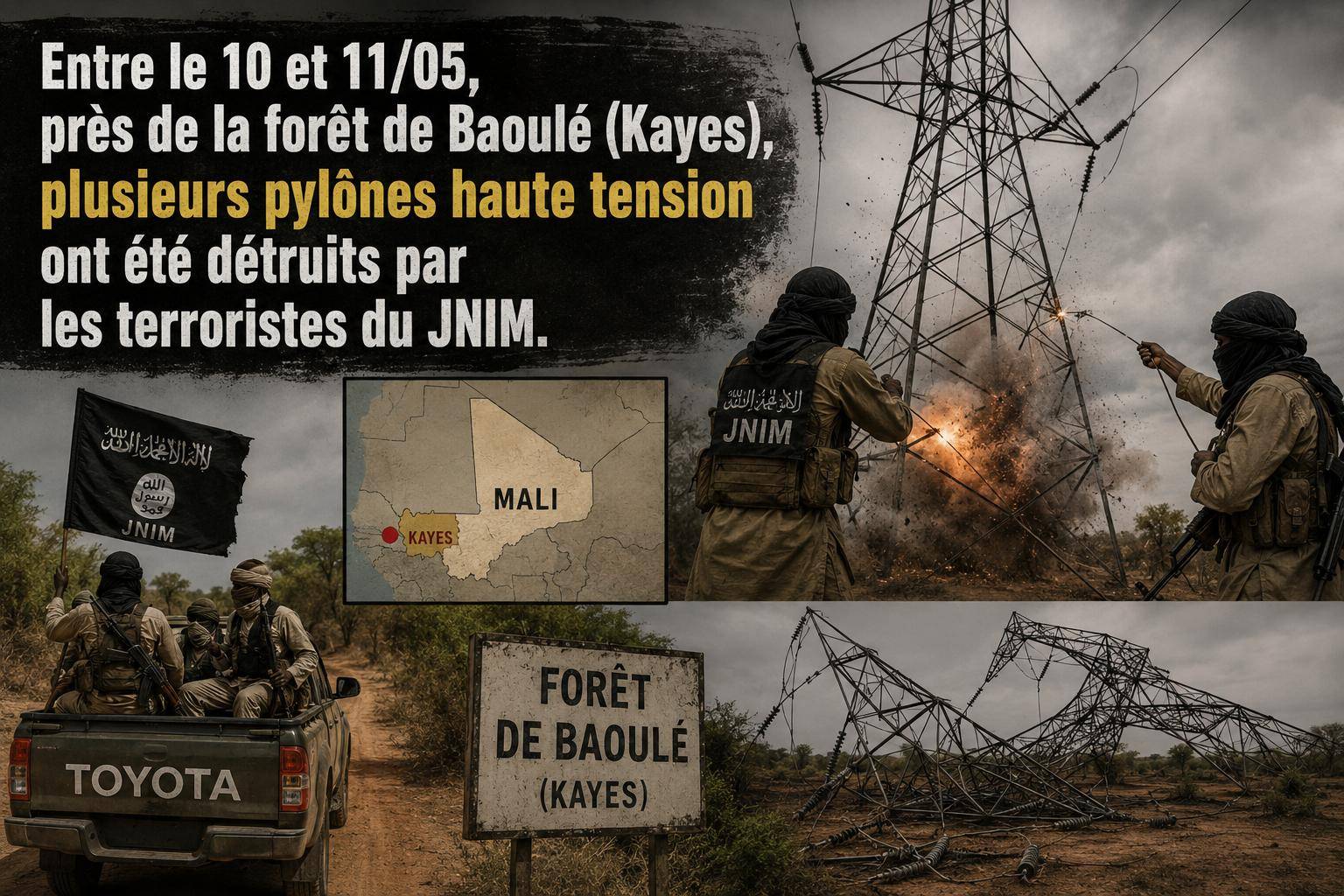

The weekend of May 10 and 11, 2026, marked a catastrophic turn for the energy sector in Mali. Near the Baoulé forest reserve in the Kayes region, militants from the JNIM successfully dynamited several high-voltage pylons. This calculated act of destruction occurred despite the presence of the Africa Corps, the Russian partner whose effectiveness is increasingly under fire. As a record-breaking heatwave collides with water shortages and total darkness, Bamako is suffocating under the weight of a growing terrorist threat now eyeing the Manantali and Sélingué hydroelectric dams.
JNIM shifts tactics to target the Malian economy
What was once a rural insurgency has evolved into a sophisticated war of attrition. After systematically choking off the main transit routes to the capital—incinerating commercial trucks and passenger buses—the JNIM has escalated its operations. By targeting the electrical transmission lines in the Kayes zone, the insurgents are striking at the heart of daily life in Bamako and the very stability of the transition government.
The execution of these attacks was disturbingly precise. Located in rugged terrain near the Baoulé forest, the massive steel structures were brought down with technical proficiency. This sabotage has triggered a massive blackout, plunging entire districts of the capital into an anxious gloom and worsening an already fragile energy situation.
Security failures of the Africa Corps and FAMa
There is a bitter irony in these events. The sabotage took place in areas that the Africa Corps and the Malian Armed Forces (FAMa) claimed to have fully secured. Questions are mounting over how terrorist cells could transport explosives, rig massive metal pylons, and vanish without a trace in a country that turned to Moscow for absolute security.
On the ground, the reality is sobering. While Russian paramilitaries are adept at wartime communication and displays of power in urban centers, their ability to thwart hybrid attacks on vital infrastructure appears non-existent. The failure of drone surveillance and joint patrols to protect the power grid raises fundamental doubts about the actual benefits of this partnership for Mali‘s civilians.
A humanitarian crisis under 45°C heat
For those living in Bamako, this latest sabotage is the breaking point. The capital is currently enduring an unprecedented heatwave, with temperatures soaring toward 45°C. Without electricity to power fans or electric pumps to distribute drinking water, daily existence has become an agonizing struggle.
While the government highlights fuel convoys protected by FAMa and the Africa Corps, technical realities contradict the official narrative. The available generators are nowhere near enough to compensate for the loss of the high-voltage network. Health centers are particularly vulnerable, with emergency units and maternity wards operating under precarious conditions, endangering thousands of lives.
Regional risks: The threat to Manantali and Sélingué
The most alarming prospect lies ahead. Security sources indicate that JNIM is now setting its sights on the Manantali and Sélingué dams. This is no longer just a crisis for Mali; it is a threat to all of West Africa. These facilities are the energy and water lifelines for the sub-region. A successful strike there would do more than just leave Bamako in the dark for months.
Such a disaster would have a direct impact on Sénégal and Mauritanie, both of which rely on regional energy-sharing agreements. It would also jeopardize irrigated agriculture across the river basin, potentially sparking an unprecedented food crisis. The transition from burning trucks to toppling pylons—and potentially sabotaging dams—represents a dangerous escalation that the military and its allies are struggling to contain.
The transition government and its Russian allies are now facing a moment of truth. The rhetoric of territorial liberation is clashing with the reality of a nation seeing its vital infrastructure dismantled piece by piece. The deployment of the Africa Corps, which places a heavy burden on the Malian budget, has yet to safeguard the national economy or protect essential services. The time for triumphant press releases has passed; the focus must now turn to the urgent protection of critical sites before the state’s remaining credibility vanishes in the Sahel heat.