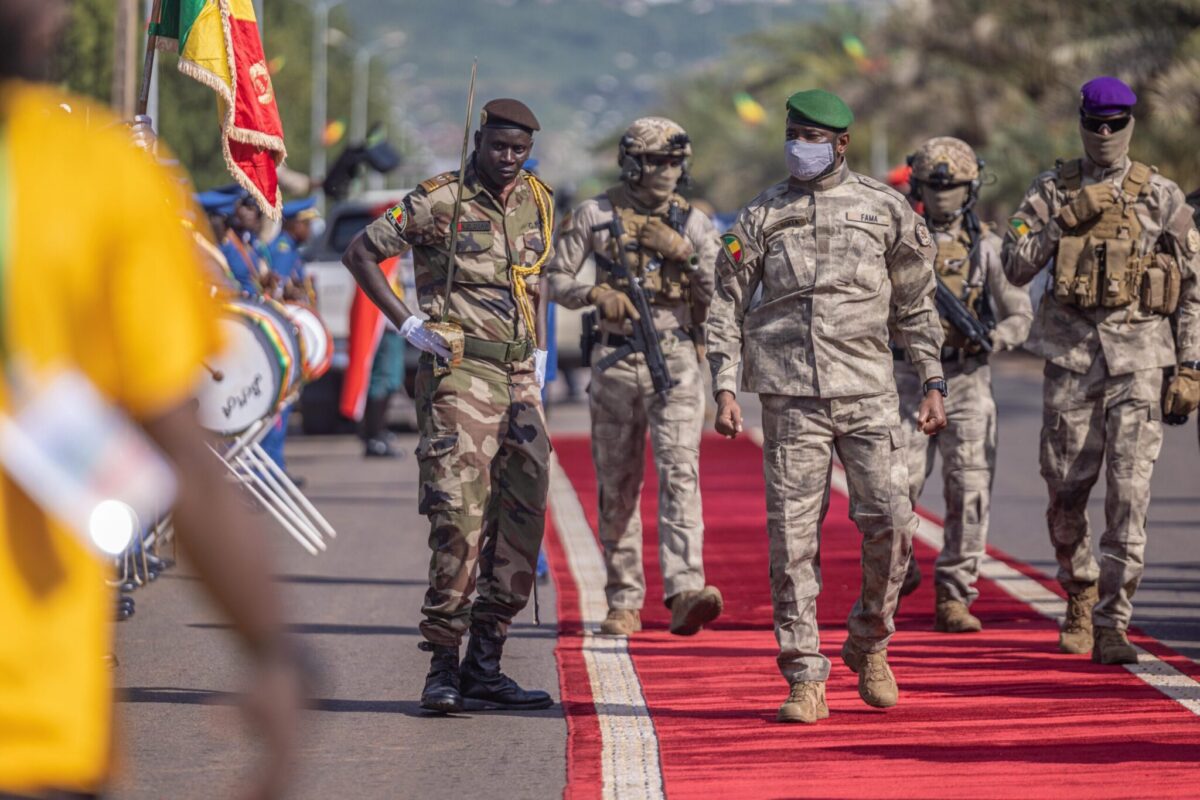

The Malian government claims to have restored full military sovereignty following the withdrawal of French forces and the gradual dismantling of Western security frameworks. Official narratives frame this transition as a historic victory—one in which an African nation has reclaimed control over its territory and rejected foreign domination.
Yet beneath this rhetoric lies a far deeper transformation of Mali’s political system. What Bamako portrays as regained independence has merely shifted the loci of power, influence networks, and war-linked economic circuits. The military now wields unprecedented authority, not only in security matters but in governance, legitimacy, and internal economic balances. Since the 2022 coup, soldiers have tightened their grip on all decision-making levers, embedding conflict not as a challenge to resolve but as the bedrock of the regime itself.
From foreign intervention to new dependencies
The departure of French troops dramatically altered regional power dynamics. For many Malians, this break symbolized liberation after years of military intervention perceived as ineffective. Transitional authorities capitalized on nationalist sentiment to bolster their legitimacy, but symbolic sovereignty cannot rewrite the harsh realities of the Sahel conflict. Armed groups remain active, violence persists across multiple regions, and the state’s logistical capacities remain critically limited. Today, Bamako faces encirclement by jihadist factions, making the debate over foreign presence secondary to the urgent question of Mali’s ability to stabilize its territory.
In this vacuum, new security partners have risen to prominence. Russia, through direct and indirect channels, has emerged as a pivotal player in the Sahel’s military realignment. Its involvement stirs both hope and controversy, reflecting a broader geopolitical shift in West Africa.
The international discourse often frames this shift as a rivalry between Paris and Moscow. Yet Mali’s trajectory is more nuanced. The regime prioritizes partners who can sustain its political survival without imposing Western-style diplomatic constraints. This pragmatism has accelerated the militarization of Mali’s political economy—budgets ballooning for security, military institutions expanding their institutional influence, and conflict becoming a permanent tool for national mobilization.
The paradox of sovereignty through militarization
As insecurity persists, the government justifies centralizing power, curtailing political pluralism, and postponing democratic deadlines. War ceases to be a context and becomes a resource for governance. The Alliance of Sahel States (AES)—comprising Mali, Burkina Faso, and Niger—exemplifies this trend, forging a political space rooted in security sovereignty, anti-colonial rhetoric, and the primacy of military apparatuses.
Yet this alliance rests on fragile foundations. Economically weakened, socially strained, and regionally unstable, the three nations strive for strategic autonomy while remaining financially and militarily vulnerable. The Malian case exposes a paradox of contemporary Sahel governance: severing ties with Western frameworks can yield symbolic sovereignty, but this sovereignty remains hollow as long as the state’s structures—economic, administrative, and security—continue to revolve around military exigency. War, in effect, becomes the permanent infrastructure of the state.
In such a system, peace itself becomes a political risk. Real stabilization would force Mali to confront long-deferred questions: economic redistribution, corruption, local governance, civilian inclusion in power, pluralism’s return, and institutional reconstruction. The crisis in Mali is not merely a clash of foreign powers—it is a structural interrogation of how a state can be rebuilt when war economics increasingly define the mechanisms of governance. Until sovereignty is redefined beyond military capacity, Bamako risks exchanging one form of dependency for another—this time, for the arms of Russian mercenaries.