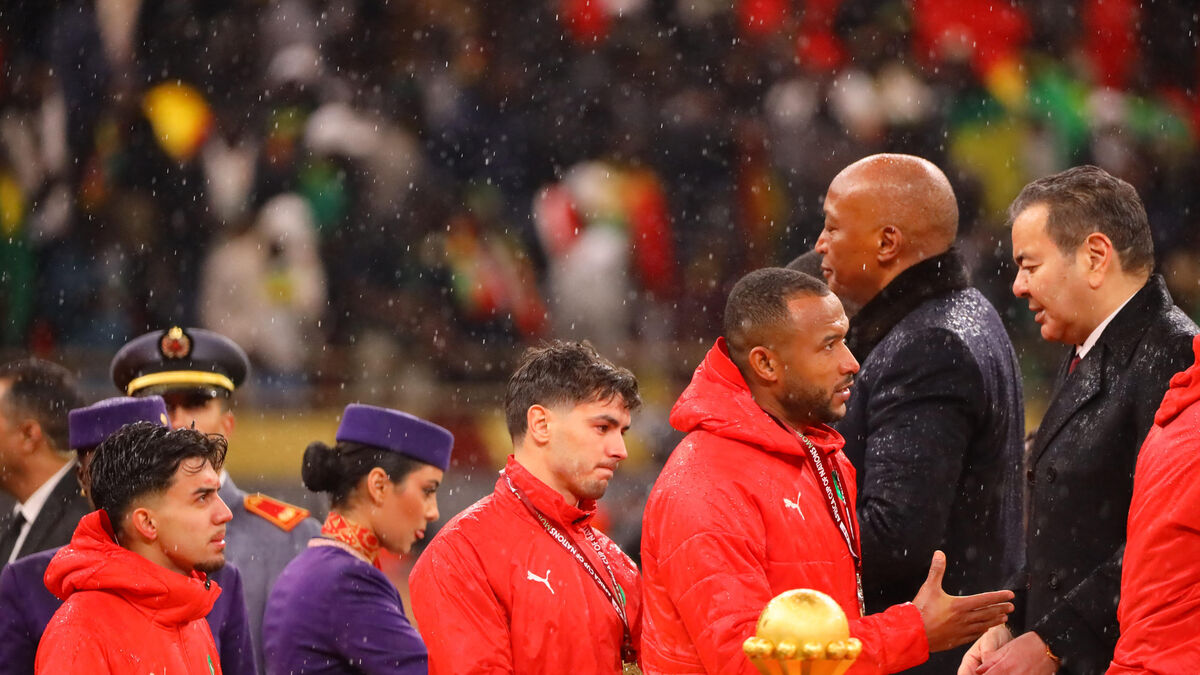

The dust has barely settled on the CAN 2025 final between Senegal and Morocco, yet the drama continues to unfold. What began as a thrilling 3-3 draw in regulation—and a breathtaking 4-3 Senegal victory in extra time—has been upended by a stunning decision from the Confederation of African Football (CAF). The governing body declared the Senegalese national team forfeited, awarding the continental title to Morocco by default, citing an unauthorized exit from the pitch following a controversial penalty decision.
What led to Morocco’s controversial title claim?
On January 18, 2025, the highly anticipated CAN 2025 final at Prince Moulay Abdellah Stadium in Rabat took a bizarre turn. With the score tied 0-0, the referee awarded Morocco a penalty following a challenge involving Senegal’s Ismaïla Diouf and Brahim Díaz. The decision sparked immediate outrage among the Senegalese players and staff, who felt a prior penalty—missed by Morocco—had been incorrectly denied.
As tensions rose, Senegal walked off the field in protest, a move that would later be deemed a forfeit under CAF regulations. The decision was later upheld by the CAF Appeals Jury, who cited Article 84 of the competition rules, which states that any team leaving the pitch without referee approval is considered to have lost the match.
CAF ruling explained: why Senegal lost on a technicality
The CAF confirmed the forfeit in an official statement, declaring: “The Appeals Jury has ruled in accordance with Article 84 and Article 82 of the CAN 2025 Regulations. As the Senegalese team exited the field prematurely and without authorization, they are deemed to have forfeited the match. The result is therefore homologated as a 3-0 victory for Morocco.”
Article 82 makes clear the consequences: “Any team that leaves the field before the end of the match without the referee’s consent shall be considered defeated and eliminated from the competition.” While the penalty was missed—Brahim Díaz attempting a risky Panenka chip that sailed over the bar—Senegal’s walkout triggered the automatic sanction. This interpretation, though controversial, has precedent in African football governance.
How Morocco turned a pitch protest into a title
Within hours of the final whistle, Morocco filed an official protest, arguing that Senegal’s actions violated the integrity of the competition. “This is not about a single match,” stated a senior official from the Royal Moroccan Football Federation. “It’s about upholding the stability, coherence, and credibility of African football. Allowing such behavior to go unchallenged risks normalizing dangerous precedents.”
This appeal drew parallels to past CAF decisions, including the 2019 Champions League final between Wydad Casablanca and Espérance de Tunis, where a similar walkout led to a forfeit ruling. The Tribunal Arbitral du Sport (TAS) ultimately upheld the decision, reinforcing the message that procedural violations carry severe consequences.
Can Senegal still challenge the decision?
Senegal has not accepted defeat quietly. In a strong statement released on social media, the Senegalese Football Federation denounced the ruling as “unjust, unprecedented, and unacceptable,” vowing to defend its rights through legal channels. “We will take this matter to the Court of Arbitration for Sport (CAS) in Lausanne to challenge a decision that tarnishes the reputation of African football,” the federation declared.
With a 10-day window to file an appeal, Senegal is expected to argue that the walkout was a collective protest against refereeing errors—not a willful abandonment of the match. However, given the precedent set by the Wydad vs Espérance case, the odds may not be in their favor.
The Moroccan Federation, meanwhile, has welcomed the decision, reaffirming its commitment to “the strict application of the rules and the protection of competitive fairness across African football.”
Reactions across Africa: shock, anger, and defiance
The fallout has been swift and emotional. Senegalese players and fans alike took to social media to express disbelief. “Come and get it!” posted Moussa Niakhaté on Instagram, holding a photo of the trophy. Teammate Pape Demba Diop echoed the sentiment: “We’re in the twilight zone here.”
Yehvann Diouf, goalkeeper for OGC Nice and a member of the Senegal squad, shared a team photo with the caption: “Two stars, in the eyes of the world.” Former international Famara Diedhou humorously taunted the Moroccan side: “Will the parade be in Rabat or Casablanca?”
As the football world watches, one question lingers: will justice be served on the pitch—or will the legacy of CAN 2025 forever be defined by a walkout and a technical ruling?



