
RDC: civil society unveils kasangulu manifesto, a citizen roadmap for national renewal
- Politique
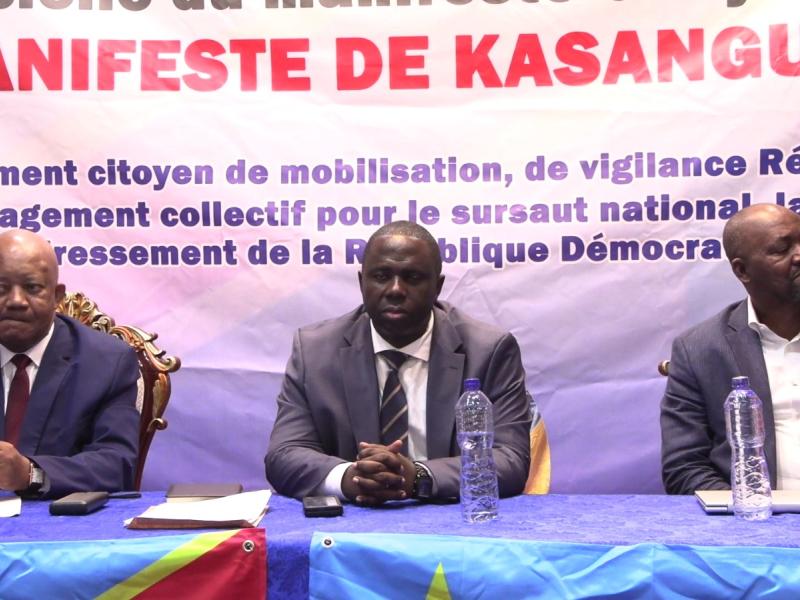
In a significant move for the Democratic Republic of Congo, the Crisis Committee of Civil Society for Peace and Security in the RDC (CCPS-RDC) spearheaded the official launch of the Citizen Manifesto in Kinshasa on Friday, June 26, 2026. This pivotal document, now known as the « Manifeste de Kasangulu », is being heralded by its creators as a crucial guiding framework for the nation’s fundamental restructuring and recovery.
Organized by various civil society groups, the Manifeste represents a unified strategy to tackle the wide array of political, security, economic, social, and institutional challenges currently facing the country. It emerged from a collaborative and inclusive process, drawing in representatives from numerous provinces across the RDC, reflecting a broad national consensus.
The Kasangulu Manifesto articulates a shared national vision for transformation, emphasizing principles such as accountable governance, lasting peace, robust security, social equity, active citizen engagement, quality education, accessible healthcare, sustainable economic growth, environmental stewardship, and a strengthened rule of law.
The launch ceremony commenced with opening remarks from Mme Sylvie Nakweti, Director of Communication, Advocacy, and Documentation for DYCOD-RDC, who commended the steadfast dedication of civil society organizations to this critical national renewal initiative.
Professor Iyoka Jean Bedel further elaborated, underscoring that the Citizen Manifesto is the culmination of an inclusive and educational approach designed to equip the Democratic Republic of Congo with a solid foundation for both thoughtful deliberation and concrete action towards its resurgence.
« The Citizen Manifesto is the product of a pedagogical and inclusive process aimed at providing the Democratic Republic of Congo with a basis for reflection and action for its rebirth, » Professor Iyoka Jean Bedel affirmed.
Me Patient Bashombe Matabishi, Coordinator of the CCPS-RDC, then formally presented the document, highlighting the historical importance of this endeavor. He stressed that the nation is currently navigating a profound crisis that demands a collective national mobilization.
« We launched today the Citizen Manifesto, known as the Manifeste de Kasangulu, because it was in Kasangulu that the commission responsible for its development convened. This manifesto outlines civil society’s vision for the Congo’s recovery. We all agree that our country is experiencing a historic crisis. The question, therefore, is how to overcome it. The Citizen Manifesto aims to provide an answer and a path forward for the Congo’s recovery and refoundation, » explained Me Patient Bashombe Matabishi.
He also elaborated on the symbolic timing of the launch, occurring just days before the celebration of national independence.
« The chosen date is highly symbolic, as it precedes June 30th, our nation’s Independence Day. We sought to contribute to the national discourse and, more importantly, to make every Congolese aware of their historical responsibility. This discussion should not be confined solely to political actors. The Congo belongs to all Congolese. Above all, the Citizen Manifesto is an expression of its citizens. It is a call to all patriots to defend the Democratic Republic of Congo, » Me Patient Bashombe Matabishi declared.
M. Daie Mutombe Pierrot, President of Onusiens congolais, presented the ideological current that will champion the Manifeste’s widespread adoption: the Democratic Citizen Revolution, championed by the BLOC-RDC movement. This initiative seeks to foster active citizenship, sound governance, and national sovereignty. During the event, Me Patient Bashombe Matabishi was acclaimed as President of BLOC-RDC, with Professor Iyoka Jean Bedel appointed as Secretary General.
Addressing the ongoing debate regarding a potential revision or amendment of the Constitution, the CCPS-RDC Coordinator reiterated civil society’s stance. He emphasized the critical need for broad consensus concerning the so-called « locked » constitutional provisions. He further affirmed the ambitious vision encapsulated in the Citizen Manifesto, asserting that it should significantly influence the constitutional reform discussions.
« Revision is indeed provided for by the Constitution itself. However, we believe that any approach that fails to consider all provinces and does not contribute to strengthening national unity could lead to an implosion. For us, the Constitution remains the fundamental instrument of national cohesion. It is the primary text that unites all Congolese people. Regarding the locked articles, which are truly at the heart of the debate, we believe consensus is indispensable, » stated Me Patient Bashombe Matabishi.
He continued:
« These provisions were locked through consensus, not electoral means. In law, the principle of parallelism of forms dictates that only a consensus can overturn a consensus. Within this dynamic, we aim to establish the Citizen Manifesto as a foundational text for the country’s future directions. It embodies the vision that we, as civil society and as a people, advocate for the renewal of the Democratic Republic of Congo. »
The gathering brought together nearly 200 civil society organizations, community leaders, academics, trade unionists, legal professionals, medical practitioners, entrepreneurs, youth organizations, women’s movements, human rights advocates, and numerous local dignitaries. Participants lauded the quality of the document and recommended initiating a comprehensive national awareness campaign to ensure its widespread adoption across the entire national territory and among the Congolese diaspora.
Concluding the proceedings, the Crisis Committee of Civil Society for Peace and Security in the RDC urged all segments of the nation to embrace the Citizen Manifesto. They presented it as a vital contribution to the state’s refoundation, the consolidation of peace, and the construction of a more equitable, prosperous, and democratic future for the Democratic Republic of Congo.
This significant assembly of civil society organizations unfolds amidst a complex national landscape. The RDC continues to grapple with Rwandan aggression, manifested through the AFC/M23 rebellion, alongside the persistent activity of various local and foreign armed groups. This volatile situation exacerbates a severe humanitarian crisis, marked by an increasing number of internally displaced persons and refugees. This is further complicated by reduced international funding, a stalemate in diplomatic efforts, and ongoing hostilities in the eastern regions of the RDC.
Adding to these challenges is the contentious debate surrounding constitutional reform. In the Democratic Republic of Congo, this issue has spurred two distinct socio-political movements: the creation of the Coalition Article 64 for the defense of the constitutional order (C64) on one side, and the Coalition of Congolese for Constitutional Change (C4) on the other. Both factions claim significant popular backing in their efforts to achieve their stated objectives.

Related Posts