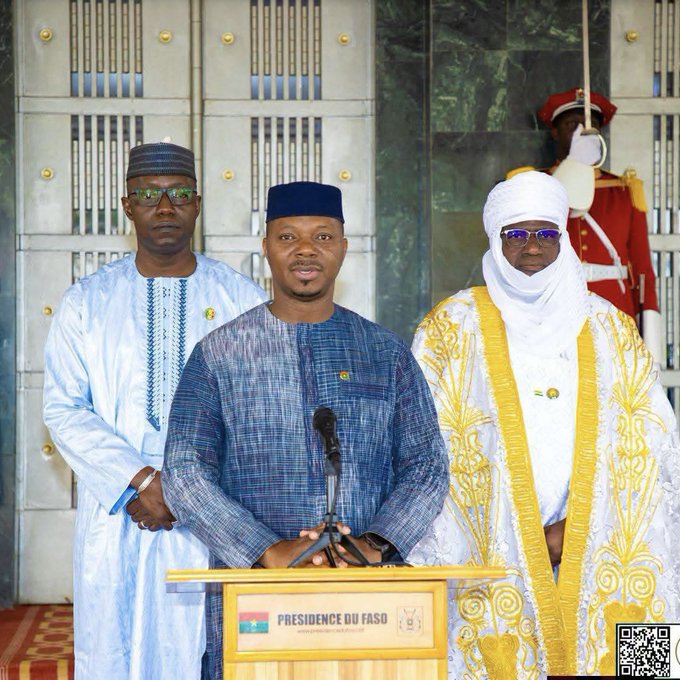

The Alliance of Sahel States (AES) is steadily advancing the establishment of its foundational institutions. In Ouagadougou, presidents of the national parliaments from Burkina Faso, Mali, and Niger recently convened with the President of the Confederation, Captain Ibrahim Traoré. This crucial meeting served to provide strategic directives ahead of the official inauguration of the confederal Parliament.
Following their discussions, parliamentary leaders announced that the selection of deputies is imminent, paving the way for the inaugural session of this newly formed legislative body. The confederal Parliament is tasked with representing the populations across the three member states, supporting the initiatives of AES institutions, and contributing to the consolidation of the political vision shared by the authorities of Burkina Faso, Mali, and Niger.
This development marks a significant institutional milestone for the Alliance of Sahel States, which, having withdrawn from ECOWAS, is now intent on equipping itself with its own governance structures.
However, this legislative assembly takes shape against a backdrop of escalating security concerns. Recent weeks have witnessed a disturbing resurgence of jihadist attacks across Burkina Faso, Mali, and Niger. These assaults, some unprecedented in scale, have exacted a heavy toll on both defense forces and civilian populations. For some observers, the decision by the highest parliamentary authorities of the AES to prioritise the acceleration of a new parliament’s creation, without any concurrent high-level meeting dedicated specifically to the worsening security crisis, raises pointed questions about the order of strategic priorities.
This perception fuels criticism from those who contend that AES leaders are placing considerable emphasis on constructing new political institutions, even as the urgent security situation continues to profoundly impact citizens. While not disputing the long-term utility of a confederal Parliament, these voices argue that such an orientation might be misunderstood when citizens are primarily seeking tangible solutions to the proliferation of attacks.
Beyond its institutional significance, this progression is also viewed by some analysts as the precursor to a more pronounced political divergence within West Africa. By progressively developing its distinct institutions, the AES is asserting its autonomy from ECOWAS, a move that risks deepening the separation between the two regional blocs and potentially complicating prospects for broader political and security cooperation.