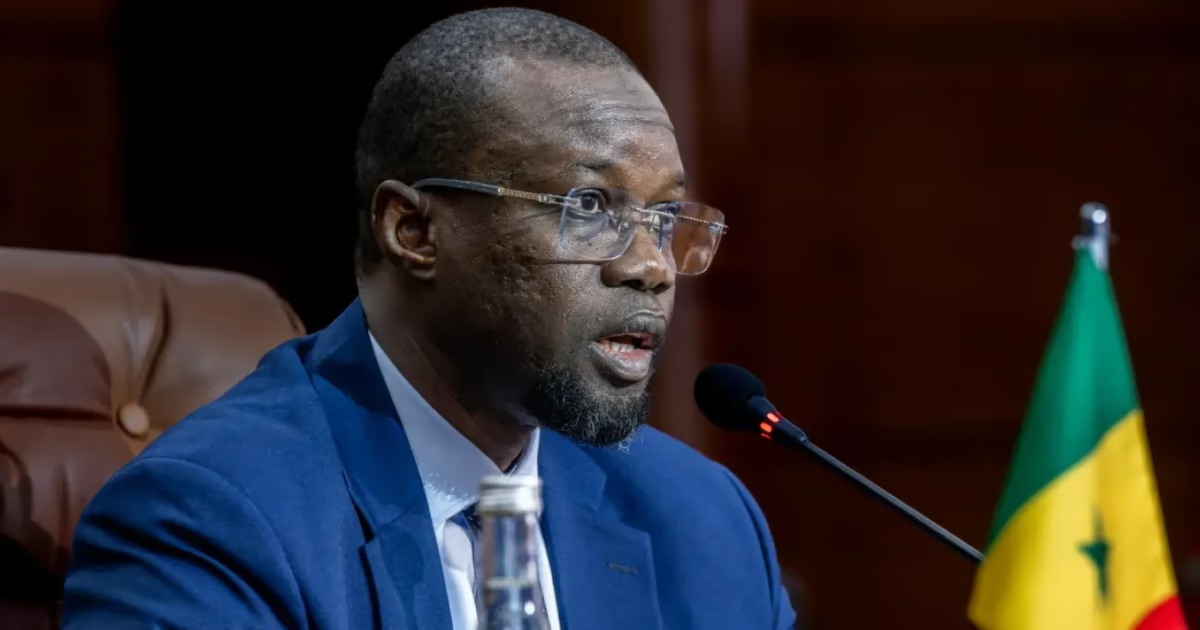

Senegal’s judicial reshuffle fuels speculation over Ousmane Sonko’s political future
Recent judicial appointments in Senegal have sparked intense debate about their potential impact on the 2029 presidential race. Political analyst Mamadou Wane suggests President Bassirou Diomaye Faye is deploying a calculated strategy to sideline Ousmane Sonko, though such maneuvers may ultimately fail against the backdrop of Senegal’s resilient democratic culture.
The July 2023 judicial overhaul—particularly the appointments to the Constitutional Council and the Saint-Louis Court of Appeal—represents a pivotal moment in Senegal’s political trajectory. According to political scientist Mamadou Wane, President Faye’s administration is reviving elements of the former neocolonial order while systematically positioning institutions to block Sonko’s path to the 2029 election. Yet this calculated approach ignores the unyielding spirit of Senegalese citizens, whose decades of struggle have forged an unbreakable resistance movement behind the PASTEF party.
Wane argues that the administration is leveraging judicial appointments to neutralize Sonko politically. The president’s July 2023 decree appointing magistrate Ousmane Diagne as head of the Constitutional Council—and former prosecutor Serigne Bassirou Guèye to the Saint-Louis Court of Appeal—has raised eyebrows, given both figures’ contentious histories with Sonko. While Diagne’s conflicts centered on procedural delays in accountability cases, Guèye faces allegations of falsifying evidence in Sonko’s high-profile trial—a move Wane condemns as disqualifying for any judge.
“I won’t prejudge Ousmane Diagne’s intentions,” Wane noted, “but Serigne Bassirou Guèye’s actions crossed a red line. Tampering with legal proceedings to manufacture a political conviction is the hallmark of a compromised judiciary.”
Restoring the past or forging a new path?
The analyst frames these appointments as part of a broader revisionist agenda, where key state institutions are repopulated with figures from the ancien régime. This strategy, Wane warns, seeks to dismantle the democratic gains of recent years and replace them with a centralized political force loyal to the outgoing coalition’s elite.
“Revisionism here means rewriting history to reverse sovereignty gains,” Wane explained. “We now face a stark choice: a return to neocolonial control or a continued march toward democratic revolution.” He cautioned that any attempt to exclude Sonko would backfire spectacularly, given Senegal’s proven capacity for sustained resistance—a lesson Bassirou Diomaye Faye’s team appears to have forgotten.
The sociologist emphasized the public’s enduring mobilization: “The people who brought you victory in 2020 and 2024 did not quit after a few weeks. They fought for three years, mastering the tactics of resistance. Underestimating their resolve is a strategic blunder.”
The PASTEF phenomenon and Senegal’s awakened youth
Wane highlighted the PASTEF’s organizational strength as a defining factor in the political equation. The party’s surge in membership drives, particularly since 2021, reflects an unprecedented level of grassroots engagement under Sonko’s leadership. “No other party matches PASTEF’s network or ideological coherence,” he stated. “This isn’t just political machinery—it’s a social movement.”
The analyst also underscored Senegal’s democratic maturation, accelerated by the 2021–2024 protest cycle. “March 2021 wasn’t a fleeting moment of outrage. It was three years of disciplined struggle that reshaped national consciousness. The memory of that resistance ensures any attempt to sideline Sonko will crash against the wall of popular will.”



