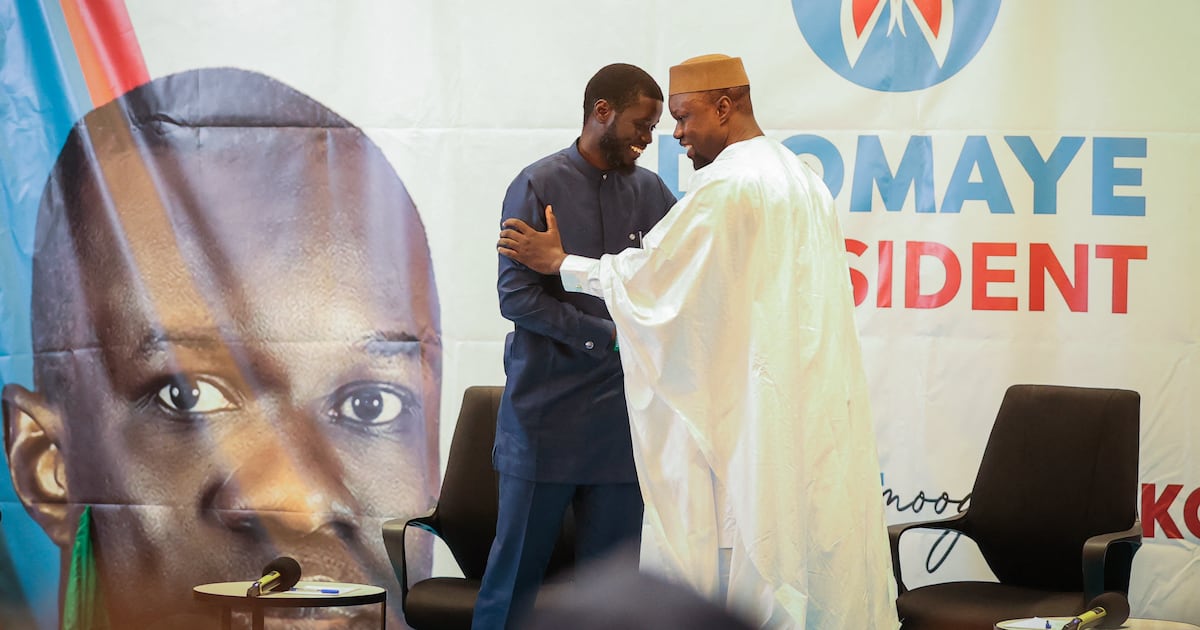

In Dakar, the political landscape has shifted dramatically in recent months. Once inseparable allies, Bassirou Diomaye Faye and Ousmane Sonko now embody a fractured partnership that once defined Senegal’s opposition movement. The slogan that once resonated across the nation, « Diomaye mooy Sonko, Sonko mooy Diomaye » (Diomaye is Sonko, Sonko is Diomaye, in Wolof), has faded into a distant memory. Today, conversations in government corridors, media circles, and local neighborhoods echo a different refrain: « Diomaye n’est plus Sonko » (Diomaye is no longer Sonko).
The growing divide between the president and his former prime minister has become impossible to ignore. Their collaboration, which propelled them to power, now teeters on the brink of collapse. Methodological disagreements, power struggles, and clashing ambitions have eroded what was once a united front. The question on everyone’s lips is clear: how did two men who reshaped Senegal’s political future end up on such divergent paths?
Ousmane Sonko’s calculated gamble
Ousmane Sonko, leader of the Pastef movement, appears to have strategically pushed his relationship with Bassirou Diomaye Faye to the edge of rupture. He understood that cohabitation with a president asserting his authority would become unsustainable. Yet, Sonko also recognized that an open confrontation could strengthen his position within the party, leveraging his status as the movement’s historical figurehead.
The true trap lay in cornering Diomaye Faye into choosing between institutional authority and the unity of the Pastef. By remaining in government while asserting his political independence—through ambiguous statements, public disagreements, and subtle reminders of his leadership—Somko intensified the pressure on the president. Each move was calculated to expose the fractures within their alliance.
Diomaye Faye found himself trapped in a no-win scenario. If he tolerated this shared leadership, he risked appearing weak and incapable of asserting his role. But if he removed Sonko, he would be seen as betraying the very movement that brought him to power—a betrayal that could alienate a significant portion of the party’s base.
Ironically, Sonko may have gained the most from his dismissal. Now, he can reclaim his identity as the movement’s undisputed leader, the martyr of the struggle, and the symbol of resistance against the old political order.
The danger of new allies
Since assuming office, Bassirou Diomaye Faye has been surrounded by a new circle of advisors—political operators, former supporters of Macky Sall’s regime, and opportunistic notables. Their refrain is consistent: “You are the president. You must assert your authority.” While this message flatters the president’s ego, it may also mask deeper motives.
Where were these individuals during the Pastef’s darkest hours—when Sonko and Faye faced judicial persecution, violent crackdowns, and smear campaigns? Many enjoyed the privileges of the old system they now condemn with revolutionary fervor. These political chameleons thrive on division, feeding rivalries and nurturing egos to serve their own agendas. History offers countless examples of movements that crumbled not from external opposition but from internal fractures.
The president risks a grave miscalculation by assuming these new allies genuinely support his consolidation of power. Many may instead seek to weaken the Pastef, diluting the transformative vision it once embodied.
The looming fracture within the Pastef
Senegal’s political reality remains unyielding: the Pastef’s dominance stems from its militant base, youthful energy, and compelling narrative forged in opposition to Macky Sall’s regime. At its core stands Ousmane Sonko, the figure who galvanized the movement. Even when legally barred from running in the presidential election, his influence persisted, shaping the public’s perception of change.
While Diomaye Faye holds institutional legitimacy, Sonko commands unparalleled popular support. Should a political or electoral showdown arise, this dynamic could prove decisive. If the Pastef splits between factions loyal to Diomaye Faye and those aligned with Sonko, the outcome is uncertain. Many cadres, elected officials, and militants may gravitate toward the leader they still view as the movement’s true architect. Faye lacks a fully developed political apparatus capable of counterbalancing Sonko’s enduring influence—a critical vulnerability.
The curse of political heirs
Historically, political heirs face an existential dilemma: the need to carve out their own identity. No president willingly accepts a subordinate role. Yet, the fallout from this power struggle extends beyond personalities—it threatens the very coherence of the Pastef’s founding mission. The movement was built on promises of ethical governance, sovereignty, social justice, and national dignity. Ego-driven conflicts risk derailing these ideals, leaving the project vulnerable to external forces.
The irony? The Pastef’s adversaries may ultimately benefit from a crisis they did nothing to create—one that weakens the movement from within.