
Washington raises alarm over Sahel security crisis
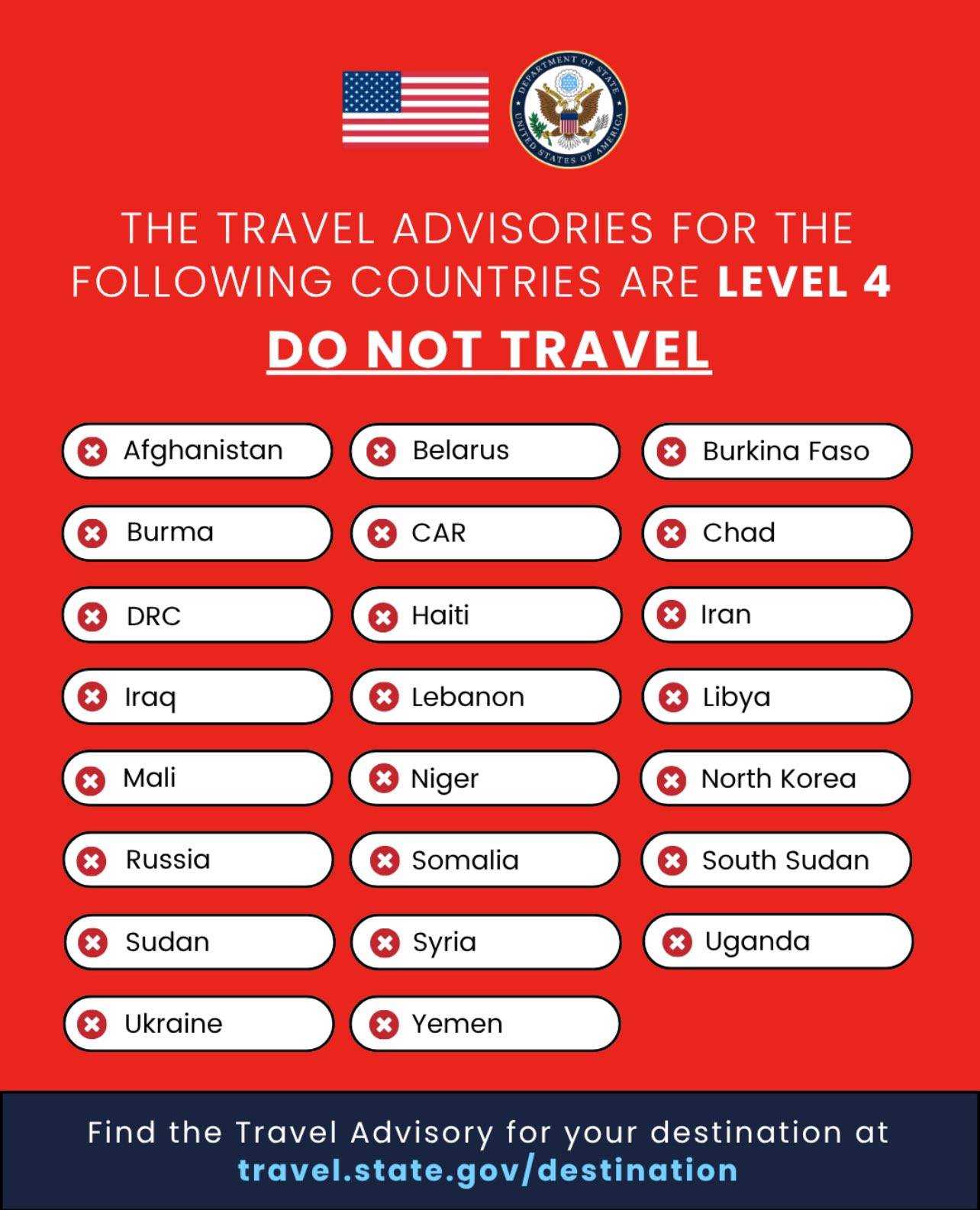
In its latest global travel advisory, the United States government has once again placed three Sahel nations—Burkina Faso, Mali and Niger—among the world’s most dangerous destinations. These countries now share the highest warning level, classified as “Do Not Travel,” alongside 20 other high-risk regions globally. The designation reflects a dramatic deterioration in security conditions across the Sahel, where jihadist groups have expanded their operational reach at an unprecedented pace.
Why the “Do Not Travel” warning matters
The U.S. State Department’s four-tier risk system sends a clear message: travelers face extreme peril in these zones. Level 4 warnings are reserved for environments where violent crime, terrorism, kidnapping, or civil unrest make normal consular support impossible. American citizens are strongly advised to avoid these areas entirely, as diplomatic and emergency services remain severely restricted due to the withdrawal of non-essential personnel.
This latest update underscores a broader geopolitical reality—the Sahel has become the epicenter of global instability, where state authority is increasingly absent and armed groups dictate the pace of daily life.
The Sahel’s triple crisis: security, governance and partnership shifts
The joint downgrade of Burkina Faso, Mali and Niger stems from interlinked challenges that have deepened over recent years. While each nation faces unique pressures, they share a common trajectory: military juntas have seized power, severed traditional alliances with Western partners, and pivoted toward alternative security arrangements—most notably with Russia. Yet these geopolitical realignments have not translated into improved stability on the ground.
Structural vulnerabilities continue to fuel the crisis:
- Weak state presence: Government control is fading in rural and border regions, creating power vacuums exploited by militants.
- Economic despair: Chronic poverty and unemployment make recruitment into extremist groups far easier for disaffected youth.
- Shifting alliances: The withdrawal of Western security forces has left security gaps, while new partnerships—particularly with Moscow-backed entities—are still unproven in delivering tangible protection.
How terror groups are reshaping the Sahel
The expansion of armed factions affiliated with Al-Qaeda’s Jama’at Nusrat al-Islam wal Muslimin (JNIM) and the Islamic State’s Greater Sahara branch (EIGS) has redefined the conflict landscape. These groups no longer operate from isolated desert redoubts. Instead, they launch coordinated assaults, impose blockades on entire towns, and extend their influence toward southern urban centers—once considered safer havens.
Burkina Faso: trapped in a cycle of siege warfare
Burkina Faso bears the brunt of this asymmetric conflict. Militant factions now control or surround vast swaths of the country, cutting off roads, markets, and essential services. Local populations face daily risks: ambushes on supply convoys, attacks on military outposts, and forced displacements that have displaced hundreds of thousands. Entire districts have been reduced to isolated pockets, accessible only by air or through dangerous humanitarian corridors.
Mali: from northern rebellion to nationwide threat
In Mali, the security crisis has deepened since the withdrawal of the United Nations stabilization mission. What began as a localized rebellion in the north has metastasized into a nationwide menace. Terrorist incursions now reach the outskirts of Bamako, once regarded as a relative safe zone. The combination of weakened state structures, resurgent rebel movements, and opportunistic extremist factions has created a toxic brew of violence and lawlessness.
Niger: caught between two fronts
Niger confronts a two-pronged insurgency. In the west, along the volatile tri-border area shared with Mali and Burkina Faso, armed groups stage regular cross-border raids. In the southeast, near the Lake Chad Basin, factions linked to Boko Haram and the Islamic State West Africa Province (ISWAP) maintain a deadly presence. Despite efforts to reorganize national defense forces, insecurity remains entrenched, compounded by strained regional cooperation and lingering diplomatic tensions among neighboring governments.
A global snapshot of instability
The U.S. advisory extends far beyond the Sahel. Other nations now share the Level 4 designation, including Russia—due to the Ukraine war and arbitrary detention risks—and the Democratic Republic of the Congo, where dozens of armed factions wage brutal campaigns against civilians in the east. Chad, a key Sahel neighbor, also remains under scrutiny due to spillover from Sudan’s conflict, porous borders, and persistent threats from extremist networks.
Beyond travel: the economic and humanitarian fallout
Level 4 warnings carry consequences that ripple far beyond tourism. For Sahel economies already struggling with debt and poverty, the designation acts as a deterrent to foreign investment. Multinational corporations hesitate to deploy executives or capital when insurance premiums skyrocket and evacuation plans become mandatory. The humanitarian sector faces even greater challenges: NGOs must navigate strict security protocols that delay or deny access to communities in desperate need of food, medicine, and education.
Civilians pay the highest price. Families displaced by violence, farmers unable to tend fields, and children barred from schools are the silent victims of a crisis that shows no sign of abating.
Can the Sahel break the cycle?
Washington’s latest warning highlights a decade of failed stabilization efforts. Despite regime changes in Bamako, Ouagadougou, and Niamey, and shifting geopolitical alliances, the core issues remain unaddressed: weak governance, social inequality, and limited access to basic services. Military solutions alone have proven insufficient. Without meaningful progress on governance, justice, and economic development, the Sahel’s future may continue to be painted in the red of conflict and crisis.



