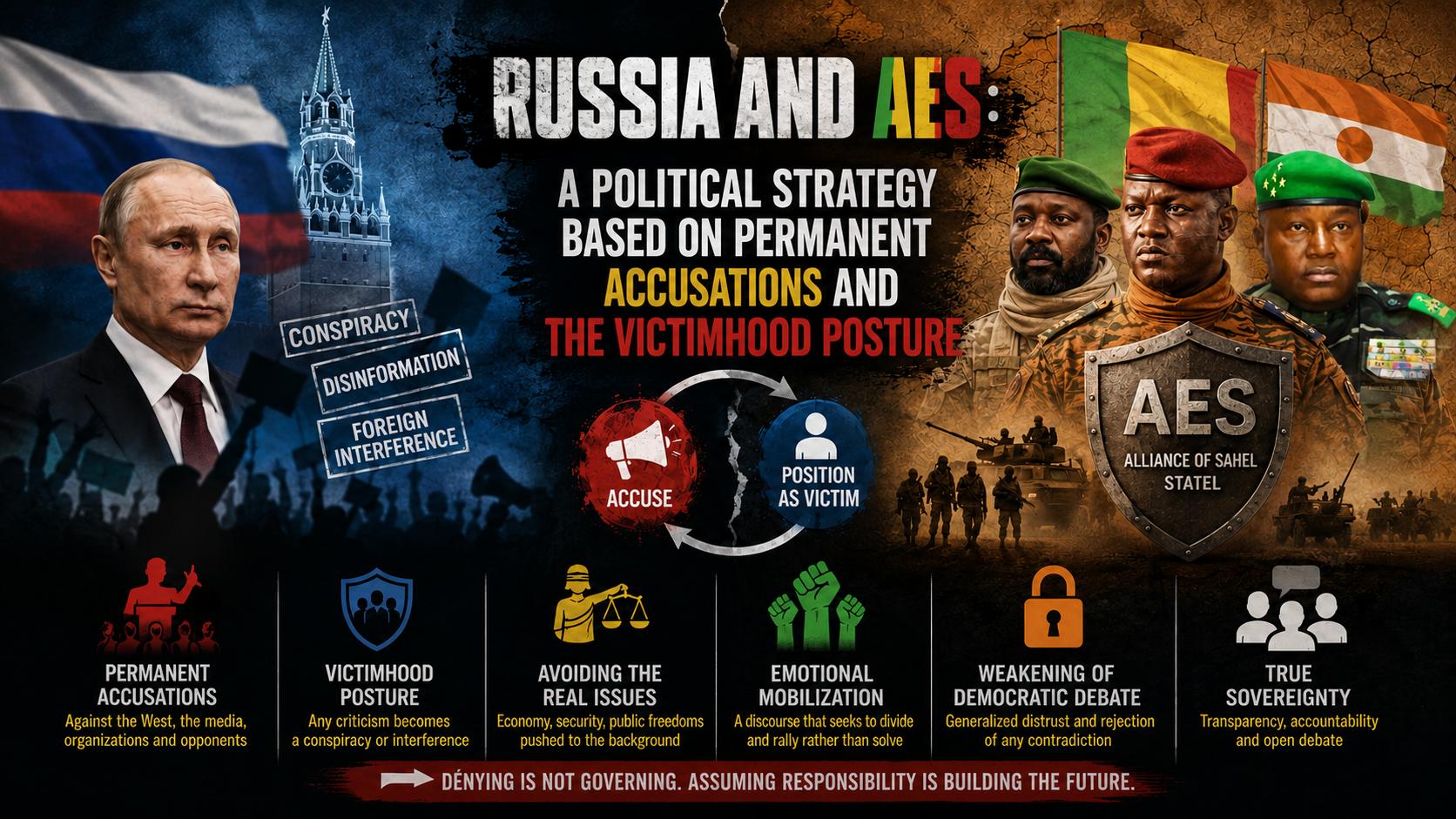

The governments of Russia and the Alliance of Sahel States (AES) have, for years, relied on a recurring narrative in their political communications: the relentless denunciation of perceived adversaries. This approach spans a broad spectrum of targets, including Western powers, international media outlets, regional bodies, and domestic opponents. Yet, a striking paradox emerges when these same actors face scrutiny themselves—they swiftly shift from accusers to victims.
a systematic strategy of deflection and victimhood
This communication tactic has become a hallmark of governance. Whenever their policies or actions are questioned, the response is almost always the same: a claim of conspiracy, accusations of misinformation, or assertions of foreign interference. Any form of criticism is framed not as constructive feedback but as a coordinated effort to undermine sovereignty or obstruct progress toward self-determination.
The political advantages of this strategy are clear. By casting themselves as victims of external enemies, leaders divert attention from pressing domestic issues such as economic stagnation, persistent insecurity, erosion of public freedoms, or the underperformance of key policies. The discourse shifts from substantive debate to an emotional appeal, prioritizing mobilization over meaningful solutions.
the Sahel states’ embrace of victimhood
Within the AES, this pattern is particularly pronounced. Authorities consistently attribute internal challenges—such as economic hardship, security failures, or governance shortcomings—to external forces, including sanctions, former colonial powers, or other foreign actors. However, when citizens, journalists, or human rights organizations raise concerns about domestic issues, these criticisms are rarely addressed on their merits. Instead, they are dismissed as part of a broader destabilization campaign orchestrated from abroad.
Russia, too, frequently employs a similar logic on the global stage. When confronted with criticism over its foreign interventions, military actions, or human rights record, official rhetoric consistently portrays the country as the target of relentless Western hostility. This narrative serves to deflect accountability and reframe dissent as evidence of an orchestrated attack rather than a legitimate concern.
the long-term costs of perpetual accusation
While this strategy may offer short-term political benefits, it carries significant long-term risks. Effective governance demands the capacity to engage with criticism, provide reasoned responses, and remain accountable to citizens. A governance model that dismisses all opposition as part of a conspiracy risks undermining democratic processes and fostering a climate of pervasive distrust.
Accusing others is a convenient tactic; accepting responsibility is far more demanding. Through their repeated recourse to victimization, Russia and several AES leaders risk conveying an impression that their primary objective is to avoid substantive discussion rather than address the challenges facing their nations. Criticism, however harsh, is not inherently a conspiracy—it can also serve as an opportunity to refine policies, correct missteps, and strengthen public trust.
True sovereignty is not defined solely by the ability to denounce real or imagined enemies. It is also measured by transparency, accountability, and the willingness to engage in open, contradictory debate. Without these principles, the narrative of perpetual victimhood risks being exposed as little more than a political tool—one that ultimately erodes credibility rather than addressing the real issues at hand.