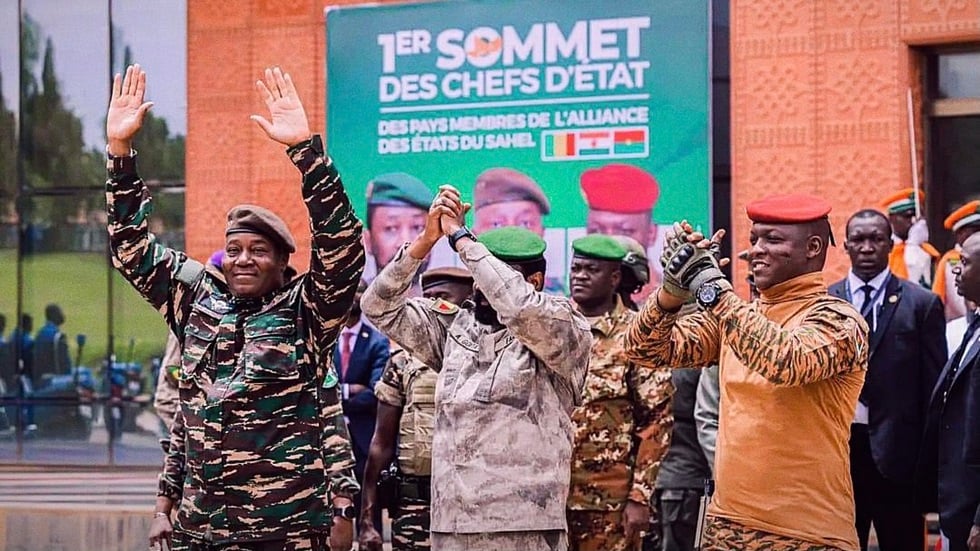

In the high-stakes world of geopolitics, timing can make or break a nation. The decision by the Alliance of Sahel States (AES)—comprising Mali, Burkina Faso, and Niger—to sever ties with the Economic Community of West African States (ECOWAS) now appears less like a bold assertion of sovereignty and more like a reckless gamble with escalating risks.
At a time when West Africa faces relentless threats from extremist groups such as Boko Haram and Islamic State West Africa Province (ISWAP), unity should be the cornerstone of regional security. Instead, the AES’s withdrawal has shifted the focus to fragmentation—a move that not only undermines collective strength but also amplifies vulnerability in the face of terror.
The AES justified its departure by accusing ECOWAS of serving as a tool of neo-colonialism, particularly under French influence. While historical grievances are valid, abandoning a regional security framework without a viable alternative is not a path to independence—it is a leap into precarious uncertainty. Sovereignty demands strategic foresight, not isolation.
Since turning toward Russia for security partnerships, the AES has framed this shift as a recalibration of alliances. Yet, the reality on the ground tells a different story: Moscow’s support is driven by transactional interests, not long-term commitment. History shows that Russia’s backing wanes when its own strategic calculations shift. This is not mere speculation—it’s a proven pattern.
Recent insurgent attacks in key Malian cities—Bamako, Sevare, Mopti, Tessalit, Gao, Kati, and Kidal—have laid bare critical weaknesses in the AES’s security strategy. The anticipated protection from external allies proved illusory, and the muted response from fellow AES members—Burkina Faso and Niger—raises serious doubts about the bloc’s operational credibility.
Why ECOWAS still matters: lessons from ECOMOG
During crises like the civil wars in Liberia and Sierra Leone, the ECOWAS Monitoring Group (ECOMOG), led by Nigeria, demonstrated the power of collective action. Though not without flaws, ECOMOG succeeded in stabilizing governments and restoring order in regions on the brink of collapse. This was not just about military intervention—it was about shared destiny and regional solidarity.
The Gambia faced a political upheaval when former President Yahaya Jammeh refused to concede defeat in the 2016 elections. Nigerian troops, acting under an ECOWAS mandate, intervened within hours, compelling Jammeh to step down and leave for exile in Equatorial Guinea. This episode underscored the bloc’s role as a stabilizing force in times of crisis.
The core truth is simple: geography does not negotiate. In West Africa, nations are bound not only by treaties but by shared borders, cultures, and the inevitable spillover of instability. When Mali faces terror, Niger suffers. When Burkina Faso struggles, Ghana feels the tremors. Security in the Sahel is indivisible—there is no isolation in survival.
Iran’s example offers a compelling lesson. Often cited as a model of indigenous resilience, Iran’s strategy was never about defiance alone—it was about building unshakable domestic capacity. Instead of relying on foreign mercenaries, Tehran invested in military self-sufficiency, intelligence networks, and technological innovation. The result? A nation capable of withstanding intense aerial assaults from global powers like the United States and Israel for extended periods.
For the AES, the path forward must prioritize three key strategies: first, a surge in homegrown security infrastructure, including local intelligence systems and community defense units; second, the revival of regional rapid-response capabilities; and third, a diplomatic re-engagement with ECOWAS—not as a subordinate, but as a strategic partner. Collaboration does not erode sovereignty—it fortifies survival.
ECOWAS, too, must address its own credibility gaps. The bloc must confront perceptions of external manipulation, improve governance transparency, and reaffirm its commitment to serving African interests—not foreign agendas.
This is not a call to revert to the past. It is an appeal for a smarter balance—one that merges sovereignty with solidarity, independence with interdependence. The Sahel does not need isolation; it needs alignment with its neighbors, who share its risks, realities, and destiny.
A path to redemption
The parable of the prodigal son reminds us that pride often precedes downfall. For the AES, the time has come to reconsider its withdrawal. Clinging to a failing strategy while cities burn is not strength—it is folly. ECOWAS, for its part, must extend an unconditional hand of reconciliation. A family is stronger when united.
The threat of annihilation is not an exaggeration—it is the stark reality facing the subregion. A united West Africa has overcome civil wars and coups; a divided one will fall to a common enemy that respects no borders. The AES must retrace its steps, invest in homegrown solutions, and rebuild the collaborative structures that only neighbors can provide. There is no alternative.