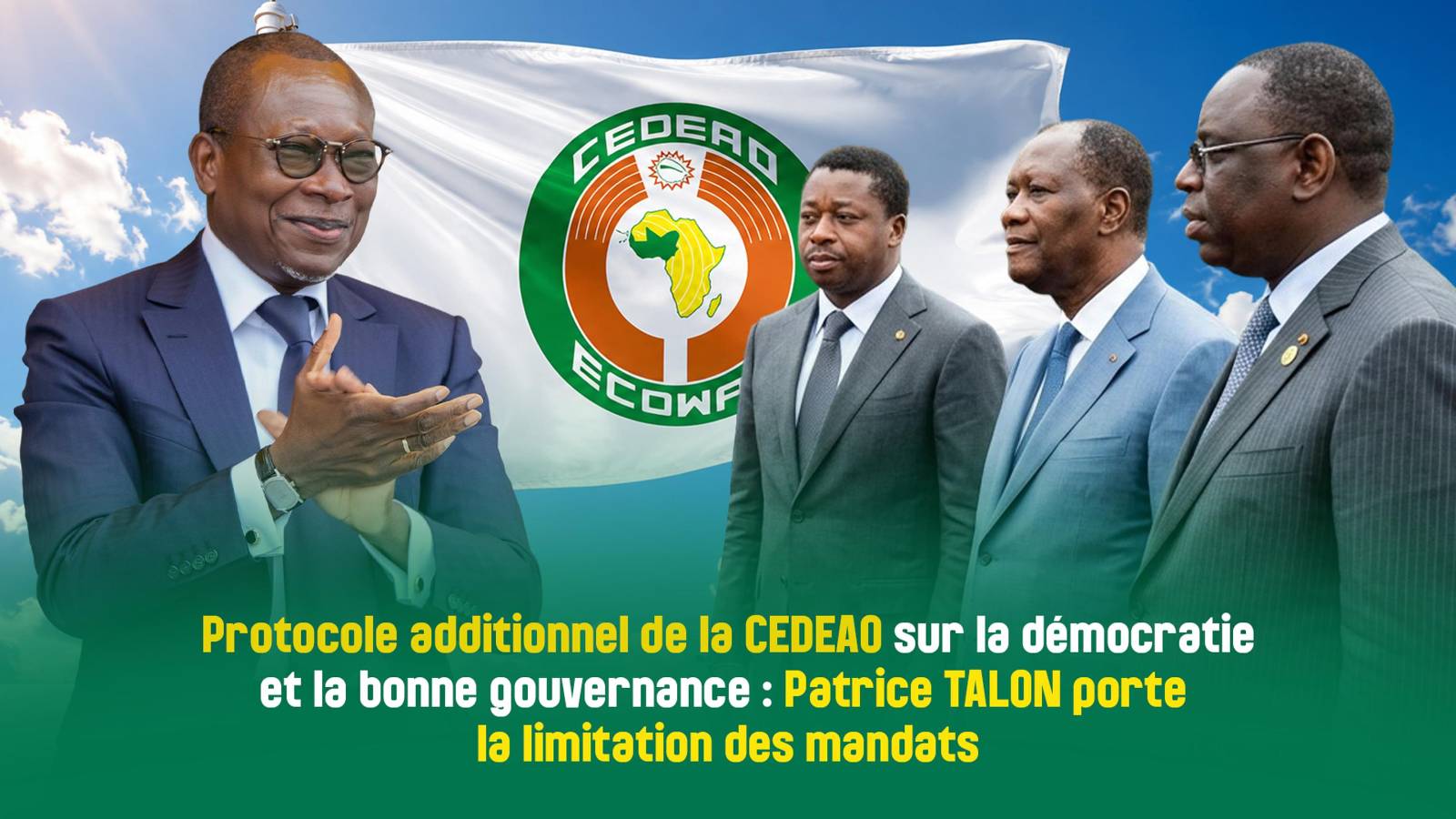

The West African political landscape is currently gripped by a deep-seated divide within the Economic Community of West African States (ECOWAS), driven by a fundamental disagreement over presidential term limits. While the region grapples with successive military coups in Mali, Burkina Faso, and Niger, Bénin‘s President Patrice Talon stands firm on his uncompromising stance: strict enforcement of the two-term rule. Yet, his absence from key regional summits reveals a stark contrast between his principles and the resistance of influential leaders.
Bénin’s unwavering push for democratic reform
Since assuming office in 2016, President Patrice Talon has made the enforcement of presidential term limits a cornerstone of Bénin‘s foreign policy. For Cotonou, the chronic instability plaguing ECOWAS member states stems directly from leaders clinging to power beyond constitutional limits. This conviction led Talon to advocate for a sweeping revision of the ECOWAS Supplementary Protocol on Democracy and Good Governance, proposing an ironclad ban on any third term, regardless of constitutional amendments.
The Béninois leader argues that such a rule is the only way to restore credibility to ECOWAS and prevent constitutional crises that erode the region’s standing. His proposal reflects a broader belief that democratic stability hinges on unyielding adherence to term limits, free from legal loopholes or political manipulation.
The resistance led by Lomé, Abidjan, and Dakar
Patrice Talon’s crusade for term limits has faced vehement opposition from a powerful bloc of leaders. In Togo, President Faure Gnassingbé dismisses the proposal as an infringement on national sovereignty, particularly after his country transitioned to a parliamentary system that effectively extends his tenure. Meanwhile, Côte d’Ivoire‘s President Alassane Ouattara remains a vocal critic, having controversially secured a third term in 2020 and continuing to serve beyond the initial constitutional cap. Sénégal, under former President Macky Sall, also firmly rejected the idea, citing national sovereignty as paramount. These leaders argue that ECOWAS should prioritize security threats and economic integration over what they view as an overreach into domestic affairs.
For this bloc, the debate over term limits is not a regional priority but a matter of internal governance, best resolved without external interference. Their unified resistance has stymied Talon’s efforts, leaving the reform agenda in limbo.
A principled stance: the diplomacy of absence
Patrice Talon’s refusal to endorse ECOWAS’s inconsistent approach to governance has manifested in his absence from several high-profile summits. While critics interpret this as isolation, Porto-Novo frames it as a deliberate stance. Bénin refuses to endorse an organization that, in its view, penalizes military coups while tolerating constitutional power grabs by civilian leaders. Talon’s absence is not merely symbolic; it underscores his commitment to a principle-driven foreign policy, even at the cost of regional unity.
Can Talon’s model reshape West Africa’s future?
Despite the opposition, Patrice Talon’s stance has struck a chord with civil society across the region. By vowing to step down in 2026—a pledge he has repeatedly reaffirmed—Talon positions Bénin as a rare exception in a landscape dominated by leaders extending their mandates. His message is clear: without a binding, region-wide term limit rule, ECOWAS risks becoming a club of entrenched leaders out of touch with the aspirations of a youthful, reform-minded population.
Talon’s gamble is bold. He believes that true stability can only emerge from universally respected rules, devoid of legal maneuvering or political expediency. Whether history vindicates his vision remains uncertain, but his principled defiance has already carved out a distinct identity for Bénin on the regional stage.
Term limits: a litmus test for ECOWAS’s future
The term limits debate within ECOWAS transcends legal technicalities—it encapsulates the broader struggle between democratic ideals and political survival. By challenging allies like Ouattara and Gnassingbé, Patrice Talon has prioritized ethical governance over diplomatic niceties. While the bloc’s traditional power structures may have won the immediate battle, Talon’s model of strict alternation remains a beacon for those advocating democratic renewal. The question now is whether the region will heed the call for reform or continue down a path of instability and unchecked executive power.