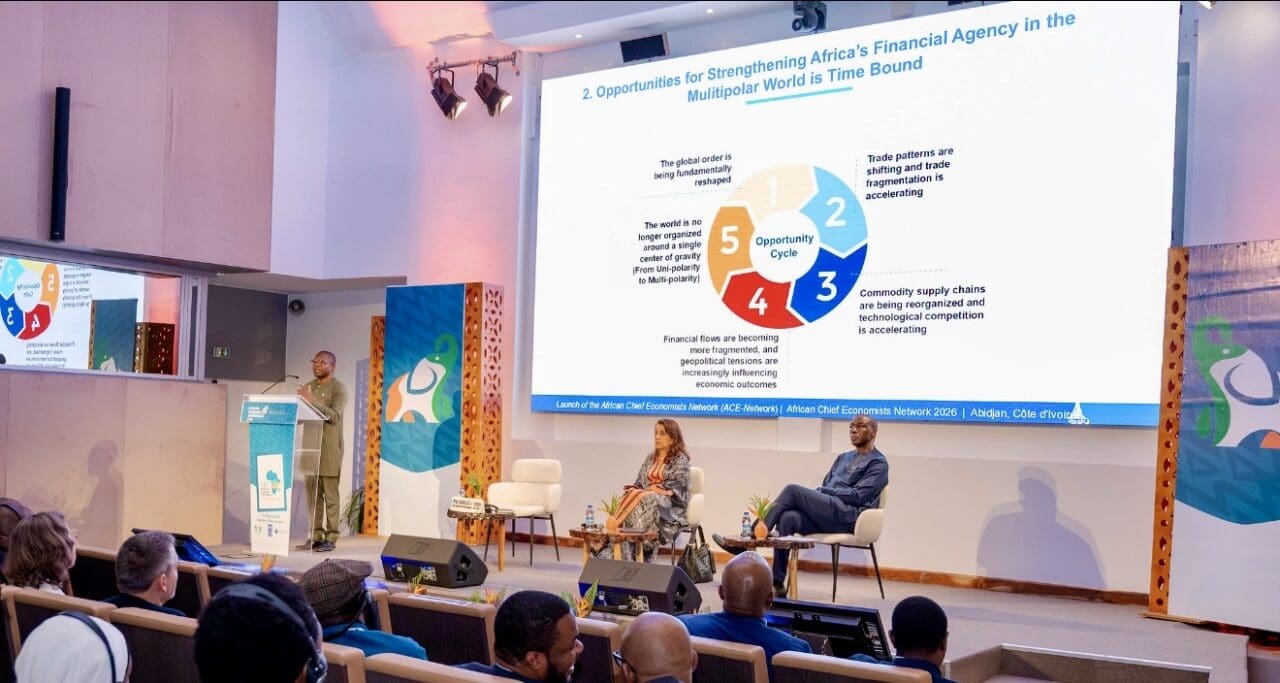

While the conference concludes, its core message is designed for lasting impact. For three days in Abidjan, economists, policymakers, and major international institution representatives consistently emphasized a singular concept: in a world undergoing a redistribution of power, Africa can no longer merely react. The continent must now assert its unique path forward.
As the 2026 African Economic Conference (AEC) drew to a close – an event jointly orchestrated by the African Development Bank (AfDB), the United Nations Development Programme (UNDP), and the Organisation for Economic Co-operation and Development (OECD) – the continent’s partners articulated a shared aspiration: to position Africa as a strategic participant in the evolving global economy, rather than a passive observer of its transformations.
Turning global crises into levers of African power
Raymond Gilpin, Chief Economist for the UNDP’s Regional Bureau for Africa, asserted that global economic turbulence should no longer be viewed solely as a threat.
“While global economic storms will persist in testing African institutions,” he acknowledged, he quickly added that these challenges “can never erode the fundamental wealth and resilience inherent in African populations.”
His declaration echoed as a central theme of this conference: the imperative to expedite reforms, fortify partnerships, and act with greater urgency to build “the resilient and prosperous Africa we deserve, for it is this Africa that the world requires.”
Beyond the evident optimism, this statement signals a fundamental shift in approach. The objective is no longer merely to withstand external shocks, but to strategically leverage geopolitical realignments for the continent’s benefit.
Adapting analytical frameworks for a complex global landscape
The deliberations also underscored another critical necessity: a re-evaluation of the analytical paradigms used for understanding development.
Ida McDonnell, Senior Advisor at the OECD, emphasized that public policies can no longer be conceived in isolation.
Trade, debt, investment, climate, fiscal policies, and development financing are now intricately interconnected. “The complexity of current policy challenges demands a more integrated analysis,” she highlighted, advocating for enhanced data and knowledge exchange among institutions to inform public decision-making effectively.
This observation reflects the swift evolution of the international environment, where every crisis—be it energy, financial, climatic, or geopolitical—now generates cascading effects across African economies.
From deliberation to tangible action
As the proceedings concluded, Marie-Laure Akin Olugbade, Senior Vice President of the African Development Bank Group, representing President Sidi Ould Tah, stressed a crucial imperative: ensuring that the discussions held in Abidjan translate into concrete decisions.
She affirmed that the recommendations emerging from the conference must now inform public policies and development partnerships across the continent.
“The exchanges we’ve had provide us with essential foundations for the policies and partnerships required to bolster Africa’s geopolitical agency and commercial resilience,” she declared.
The primary challenge now lies in implementation, especially within a context of constrained budgetary resources and intensifying global economic competition.
The core objective: forging African economic power
Ahunna Eziakonwa, UN Assistant Secretary-General and Director of the UNDP’s Regional Bureau for Africa, emphasized that the conference represents merely one step in a larger journey.
The true test begins now: dismantling barriers to intra-African trade, significantly increasing investment in innovation, accelerating the growth of regional value chains, and preparing Africa’s burgeoning youth population to thrive in a profoundly transformed global economy.
Her concluding remarks encapsulated the spirit of this edition: “In a multipolar world, Africa’s primary leverage will not stem from aligning with one side or another, but from strengthening its inherent economic power.”
This statement asserts that African sovereignty will be achieved neither through alignment with a major power nor through isolation, but rather through the continent’s capacity to generate its own value, fund its development, and vigorously protect its interests.
Abidjan: a crucible for new African aspirations
The 2026 African Economic Conference also featured the annual gathering of the Global Network of Chief Economists from Development and Financing Institutions, alongside the official launch of the African Chief Economists Network (ACE Network).
Beyond these specific announcements, this conference primarily marked an evolution in the discourse surrounding African development. Discussions no longer focused solely on the continent’s needs, but rather on its growing capacity to influence the global economic framework.
Within a deeply disrupted international landscape, organizers are confident that Africa now holds a historic window of opportunity. The challenge remains to translate this collective ambition into concrete public policies, significant investments, and measurable, tangible outcomes. Only under these conditions can the commitments made in Abidjan transcend mere declarations and truly foster a more sovereign, resilient, and influential Africa on the global stage.