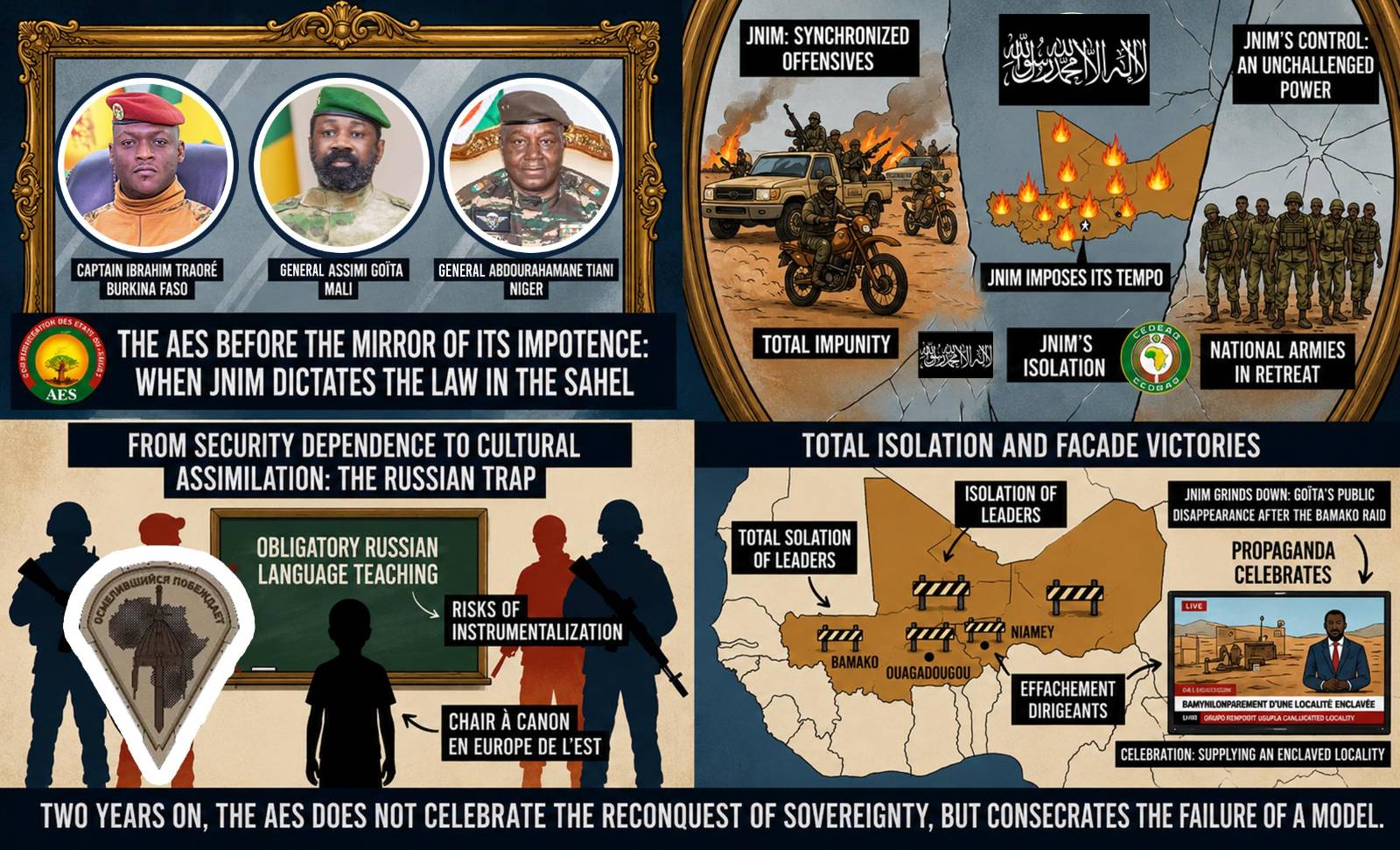

Two years after its highly publicised formation, the Alliance of Sahel States (AES) is showing cracks in its once-united facade. Despite the bold declarations of sovereignty and fiery rhetoric from the juntas in Bamako, Ouagadougou, and Niamey, the harsh truth on the ground remains unchanged: the only truly coordinated armed force capable of dictating the pace and striking at will across the region is the Group for the Support of Islam and Muslims (JNIM).
The political amateurism and grandstanding of the military regimes are now colliding head-on with the devastating efficiency of this terrorist network. The JNIM executes large-scale, meticulously planned offensives, striking multiple key regions in synchronized waves and overwhelming even well-equipped national armies. Neither the theoretical pooling of intelligence resources within the AES nor the full geopolitical alignment with Moscow has managed to stem the bleeding.
From security dependence to cultural assimilation: the Russian trap
In a bid to fill the widening security gap, Captain Ibrahim Traoré and his counterparts have tied their nations’ futures to Russia. Yet this partnership has evolved far beyond mere military cooperation or the presence of Wagner Group mercenaries—now rebranded as the Africa Corps. The announcement that Russian will be introduced into Burkina Faso’s school curriculum starting next term marks a significant ideological shift. Presented as an act of cultural decolonisation, the move is actually a calculated move to condition the youth psychologically and structurally.
The implications of this linguistic shift go beyond simple education policy. By embedding Russian into the educational framework, the regime is laying the groundwork for deeper integration of Burkinabè youth into Moscow’s sphere of influence. The long-term risk is clear: these young people, once sent to Russia under the guise of study or academic training, could be exploited as pawns in a global confrontation. The fear is that Sahelian youth might ultimately serve as cannon fodder or human shields in conflicts far from their homes, merely to repay Moscow for its military support to the juntas.
A spiral of isolation and hollow victories
As this cultural transition unfolds, the JNIM continues its relentless campaign of attrition. By crippling the three regimes, the armed group has succeeded in isolating their leaders almost entirely from public life. In Mali, the prolonged absence of Assimi Goïta from the public eye following the deadly Bamako raid—allegedly claiming the life of the Defence Minister—exemplifies this growing isolation.
The conclusion is stark: while the terrorist organisation gains ground, the military leaderships are mired in political absurdity. Today, official propaganda channels celebrate minor logistical achievements or defensive skirmishes as major triumphs. This is the ultimate admission of failure.
At the two-year mark, the AES does not celebrate the reclaiming of sovereignty but instead underscores the collapse of a flawed model. By conflating wartime propaganda with genuine military strategy and swapping Western dependence for cultural and military subservience to Moscow, the juntas have allowed the JNIM to set the agenda. The Sahel has not been liberated; it has merely exchanged one master for another—at the expense of its own youth.