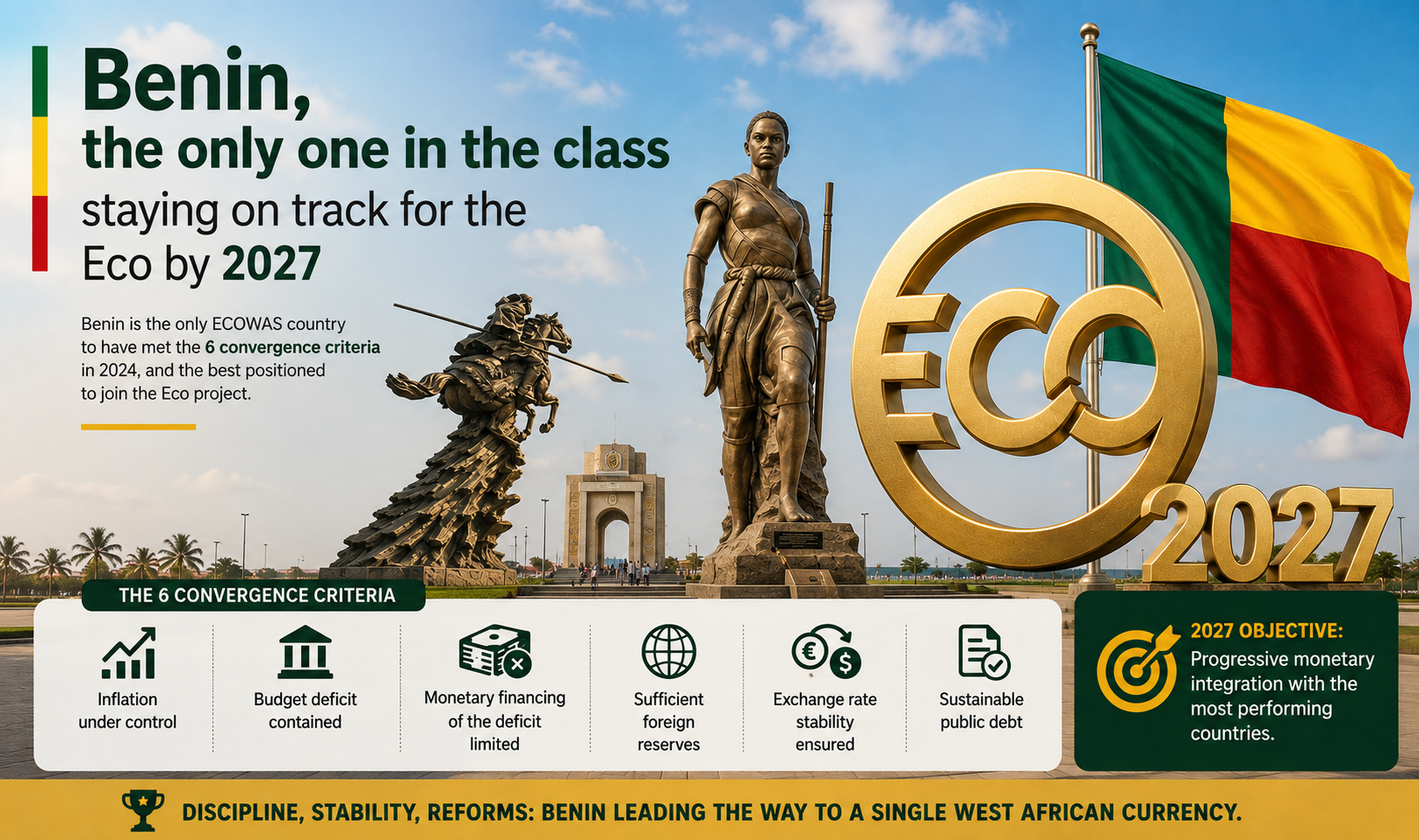

The Economic Community of West African States (CEDEAO) remains committed to launching the Eco by 2027, yet economic disparities across the region suggest an uneven progression toward monetary integration. In this landscape, Benin emerges as a frontrunner, positioned to participate in the initial phase of this historic transition.
The concept of a single West African currency has long been a cornerstone of CEDEAO’s economic integration agenda. However, the journey from political ambition to practical implementation faces substantial hurdles, including inflationary pressures, fiscal deficits, debt sustainability, foreign reserves, exchange rate stability, and divergent national economic policies.
Macroeconomic Convergence: A Clear Path Forward
Benin’s recent economic performance has set it apart. In 2024, it became the sole CEDEAO member state to meet all six macroeconomic convergence criteria outlined for the Eco project, a distinction that underscores its disciplined fiscal and monetary policies.
These criteria are not arbitrary; they assess multiple facets of economic resilience: inflation control, budget deficit limits, monetary financing restrictions, foreign reserve adequacy, exchange rate stability, and debt sustainability. Meeting these benchmarks simultaneously signals a coherent and credible economic framework one that aligns with the stringent requirements of a shared currency.
The Six Pillars of Convergence
The convergence criteria serve as the technical foundation for a unified monetary system, designed to prevent destabilizing divergences among member states. Key indicators include:
Inflation Management: Keeping price increases within sustainable thresholds to safeguard purchasing power and monetary stability.
Fiscal Discipline: Limiting budget deficits to levels prescribed by regional agreements.
Monetary Financing Constraints: Preventing excessive money supply growth to finance public spending.
Foreign Reserve Adequacy: Ensuring reserves can cover several months of imports.
Exchange Rate Stability: Maintaining a stable nominal exchange rate to bolster confidence in the prospective currency.
Debt Sustainability: Keeping public debt at levels deemed manageable over the long term.
A Deliberate Strategy, Not Coincidence
Benin’s achievement reflects years of deliberate economic reforms. The government has prioritized revenue mobilization, enhanced public financial management, and sustained investment in critical infrastructure and public services. Yet this progress has required difficult trade-offs, balancing fiscal prudence with the need to fund development and social programs.
The next challenge lies in institutionalizing this performance. While compliance with convergence criteria in a single year is commendable, sustained adherence over multiple years will be essential to cement Benin’s credibility in the Eco framework.
A Phased Approach to Monetary Integration
The heterogeneity of West African economies presents a significant obstacle. Member states vary widely in debt levels, fiscal space, inflation rates, and susceptibility to external shocks such as security crises, geopolitical tensions, and trade disruptions.
Under these conditions, a staggered adoption of the Eco appears more feasible than a simultaneous transition. Rather than imposing uniform deadlines, the focus shifts to enabling economies that meet the criteria to advance first, while others continue working toward convergence.
Benin’s Strategic Advantage
If this phased model gains traction, Benin stands to benefit substantially. By fulfilling the convergence criteria ahead of its peers, Cotonou could become one of the first countries to adopt the Eco, reinforcing its economic influence in regional negotiations.
A shared currency extends beyond the exchange of banknotes; it demands deeper coordination in fiscal, monetary, and trade policies. For Benin, early adoption could enhance its attractiveness to investors, strengthen its financial credibility, and deepen its integration within the regional economy.
Uncertainties Loom Ahead
Despite progress, the 2027 launch cannot be taken for granted. Success hinges not only on individual economic performance but also on collective political will and institutional readiness. Critical questions remain unanswered: How will monetary governance be structured? What role will regional institutions play? How will solidarity mechanisms function among member states?
The regional landscape has further complicated the outlook, with several countries reconsidering their participation in CEDEAO. This shifting dynamic introduces new variables that the Eco project must navigate, reshaping the original vision of monetary integration.
A Head Start to Protect
Benin’s current lead is a product of disciplined economic governance, but it is not irreversible. The path forward demands continued vigilance: controlling inflation, managing debt, preserving foreign reserves, and advancing structural reforms while sustaining essential public investments.
As the 2027 target approaches, Benin’s true test will be its ability to remain among the frontrunners when the Eco transitions from a political aspiration to an economic reality. If the currency is introduced incrementally, the country could secure a pivotal role in shaping the future of West African monetary cooperation provided it maintains its hard-earned momentum.