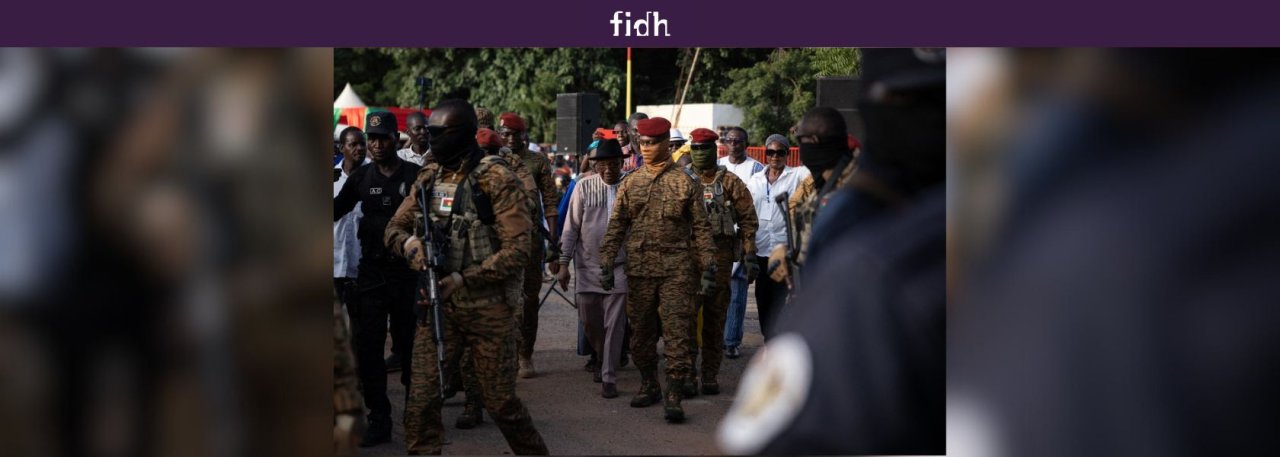


The transitional administration in Burkina Faso is currently at a standstill, with the restoration of constitutional governance appearing increasingly remote. Despite their early pledges, the military leaders who seized control two years ago have systematically restricted democratic and civic spaces, effectively silencing dissent and eroding basic freedoms. The International Federation for Human Rights (FIDH) strongly denounces these widespread abuses and demands a return to the rule of law.
Since the military coup on September 30, 2022, authorities in Burkina Faso have established a repressive framework designed to crush any criticism of human rights abuses. Human rights advocates, journalists, and political rivals face daily threats, including arbitrary arrests, kidnappings, forced disappearances, and physical assaults. This atmosphere of intimidation is further intensified by violent rhetoric and hate speech spread on social media by pro-government activists.
The FIDH urges the leadership in Burkina Faso to immediately halt these attacks and release all individuals held without cause. Furthermore, the organisation calls on the state to honor its legal obligations at national, regional, and international levels.
“The suppression of civil society and the persecution of those who defend human rights is unacceptable, particularly during a transition meant to rebuild the state,” noted Me Drissa Traoré, Secretary General of the FIDH. He emphasized that protecting civil society and ensuring the rights to free speech, assembly, and a free press are vital for the country’s future.
While the current regime claimed that ending the ongoing armed conflict was its top priority, the FIDH has observed a sharp rise in violence against civilians by all parties involved. A notable example occurred on August 24, 2024, when an attack claimed by the Group for the Support of Islam and Muslims (JNIM) resulted in dozens of civilian and security force casualties. These atrocities have been condemned by both the FIDH and the People’s Coalition for the Sahel.
Forced military recruitment of critics and judicial officers
Starting in late November 2023, the government began a policy of forcibly enlisting human rights defenders, journalists, and political opponents into the military. As a form of retaliation for their public critiques, at least ten individuals have been abducted and sent to the front lines under the 2023 “General Mobilisation and Warning” decree. Notable victims include civil society leader Dr Daouda Diallo and politician Ablassé Ouédraogo.
The judiciary has not been spared, threatening the separation of powers and judicial independence. In August 2024, at least five magistrates, including prosecutors who were handling cases involving individuals close to the regime, were conscripted. These officials from Ouagadougou, Boromo, Bobo-Dioulasso, Gaoua, and Ziniaré have been ordered into service for a three-month period.
Alice Mogwe, President of the FIDH, stated: “Sending judges to the war front as punishment for their legal decisions is a flagrant violation of fundamental rights. Burkina Faso is ignoring its own Constitution and the African Charter on Human and Peoples’ Rights.”
The collapse of media freedom
Information rights have been severely curtailed in Burkina Faso. Local outlets are under strict control, while several international media organisations have been banned. Journalists are pressured to provide “patriotic” reporting that favors the government, leading to widespread self-censorship. Investigative journalist Atiana Serge Oulon was kidnapped from his home by the National Intelligence Agency (ANR) in June 2024, and his whereabouts remain unknown. Similarly, commentators Kalifara Séré and Adama Bayala disappeared following the suspension of their television program on BF1.
Targeting the families of political exiles
Recent weeks have seen a disturbing trend of harassment and abductions targeting the relatives of former officials living in exile. In mid-September 2024, family members of Djibril Bassolé, a former foreign minister, were assaulted and kidnapped in Ouagadougou. These acts are often preceded by online incitement from government supporters.
Professor Mabassa Fall, representing the FIDH at the African Union, called for the United Nations and the African Union to work together to pressure Burkina Faso to end this cycle of violence and ensure the safety of all citizens.