
Burkina Faso’s beauty pageant ban: a marker of escalating authoritarianism
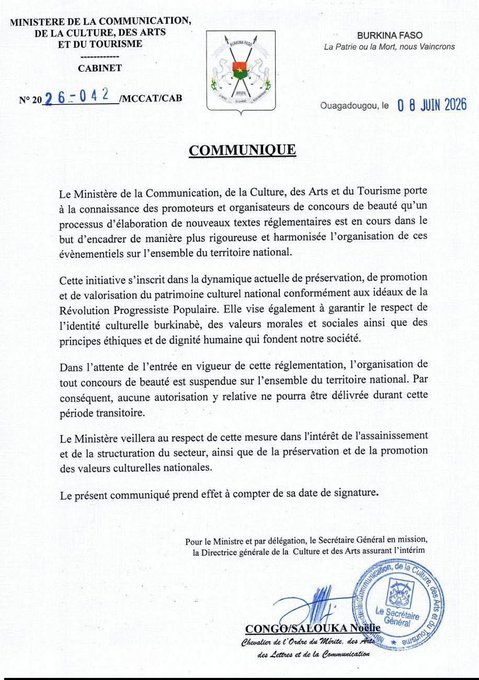
A recent official decree has sent ripples across Burkina Faso. The Burkinabè government has announced the indefinite suspension of all beauty pageants throughout the national territory. While the authorities present this measure as a means to uphold « cultural values » and acknowledge the nation’s ongoing security challenges, a critical examination of the decision suggests a more concerning reality: the gradual entrenchment of a disguised authoritarian regime.
The art of political misdirection
In a nation grappling with significant security threats and chronic humanitarian instability, the specific timing and target of this prohibition warrant scrutiny. Why prioritize the suppression of beauty pageants when the urgent imperative remains the reclamation of national territory?
For many observers across the region, this governmental foray into the cultural and entertainment sphere exemplifies a well-established political tactic: diversion. By steering public discourse towards matters of morality and social conduct, the transitional authorities appear to be attempting to deflect attention from unfulfilled pledges of stability and the promised return to constitutional governance.
State puritanism as a tool for social control
The prohibition of beauty contests is not an isolated event; it integrates into a wider pattern of systematic state intervention in citizens’ private lives and individual freedoms. Under the pretext of « moral recalibration, » the current administration is seemingly establishing the foundations for a rigorous moral framework.
« Today, a beauty pageant is banned in the name of values. Tomorrow, what will be prohibited? A particular dress style? A work of art? A school of thought? » expressed a human rights activist, who requested anonymity due to the sensitive nature of the topic.
This inclination to regulate personal aesthetics, recreational activities, and cultural expressions is a classic hallmark of autocratic systems. The methodology is subtle: it does not (yet) employ force, but rather relies on restrictive decrees, thereby infantilizing a populace by dictating what is deemed « worthy » or unworthy of celebration.
A slowly suffocating democracy
The implications of these developments in Burkina Faso extend far beyond the realm of fashion shows. They signify a continuous erosion of civic and democratic space. Following the suspension of political parties, the silencing of independent media outlets, and the detention of dissenting voices, the assault now targets cultural industries.
A disguised dictatorship is identifiable by its pervasive infiltration, its capacity to legitimize arbitrary actions, and its transformation of puritanism into state doctrine. By depriving youth and cultural stakeholders of their platforms for expression and entertainment, the transitional government transmits an unambiguous message: ideological conformity is paramount, and dissent, even of an aesthetic nature, will no longer be tolerated.
Behind the rhetoric of sovereignty and moral rectitude, Burkina Faso is dangerously drifting towards a social monolith where the state dictates every aspect of life for all citizens. This trajectory, while presented under a guise of protection, bears a name well-recognized in political history: authoritarianism.