
From rhetoric to reality: the contradictions of Burkina Faso’s economic strategy
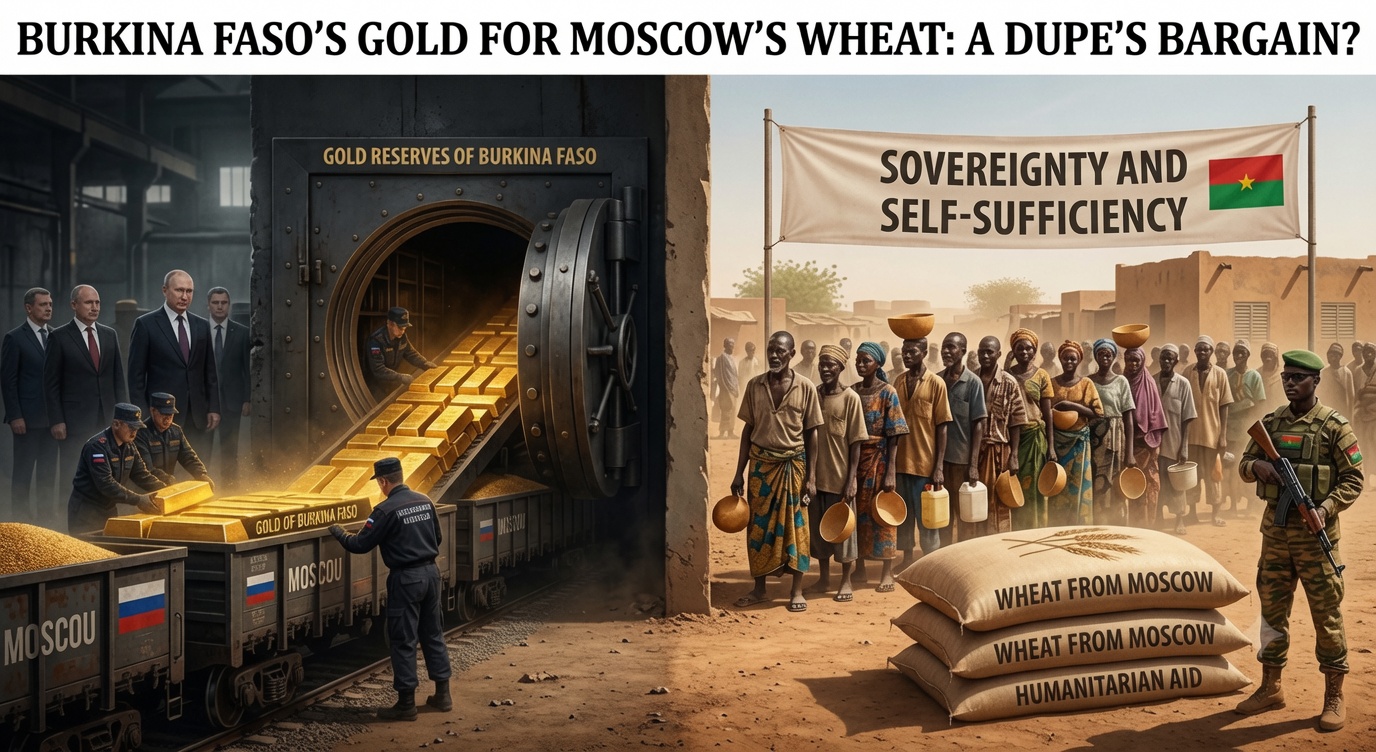
The contrast is stark—bordering on the grotesque. On one side, an official narrative of “reclaimed sovereignty” and an uncompromising stance against local solidarity. On the other, a humiliating dependence on foreign food aid. By barring grassroots initiatives and NGOs from assisting the most vulnerable Burkinabè under the guise of managing humanitarian aid, Captain Ibrahim Traoré has taken political cruelty to unprecedented levels. Yet the irony deepens when Ouagadougou’s authorities simultaneously beg Moscow for sacks of wheat.
The gold-for-wheat exchange: a transaction without benefits
The recent visit of the Russian Foreign Minister laid bare the mechanics of this lopsided “cooperation.” With a diplomacy as rigid as it is polished, the Kremlin’s envoy praised Burkina Faso’s decision to transfer and store its gold reserves directly at the Bank of Moscow. A move that reads like a confession of economic surrender. For a regime that built its legitimacy on breaking away from neocolonialism and promising total independence, handing over the nation’s treasure to Russia smacks of a fool’s bargain.
The inconsistency is glaring. Official discourse has long championed self-sufficiency and economic sovereignty, yet the country’s most basic nutritional needs remain unmet without external assistance. A sovereignty that relies on foreign grain shipments is a hollow one—it neither secures food security nor guarantees citizen autonomy. The equation is clear: Burkina Faso is pledging its sovereign wealth—its gold—in exchange for security promises and emergency food aid. Receiving Russian wheat to feed a population crippled by insecurity is not a geopolitical triumph; it is a symbol of failure.
Where national wealth meets empty stomachs
Beyond symbolism, this arrangement raises pressing questions about the government’s economic priorities. Burkina Faso ranks among West Africa’s top gold producers, a resource that should, in theory, fund agricultural policies, storage infrastructure, irrigation systems, and sustainable support for local producers. Yet the country continues to depend on foreign food aid, leaving many to question how national wealth is being mobilized—and, more critically, whether it is improving the lives of ordinary citizens.
The most distressing aspect remains the domestic management of this crisis. While it is undeniable that a government struggling to feed its people amid an asymmetric conflict faces harsh realities, actively sabotaging national solidarity is a matter of absolute social control. By centralizing aid distribution, the Traoré regime appears determined to ensure that every grain of rice or wheat received by the hungry is perceived as a gift from the state—not an act of human solidarity. This monopolization carries dangerous political implications.
The hidden cost of restricting aid
In many crisis contexts, humanitarian organizations, local associations, and citizen initiatives play a vital role, particularly in areas where state presence is weak or security constraints are severe. Limiting their ability to act slows assistance to vulnerable populations and reinforces dependence on state-controlled mechanisms, fueling accusations of political manipulation of aid.
The paradox deepens when the sacrifices demanded of the population fail to yield tangible results. Burkinabè are repeatedly called upon to endure hardship in the name of national sovereignty, the fight against terrorism, and state rebuilding. Yet these sacrifices lose their meaning when insecurity persists, daily life remains precarious, and the country continues to rely on external assistance for fundamental needs like food. True sovereignty is measured not just by words but by a state’s capacity to protect and sustain its people.
A sovereignty traded at a pittance
While Burkina Faso’s gold flows into Russian vaults to shore up the political survival of its leadership, ordinary citizens are left with a sovereignty of appearances—and very real hunger. By confusing independence with merely swapping one patron for another, Captain Traoré has not liberated Burkina Faso; he has merely renegotiated its dependence at a bargain-basement price.
Ultimately, the real question is not which partner Burkina Faso cooperates with, but whether these alliances truly strengthen the country’s autonomy and improve the lives of its people. Sovereignty cannot be declared through rhetoric alone; it is proven through action—by securing safety, prosperity, and dignity for all citizens. When reality falls short, the gap between political promise and daily struggle becomes impossible to ignore.